

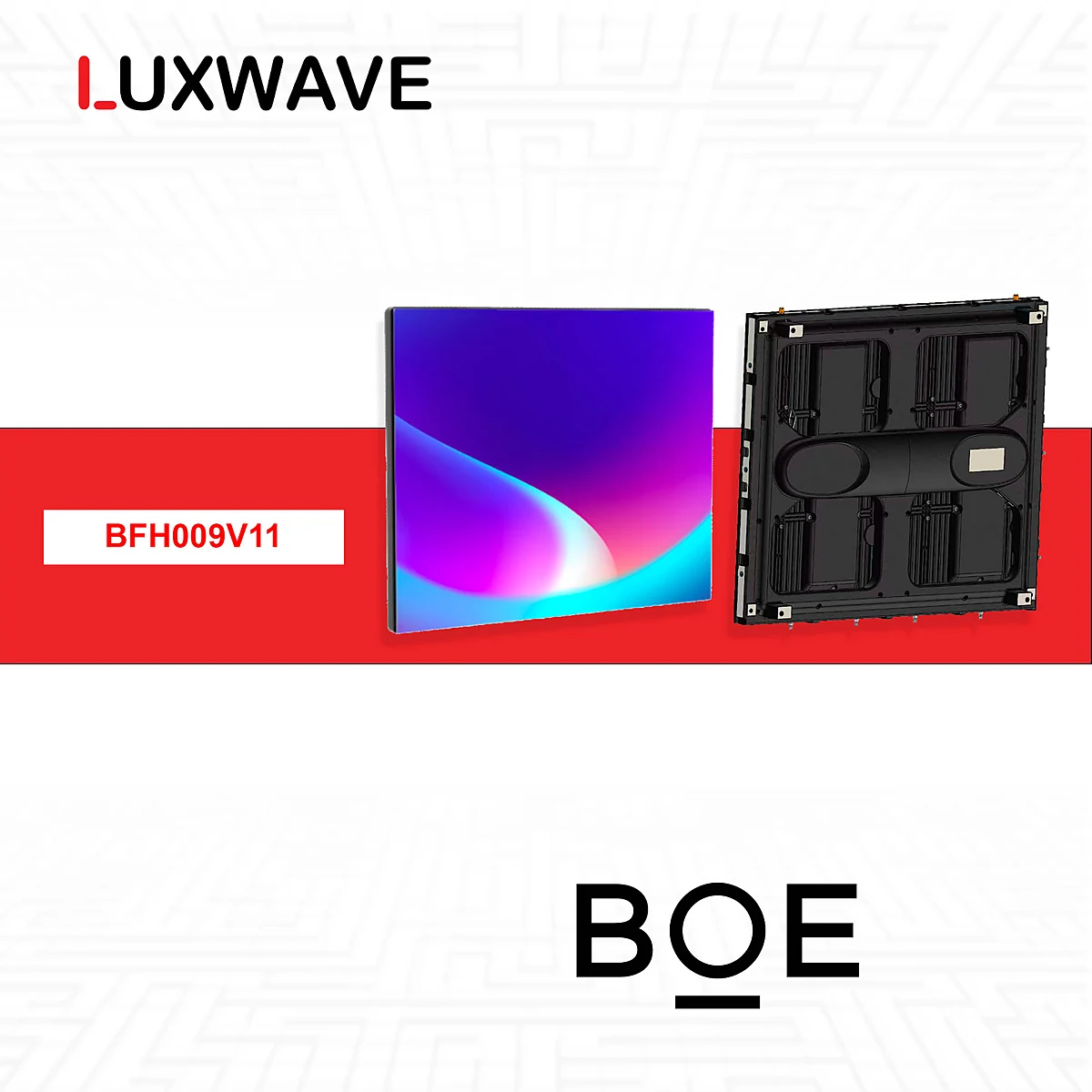
COG is frequently discussed in fine-pitch LED display circles because it represents a fundamental shift in packaging: the chip is no longer placed on a PCB, as is common with many familiar SMD or COB displays, but is directly mounted onto a TFT active-matrix glass substrate. With the BOE BFH009V11, this concept is no longer abstract. This is the P0.935 COG model in the Luxwave catalog, utilizing flip-chip Mini-LEDs on a glass substrate, targeting premium indoor spaces that require close viewing, stable images, and a thin, flat surface.
It's crucial to correctly identify the product. This article discusses the BOE BFH009V11, and the international model names BYH-COG or BYH-G009A0 should not be used as substitutes for the model sold in Vietnam. Specifications such as the 598.4×504.9mm module size, 640×540 pixels/unit resolution, approximately 600 nits calibrated brightness, around 35mm thickness, and approximately 2.5kg weight per assembly unit are all taken from the BFH009V11 datasheet. The article also provides an honest comparison with COB to avoid choosing technology based solely on its name.
!BOE BFH009V11 Glass-based COG LED Panel
What is a Glass-based COG?
COG stands for Chip-on-Glass: the LED chip is directly mounted onto a glass substrate instead of a PCB. For the BFH009V11, BOE uses flip-chip Mini-LEDs on a TFT glass substrate, manufactured using a yellow-light process and active-matrix control. The glass is not merely a protective layer; it serves as the electrical substrate, mechanical base, and part of the display structure. This approach brings fine-pitch LED displays closer to the manufacturing philosophy of panel displays.
In traditional LED displays, the PCB acts as the primary substrate for mounting LEDs, routing circuits, and transmitting signals. COG replaces this substrate with TFT glass, enabling a flatter, thinner, and more uniform surface for close viewing distances. Active-matrix allows for per-pixel control rather than passive scanning methods. Therefore, COG is often considered a packaging branch of Micro-LED technology, similar to MiP, although not all COG products should be equated with all future Micro-LED displays.
For buyers, COG should be understood as a technical platform with distinct advantages and disadvantages. It is suitable for applications requiring fine detail, close viewing, minimal flicker, an aesthetically pleasing surface, and long operational life. It does not automatically improve every project, nor does it eliminate the role of COB or SMD. The correct decision always begins with the installation environment, ambient light, viewing distance, content type, and post-acceptance maintenance requirements.
What Key Specifications Should Be Noted for the BFH009V11?
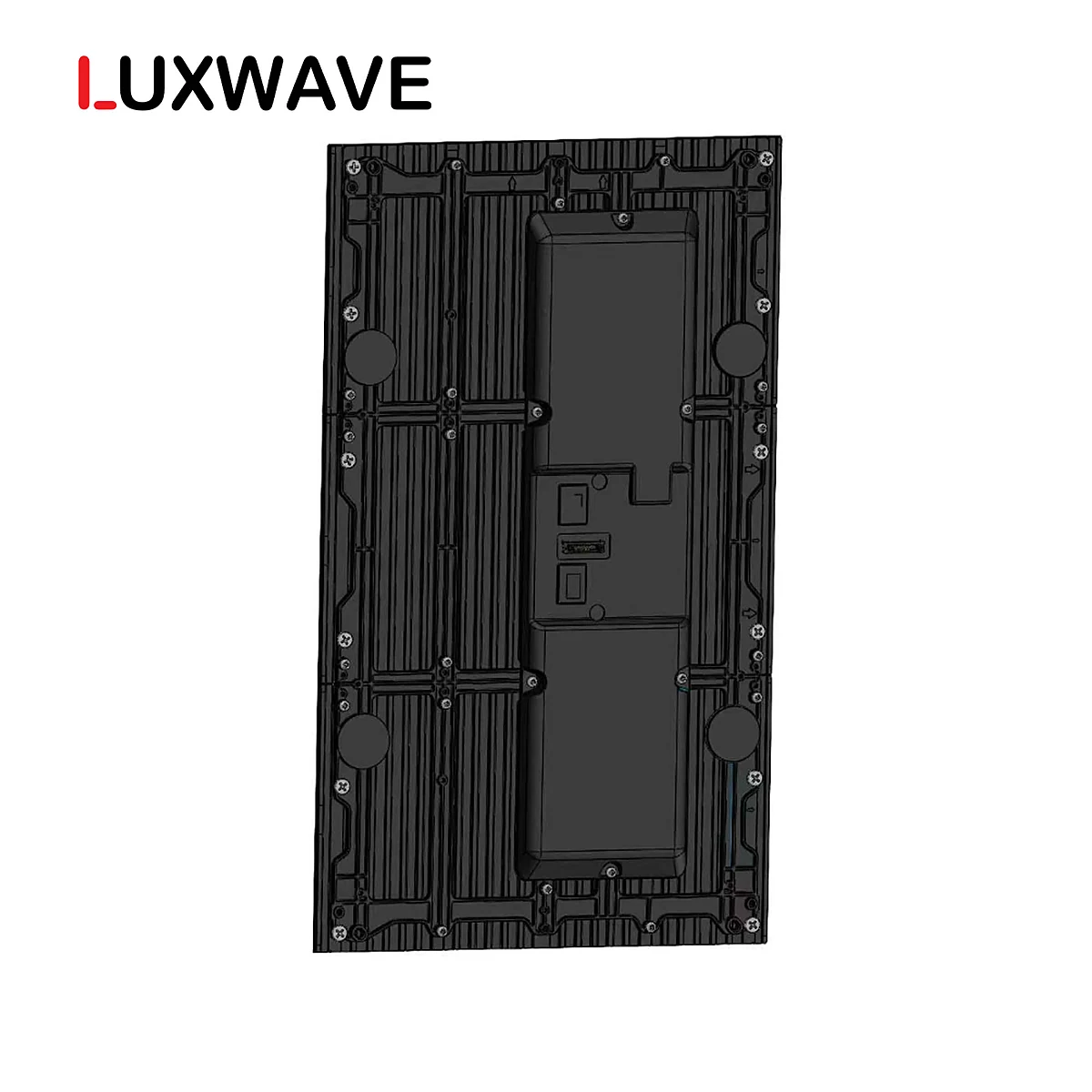
The BOE BFH009V11 is a P0.935 glass-based COG LED panel. Each assembly unit measures 598.4×504.9mm, with a resolution of 640×540 pixels/unit, a weight of approximately 2.5kg, and a thickness of about 35mm. The calibrated brightness is around 600 nits, with an 8/10-bit grayscale, and a dark ink surface for more uniform black states. The module supports front maintenance via magnetic suction, making it suitable for wall-mounted installations or where rear access is limited.
The specifications indicate that the BFH009V11 is not positioned as a display for brightness races. The focus of this model is its P0.935 pixel pitch for close viewing, active-matrix glass substrate, lightweight construction, quick installation, and thin, flat surface. With a resolution of 640×540 pixels per assembly unit, engineers can quickly calculate the number of units needed to achieve the desired display area and then verify the total resolution based on the signal source, processor, and content aspect ratio.
It is important to avoid using specifications from international pages for different product lines when describing the BFH009V11. Some international sites have listed figures like 1000 nits or a 600×337.5mm cabinet size for other COG series, but these are not the data for this model as sold by Luxwave. When preparing technical documentation, quotation configurations, or installation drawings, adhere to the BFH009V11 datasheet to prevent discrepancies during acceptance. For projects requiring complex multi-layer image processing, refer to the PixelHue knowledge base to evaluate the entire system, not just the LED panel.
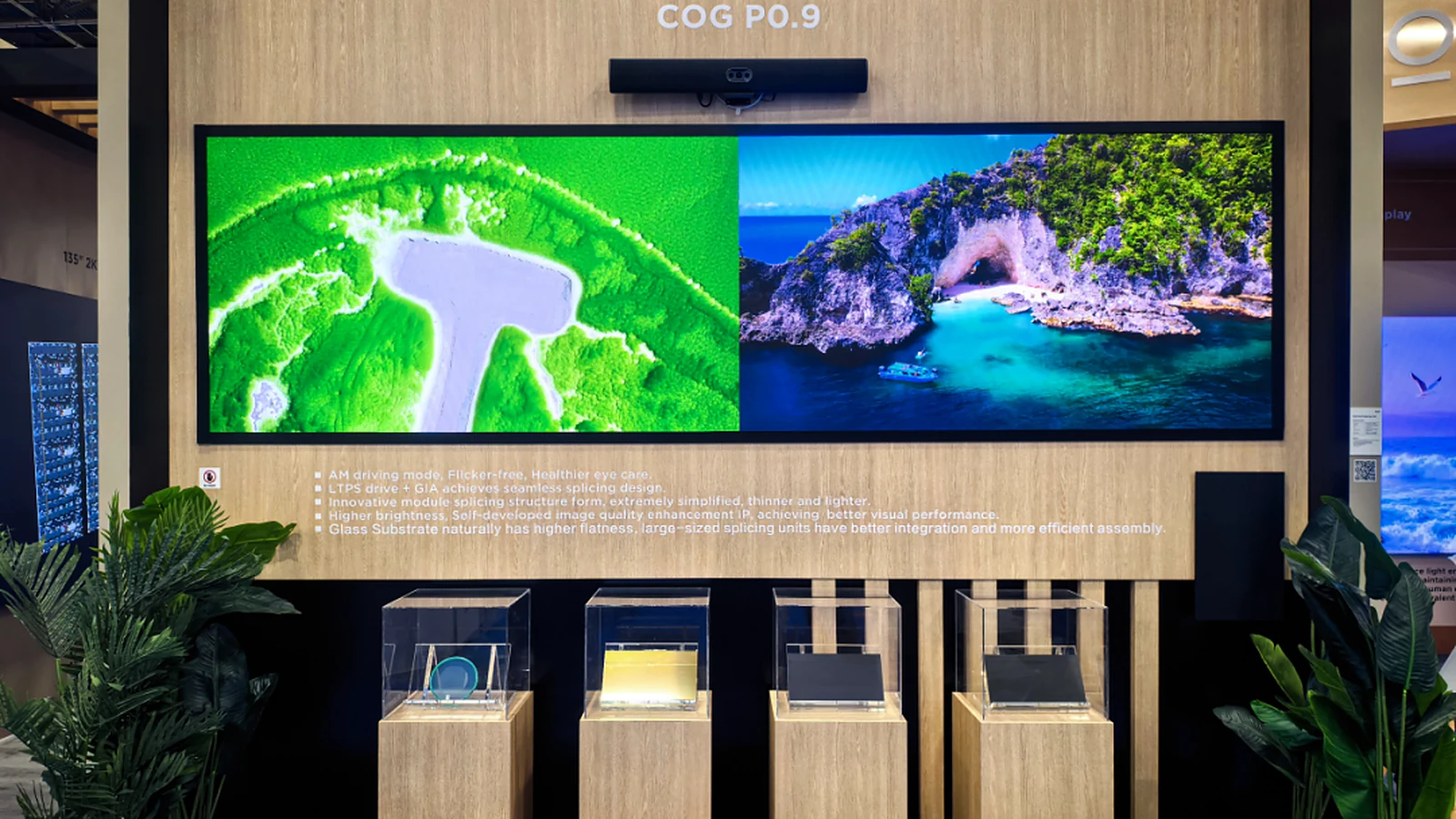
!COG panel displaying eye-friendly content

How Does COG Differ from COB, and When Should You Choose It?
Both COG and COB fall under the premium LED category, but their underlying technologies differ. COB involves placing chips on a PCB and then encapsulating the surface; COG places chips directly onto an active-matrix TFT glass substrate. If you need to understand the COB platform before comparing, the article What is a COB LED Display? will clearly distinguish between PCB, chip packaging, and encapsulation. Once the material substrate is understood, the differences between COG and COB become much more practical.
COG is ideal for premium indoor applications requiring close viewing, long operational hours, a thin and flat surface, and a comfortable viewing experience. The BFH009V11 offers a calibrated brightness of approximately 600 nits, sufficient for many control rooms, executive meeting rooms, showrooms, or indoor presentation spaces with controlled lighting. Conversely, COB still holds a distinct advantage. The BOE BYH Ultra COB series, with its 2000 nits brightness, is more suitable for brightly lit rooms, studios, or environments requiring high brightness.
Therefore, asking "Is COG better than COB?" in absolute terms is not productive. The correct question is what the project prioritizes: brightness, surface quality, thinness, long-term viewing comfort, maintenance, camera compatibility, or installation/dismantling conditions. Outdoor, rental, and DOOH applications often still require SMD or COB depending on the structure, durability, and operational standards. COG is a noteworthy option for premium fine-pitch indoor applications, not a universal replacement for all LED technologies.

Why is COG More Eye-Friendly and Energy-Efficient?
According to BOE data, the active-matrix COG structure supports flicker-free full-grayscale images and low blue light emission at the hardware level. For individuals who view screens for extended periods, this is more significant than some easily impressive brochure specifications. Displays in control rooms, executive meeting rooms, or monitoring centers need not only brightness but also the ability to render small text, dark areas, graphics, and video stably without causing eye strain.
At the BOE COG series level, the point-to-point AM drive is reported to consume approximately 20% less power than PM and reduce heat by about 4.4°C. These are characteristics of the technology series and should not be misattributed as specific parameters of the BFH009V11 unless the model's datasheet explicitly states them. Nevertheless, this explains why BOE chose active-matrix for its glass substrate: per-pixel control is more efficient, reducing consumption and heat in continuously operating display systems.
Eye-comfort certifications like TÜV Rheinland Low Blue Light and TÜV SÜD Visual Comfort should also be understood correctly. They provide a technical basis for evaluating the design direction of the COG series, but on-site acceptance testing with actual content is still necessary. For command centers, it is advisable to test dashboards, maps, small text, dark backgrounds, and slow-moving scenes. The set brightness, room lighting, wall color, seating position, and the processor system all influence the final perceived eye comfort.
How Commercially Mature is COG?
COG is no longer purely a concept for demonstrations. BOE has mass-produced active-matrix COG, and this technology has appeared in products from major manufacturers such as Lenovo, KONKA, and Skyworth. At the industry level, BOE has showcased COG at significant display events multiple times: the COG series received recognition at CES 2021 and SID 2022. At InfoComm, BOE demonstrated an Ultra Slim HDR COG display with a 5mm thickness, 12kg/m² weight, 3000 nits peak brightness, and a 23.1-inch unit.
These facts provide context but must be separated from the specific specifications of the BFH009V11. The BFH009V11 model discussed here is P0.935, with a 598.4×504.9mm assembly unit, approximately 600 nits calibrated brightness, and front maintenance. Information such as the Ultra Slim HDR COG or the 205-inch COG display at SID 2026 indicates BOE's expanding roadmap for glass substrates, but it should not replace the datasheet for products currently deployed in Vietnam.
BOE's strong foundation is notable as the world's number one display panel manufacturer, holding approximately a 35% market share according to Omdia. In Vietnam, Ho Gia is the exclusive distributor for BOE, while Luxwave plays a role in integrating their products into premium LED solutions, from datasheet interpretation to system design. For insights into how the international industry perceives the glass substrate direction, refer to the article Glass-Substrate COG Displays: What Does International TV Say?, but purchasing decisions should always be based on the specific model and project requirements.
Which Projects in Vietnam is the BFH009V11 Suitable For?
The BFH009V11 is best suited for premium indoor projects requiring close viewing, a flat surface, and long operational hours. Typical applications include control rooms, executive meeting rooms, technology showrooms, experience centers, product display areas, and certain indoor event spaces. With its P0.935 pixel pitch, the display is ideal for environments where viewers need to read small text or view fine details at closer distances than typically possible with larger-pitch LED displays.
In broadcast studios, COG offers advantages in terms of flicker-free images and a uniform surface, but it is not always the first choice. Bright studios with extensive lighting and cameras might benefit more from higher-brightness COB, depending on the lighting setup and image requirements. For event stages, the BFH009V11 is suitable for premium, fixed, or semi-fixed indoor venues; it should not be forced into demanding, frequent rental setups if the mechanical and maintenance conditions are not appropriate.
During site surveys, start with operational questions: How many hours per day will the display operate? What is the closest viewing distance? Is the primary content text, video, or dashboards? Can the room lighting be controlled? Is front maintenance required? If the answers lean towards close viewing, long operation, a premium surface, and a glass-substrate technology profile, the BOE MLED BFH009V11 is a candidate worth shortlisting. If the priority is extreme brightness or a challenging environment, reconsider COB or SMD options.
!COG module structure with front maintenance
Conclusion: How Should the BFH009V11 Be Viewed?
The BOE BFH009V11 should be viewed as a premium indoor P0.935 glass-based active-matrix COG LED display, not a rebranded version of COB. Its core value lies in its TFT glass substrate, flip-chip Mini-LEDs, dark ink surface, approximately 35mm thickness, approximately 2.5kg weight per assembly unit, front maintenance capability, and its focus on flicker-free, eye-friendly display. This is a model that requires consultation of its specific datasheet, not to be confused with specifications for BYH-G009A0 or other demonstration COG versions.
COG represents an important direction for the industry as it relates to Micro-LED, transparent displays, and future smaller pitch structures. However, the correct choice for a project in Vietnam must remain practical. If a bright room or studio requires high brightness, COB solutions like the BOE BYH Ultra may be more suitable. For outdoor, rental, or DOOH applications, SMD/COB remain the primary considerations. If the requirement is for premium indoor fine-pitch viewing, long operation, a thin and flat profile, and eye comfort, the BFH009V11 is a COG product worth serious consideration with Luxwave. If the priority is extreme brightness or a challenging environment, reconsider COB or SMD options.
Pitfalls
Common mistakes
- Referring to the BFH009V11 as BYH-COG or BYH-G009A0; these are not model names in the Luxwave catalog.
- Using 1000 nits or 600×337.5mm cabinet specifications from international websites to describe the BFH009V11.
- Viewing COG as a replacement for COB in all projects, including bright rooms, outdoor, rental, or DOOH applications.
- Focusing solely on pixel pitch while overlooking calibrated brightness, front maintenance, image processing systems, and actual viewing conditions.
FAQ
Frequently asked questions
What type of LED display is the BOE BFH009V11?
The BOE BFH009V11 is a glass-based COG LED display with a P0.935 pixel pitch. It features flip-chip Mini-LEDs directly mounted on a TFT active-matrix glass substrate instead of a PCB. This model belongs to the premium indoor fine-pitch category, emphasizing a thin and flat surface, flicker-free images, low blue light at the hardware level, and front maintenance.
How does a glass-based COG differ from a PCB-based COB?
COG mounts chips on a TFT active-matrix glass substrate, while COB typically mounts chips on a PCB and then encapsulates them. Due to differences in substrate materials and control methods, COG offers advantages in flatness, thinness, close-viewing capability, and its pathway to Micro-LED technology. COB retains advantages in applications requiring high brightness or more demanding usage environments.
Can the BFH009V11 be used in control rooms?
Yes, if the control room requires a P0.935 display for close viewing, long operation, clear small text, and a uniform surface for dark backgrounds. The 598.4×504.9mm assembly unit, 640×540 pixel resolution, and front maintenance support flexible system design. However, ambient lighting, displayed content, and the signal processing system still need to be assessed.
Does COG replace COB in all projects?
No. COG is suitable for premium indoor applications requiring eye comfort, thinness, flatness, close viewing, and long operation. COB, such as the BOE BYH Ultra 2000 nits, is better suited for bright rooms, studios, or environments needing high brightness ranges. For outdoor, rental, and DOOH applications, SMD or COB are typically considered first based on structure, durability, and installation requirements.
Why is COG considered more eye-friendly?
According to BOE data, the active-matrix COG structure supports flicker-free full-grayscale images and low blue light emission at the hardware level. This is significant for users who view screens for extended periods. However, actual eye comfort perception also depends on the set brightness, room lighting, content, color calibration, and viewing distance.
Is the BFH009V11 a commercial product or just a concept?
The BFH009V11 is a COG model with a product datasheet and should not be considered a demonstration concept. More broadly, BOE's active-matrix COG technology is mass-produced and has been featured in products from major brands like Lenovo, KONKA, and Skyworth. When deploying in Vietnam, it is essential to verify the specific model, documentation, display configuration, and warranty conditions.
References
- 1.ManufacturerPixelHue Official
- 2.NewsPixelHue Facebook
- 3.StandardPixelHue Master Academy (PMA) Curriculum
- 4.DatasheetBOE — BFH009V11 COG P0.9 Product Spec V1.1
- 5.ManufacturerBOE Technology Group — MLED COG
- 6.StandardTÜV Rheinland Low Blue Light / TÜV SÜD Visual Comfort
- 7.ResearchCOG/Micro-LED Industry Technical Compendium