

COG is becoming one of the most talked-about topics in premium LED displays because it brings the LED industry closer to panel manufacturing logic: Mini/Micro-LED chips are placed on a glass TFT active-matrix substrate instead of a PCB. For ultra-premium TVs and home displays, this direction promises a flatter surface, thinner chassis, lower flicker, and the ability to achieve very fine pitches. However, this trend doesn't mean every project should immediately opt for COG. This article places COG in an international context, distinguishes between the BOE COG P0.9 2K TV demo and the BOE BFH009V11 commercial product, and offers insights for Vietnamese businesses to approach this technology with a clear perspective.
If you need a technical foundation before diving deeper, you can refer to the article BOE BYH-COG: Chip-on-Glass LED Display. For high-end LED systems with multiple signal sources, image processing remains the layer that determines the final experience; the knowledge base on What is PixelHue helps clearly differentiate between panels, processors, and operating systems.
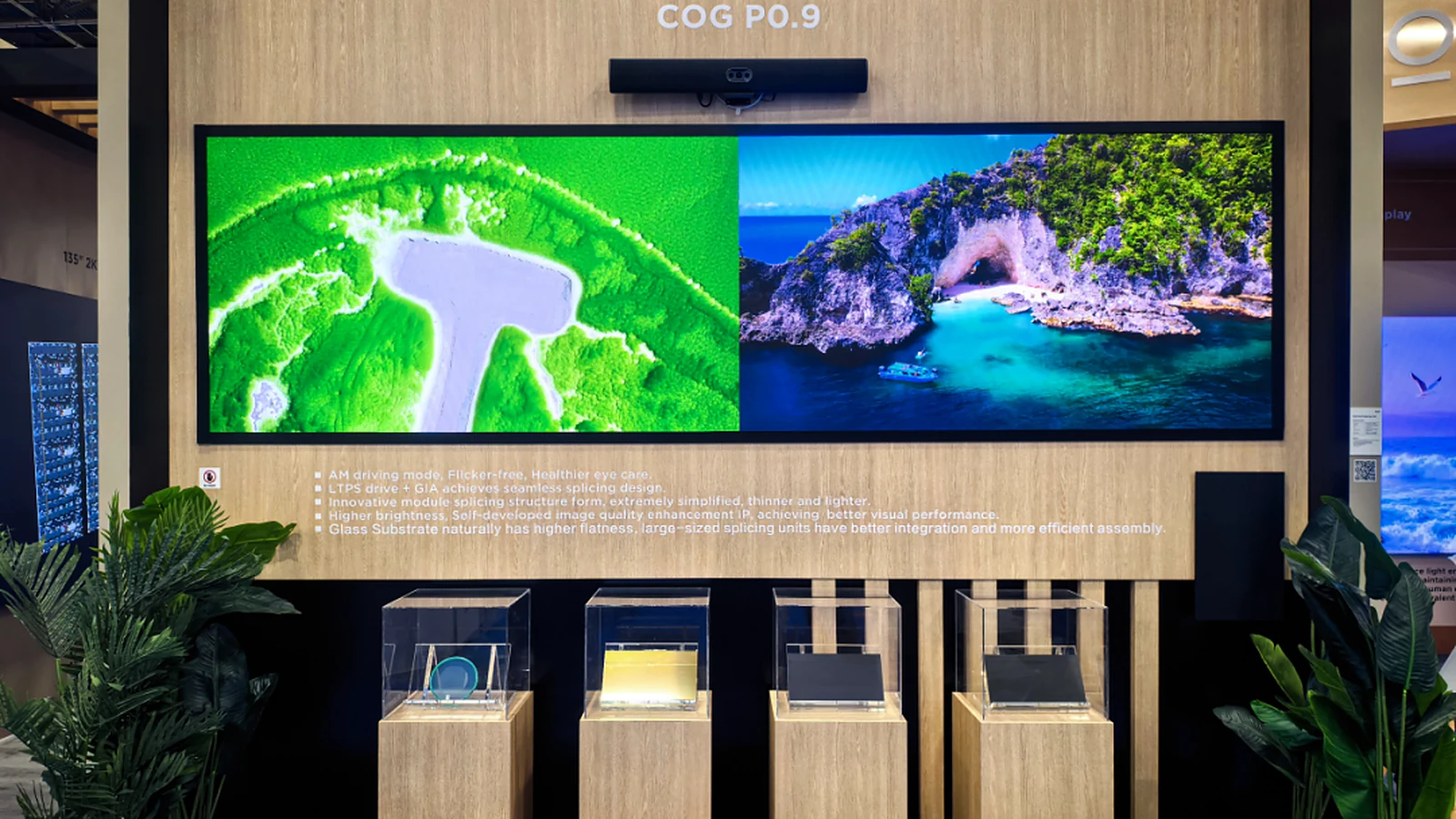
!BOE COG glass-based LED display showing content
What is Glass-Based COG and Why is it Considered the Future?
COG, or Chip-on-Glass, is a structure where Mini/Micro-LED chips are mounted on a glass TFT active-matrix substrate. Instead of using a PCB as the circuit board, COG integrates the conductive traces and control mechanisms into the glass substrate, where each pixel has its own transistor. Therefore, the industry often views COG as an upgrade from COB in the roadmap for fine-pitch and Micro-LED technology: it's still a direct-view LED display, but the substrate material and driving mechanism have shifted towards logic closer to the panel industry.
The first advantage is active-matrix driving. When each pixel is actively controlled with a near 100% duty cycle, the display can reduce flicker, maintain better grayscale, and provide a more comfortable viewing experience for extended periods. BOE announced that its COG P0.9 has received TÜV SÜD visual comfort and low blue light certifications, indicating that the company is focusing not just on resolution or brightness, but on the visual experience at the core of the COG glass substrate. This is crucial for boardrooms, studios, control centers, and premium home environments.
The second advantage lies in the glass substrate. Glass is flatter than PCB, offers better thermal stability, and has the potential for more seamless module integration when assembling multiple units. In its specifications, COG can achieve a display chassis thickness of approximately 5mm and a weight of around 12kg/m² in international demonstration configurations. These figures explain why COG is frequently mentioned in the context of Micro-LED TVs, transparent displays, and ultra-premium display systems, where a thin, flat, and seamless surface is not just a technical feature but an integral part of the architectural experience.
What is the International Landscape for COG, Glass Backplanes, and Micro-LED TVs?
COG is not a story of a single company. BOE is leading the active-matrix COG segment, showcasing a 31.5-inch 4K COG Mini-LED monitor at CES 2025 and having its COG P0.9 achieve TÜV SÜD certification. Samsung is pursuing a glass-based Micro-LED TV direction with its TGV (Through Glass Via) technology, featuring a 144-inch 21:9 aspect ratio model that won a CES Innovation Award 2025, and its Micro RGB series. AUO is participating in this chain by supplying a 42-inch LTPS backplane for Samsung's 127-inch Micro-LED TV.
Beyond these three major players, Innolux offers a 101-inch chip-on-TFT-glass tiled display, Vistar introduced an 88-inch P0.5 TFT-based home theater module and transparent display, and TCL CSOT is utilizing glass substrates for automotive HUDs and transparent screens. The international picture is thus quite clear: glass-based technology is not only for TVs but also opens up numerous new display applications. TVs/home displays are the most visible segment, but commercial applications, automotive, showrooms, and transparent displays are where the technology is likely to spread incrementally.
For the Vietnamese market, the significance lies in the evaluation standards. When international manufacturers discuss COG or glass backplanes, they are not just talking about "smaller pitches." They are discussing glass substrates, active-matrix, mass transfer, yield, flatness, thinness, repairability, grayscale quality, and supply chain maturity. Therefore, when reading news like BOE COG P0.9 Wins Best of Show at InfoComm 2026, it should be seen as a technological signal, not an assertion that all high-end projects should immediately switch to COG.
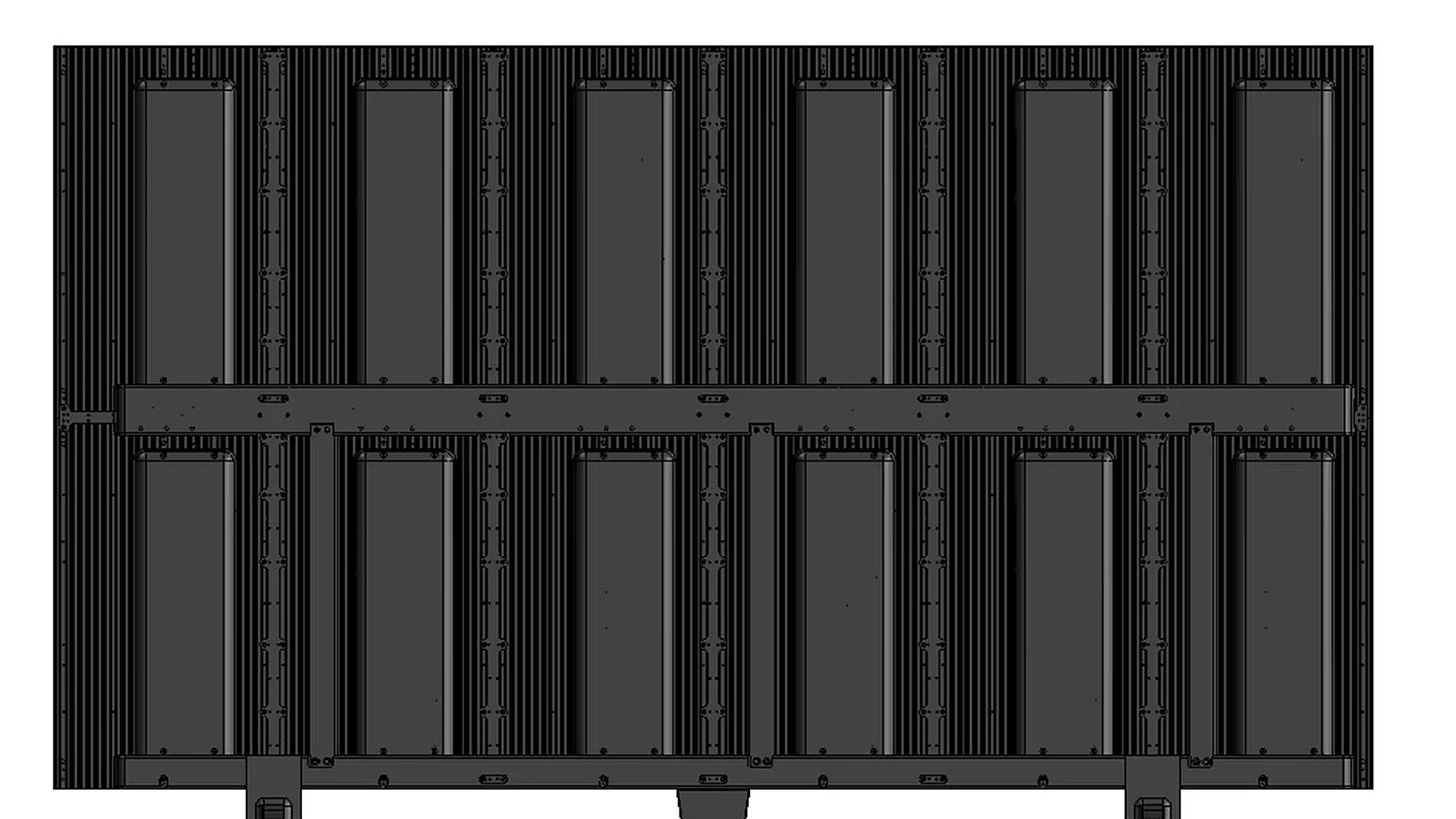
!Structure of 12 modules for the COG P0.9 2K TV

How Does COG Differ from COB, and When Should Each Technology Be Used?
COB remains the primary fine-pitch architecture due to its practicality, ease of deployment, and simpler repair in many projects. COB involves mounting chips onto a PCB and then encapsulating them, making it suitable for commercial deployments, meeting rooms, control centers, studios, and various indoor spaces requiring durable, high-quality displays with manageable lifecycle costs. COG shifts the substrate to a glass TFT active-matrix, emphasizing flatness, thinness, eye comfort, full Gamma grayscale, and the potential for Micro-LED or transparent displays.
A major drawback of COG is the difficulty in repairing defective pixels. When chips are integrated onto an active-matrix glass substrate, pixel defect repair is not as straightforward as with many PCB-based structures. This makes yield and manufacturing costs significant barriers. In its specifications, die costs account for 40-50% of the Bill of Materials (BOM), and achieving further advancements requires mass transfer yields of approximately 99.999%. This is why COG should currently be understood as an additional ultra-premium tier, not an immediate replacement for COB across the entire market.
The correct decision therefore begins with the use case. If a project requires budget control, convenient maintenance, commercial-standard installation, and does not demand an ultra-thin glass substrate, COB remains a highly viable option. If the project involves flagship showrooms, luxury residences, high-end exhibition spaces, advanced image command centers, or IOCs that require close-viewing displays, long operational hours, a flat surface, and distinct technological differentiation, COG is worth considering for the shortlist. The BOE MLED page serves as a relevant reference for comparing these two branches within the same brand ecosystem.
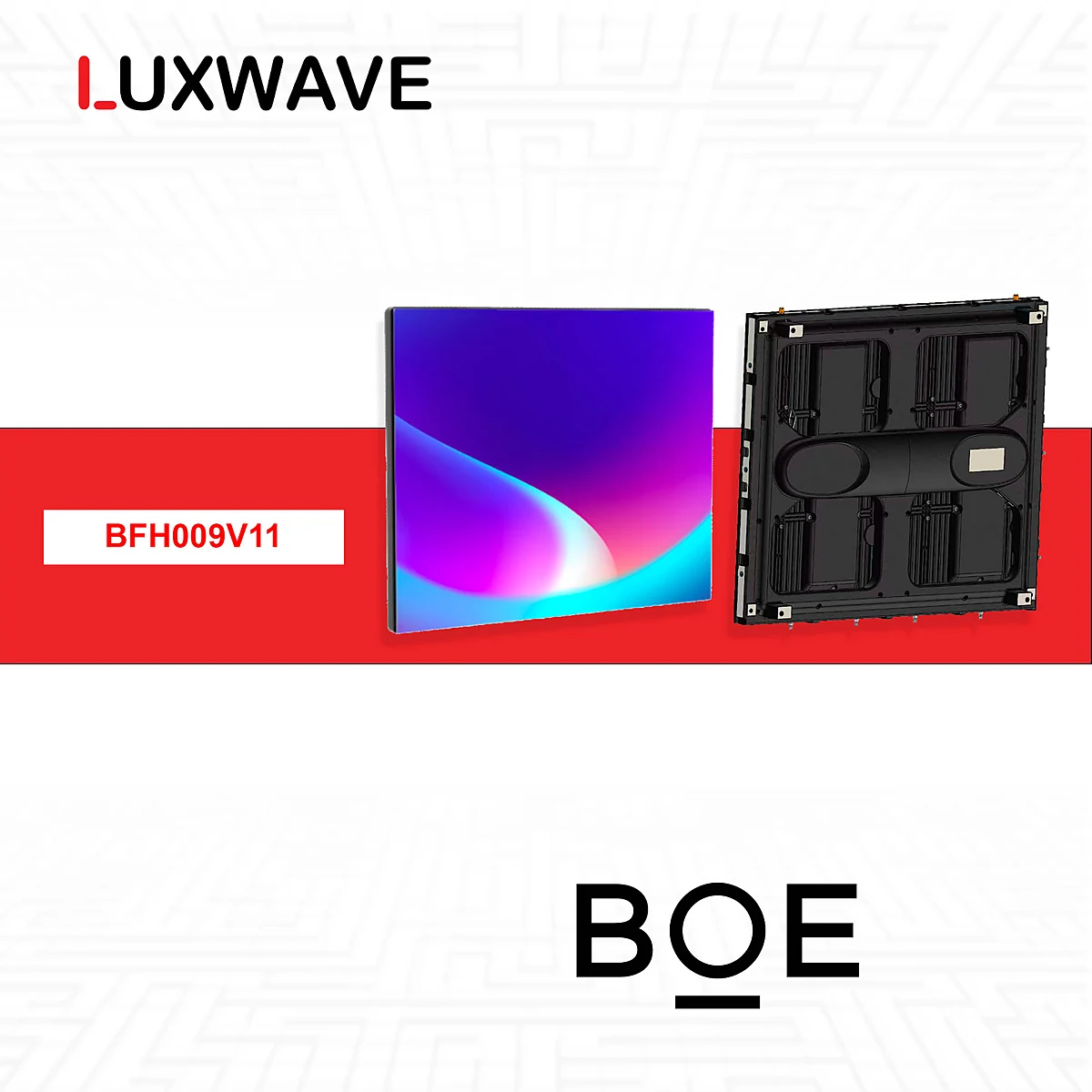
!BOE BFH009V11 commercial COG product

How Far Has COG Entered the TV and Home Theater Market?
COG has entered the TV/home market in the sense that the technology is being seriously demonstrated and developed by major manufacturers, but it should not be understood as a mainstream product yet. The BOE COG P0.9 2K TV mentioned in the brief is an all-in-one glass-substrate TV, using a P0.935 pitch, assembled from 12 23.1-inch modules, with a minimum thickness of 5mm, a typical brightness of 600 nits and a peak of 1000 nits, an NTSC gamut of at least 110%, supporting HDR, 8/10-bit, and a 2K resolution. This is a preview of BOE's direction for integrating COG into TVs/home displays; it is not yet in mass production.
The significant aspect of this demo is not that "new TVs are ready for every home," but rather how BOE packages the COG glass substrate into a form factor more familiar to the home market: all-in-one, fewer modules, thin chassis, and a comfortable viewing experience. When an LED display transitions from a technical video wall format to a TV format, the criteria change significantly. Consumers not only ask about brightness and pitch but also about thinness, flatness, heat dissipation, noise, skin tones, HDR movies, streaming content, maintenance, and its integration as a piece of furniture.
The market is also growing, but from a small base. According to Omdia data in the brief, Micro-LED display revenue is projected to increase from $52.4 million in 2025 to $105.4 million in 2026, and is forecast to reach approximately $6.8 billion by 2032. TrendForce considers 2025 the "first full commercial year" for Micro-LED. These are industry market figures, not product prices, and they reveal a dual reality: the trend is real, but the time it takes to move from ultra-premium to widespread adoption is still considerable.
What's the Difference Between the BOE COG P.09 2K TV and the BFH009V11?
The BOE COG P.09 2K TV and the BOE BFH009V11 need to be clearly distinguished. The COG P.09 2K TV is a demo model, intended to show BOE's capability to integrate active-matrix glass substrates into a TV/home form factor. It features a P0.935 pitch, 12 23.1-inch modules, a minimum chassis thickness of 5mm, typical brightness of 600 nits/peak 1000 nits, an NTSC gamut of at least 110%, HDR, and 8/10-bit support. However, the brief clearly states: this is not yet a mass-produced commercial product.
Conversely, BOE BFH009V11 is a commercial COG P0.935 product that is available. This display uses Mini-LED flip-chip LEDs mounted directly on a glass TFT substrate, without a PCB, employing active-matrix control to achieve full grayscale, low flicker, hardware-level low blue light, and HDR. The product also supports front maintenance, making it suitable for premium spaces like high-end boardrooms, studios, and flagship showrooms, where visual experience and surface finish are more critical than low cost.
The correct interpretation is to view the TV demo as a roadmap signal, while the BFH009V11 represents the current commercial entry point. If a business requires a glass-substrate display for a real-world installation, the commercial product is where configuration discussions should begin. If a business is tracking the Micro-LED TV trend, the COG P.09 2K TV demo helps visualize BOE's direction. For spaces looking to experiment with transparent displays or new display architectures, the article on The Future of Transparent Micro-LED Displays will be more useful than focusing solely on a demo TV model.
How Should Vietnamese Businesses Understand COG to Avoid Chasing FOMO?
COG should be viewed as a future technology with a solid foundation, but the decision to implement it must stem from the specific space, content, and operational requirements. For flagship showrooms, IOCs, luxury residences, high-end home theaters, or executive boardrooms, COG offers clear advantages: a thin, flat, eye-friendly glass substrate, low flicker, full Gamma grayscale, and a premium visual feel at close viewing distances. For mainstream projects, COB remains the primary choice due to its balanced quality, cost-effectiveness, maintenance, and supply chain readiness.
The key is to avoid adopting technology based solely on its name. A COG project still requires careful consideration of room brightness, minimum viewing distance, content type, camera requirements, operating hours, signal paths, processors, source devices, and maintenance capabilities. When a display operates at the ultra-premium tier, system-level missteps can render the panel's advantages obsolete. For systems with multiple sources or high-end presentations, selecting a processor from the PixelHue ecosystem, such as PixelHue Q8, PixelHue P10, or larger series like PixelHue P20, should be evaluated alongside the display configuration.
In Vietnam, customers can access COG/glass-based technology through Ho Gia/Luxwave, acting as the exclusive distributor for BOE. The appropriate consultation approach is not to push clients towards COG at all costs, but rather to compare COG with COB and other LED solutions based on specific project needs. If the goal is a flat, thin, eye-friendly display for close viewing and creating a technological statement in a premium space, COG is worth exploring. If the objective is return on investment, practical durability, and familiar maintenance, COB remains a very strong answer.
Conclusion: Where Does the World Stand with Glass-Based COG Displays?
The world is in a phase where COG/glass-based technology is moving out of the lab and into the ultra-premium product tier, particularly for Micro-LED, ultra-premium TVs, home theaters, transparent displays, and professional displays. BOE, Samsung, AUO, Innolux, Vistar, and TCL CSOT all demonstrate that glass substrates are a genuine direction. However, a significant gap remains between international demos and widespread implementation, primarily due to yield, mass transfer, pixel defect repair, and manufacturing costs.
For BOE, the COG P.09 2K TV is a noteworthy roadmap signal, while the BFH009V11 is a more concrete commercial product for businesses to consider. For Vietnamese customers, the right question is not "Is COG the latest?" but rather "Does this space require an active-matrix glass substrate?" If so, COG can offer a distinct advantage. If not, COB remains the primary and more practical fine-pitch choice for many projects.
The most important point is to base decisions on evidence: actual specifications, real demos, genuine signal sources, authentic content, and actual room conditions. COG represents the pinnacle of future technology, but it only creates value when it solves the right problem. Luxwave can assist with datasheet analysis, COG vs. COB comparisons, image processing system evaluations, and implementation plan designs to help customers make the correct choice, rather than simply following trends.
Pitfalls
Common mistakes
- Viewing the BOE COG P.09 2K TV as a mass-market product; it is a demo oriented towards TV/home applications and not yet in commercial production.
- Assuming COG will immediately replace COB; COB remains the primary fine-pitch architecture due to easier repair and suitability for smaller batches.
- Focusing solely on the P0.9 pitch while overlooking the active-matrix glass substrate, yield, pixel defect maintenance, and image processing system requirements.
- Equating all glass-substrate displays with mainstream home TVs; currently, COG/glass-based technology is primarily positioned in the ultra-premium segment.
FAQ
Frequently asked questions
Is glass-based COG a new version of COB?
COG is often referred to internationally as an upgrade from COB because both aim for high-end fine-pitch LED displays, but their structures are distinctly different. COB mounts chips on a PCB and then encapsulates them, while COG mounts Mini/Micro-LED chips directly onto a glass TFT active-matrix substrate. The glass substrate enables flatter, thinner displays and more active pixel control.
Has the BOE COG P.09 2K TV been commercially released?
No. The BOE COG P.09 2K TV mentioned in the brief is an all-in-one glass-substrate demo model, assembled from 12 23.1-inch modules, with a minimum thickness of 5mm and using a P0.935 pitch. It showcases BOE's direction for integrating COG into TVs/home displays but should not be considered a mass-produced commercial product.
Which BOE COG product is currently available for deployment?
The BOE BFH009V11 is a commercial COG P0.935 product mentioned in the brief. This display uses Mini-LED flip-chip LEDs mounted directly on a glass TFT substrate, employs active-matrix control, and supports full grayscale, low flicker, hardware-level low blue light, HDR, and front maintenance, making it suitable for boardrooms, studios, or flagship showrooms.
Why is COG considered more eye-friendly?
COG utilizes active-matrix driving, meaning each pixel has its own transistor and operates with a near 100% duty cycle. This helps reduce flicker compared to passive matrix scanning. BOE also announced that its COG P0.9 has received TÜV SÜD visual comfort and low blue light certifications. However, the eye-friendly experience also depends on the set brightness, content, and ambient room lighting.
Will COG replace COB in fine-pitch LED projects?
This should not be assumed yet. COG is an additional ultra-premium tier, suitable for projects requiring thin, flat, eye-friendly glass substrates and a roadmap towards Micro-LED. COB remains the primary fine-pitch architecture due to its more manageable cost, easier pixel defect repair, and suitability for various commercial projects or small batch deployments.
How rapidly is the Micro-LED market growing?
According to Omdia data in the brief, Micro-LED display revenue is projected to increase from $52.4 million in 2025 to $105.4 million in 2026, and is forecast to reach approximately $6.8 billion by 2032. These are industry market figures, not product prices, and indicate a long-term trend that still requires time to mature.
References
- 1.ManufacturerOfficial PixelHue
- 2.NewsPixelHue Facebook
- 3.StandardPixelHue Master Academy Curriculum
- 4.ManufacturerBOE MLED — COG/glass-based at InfoComm 2025
- 5.ResearchTrendForce — Glass-based & Silicon-based Micro LED
- 6.ResearchOmdia — Micro-LED display revenue