

What is the 2026 World Cup Saying About China's LED Supply Chain?
The 2026 World Cup, kicking off on June 11, 2026, will be the first to be co-hosted by three nations: the USA, Canada, and Mexico. The tournament expands to 48 teams, featuring 104 matches over 39 days. This means the in-stadium visual infrastructure must operate at an extremely high intensity. Each stadium requires not just scoreboards or replay screens, but a comprehensive visual system serving spectators, sponsors, broadcasters, and organizers simultaneously. In this context, the presence of Chinese LED companies is far more significant than a typical hardware supply contract.
!China's LED Supply Chain Footprint at the 2026 World Cup in the USA, Canada, Mexico
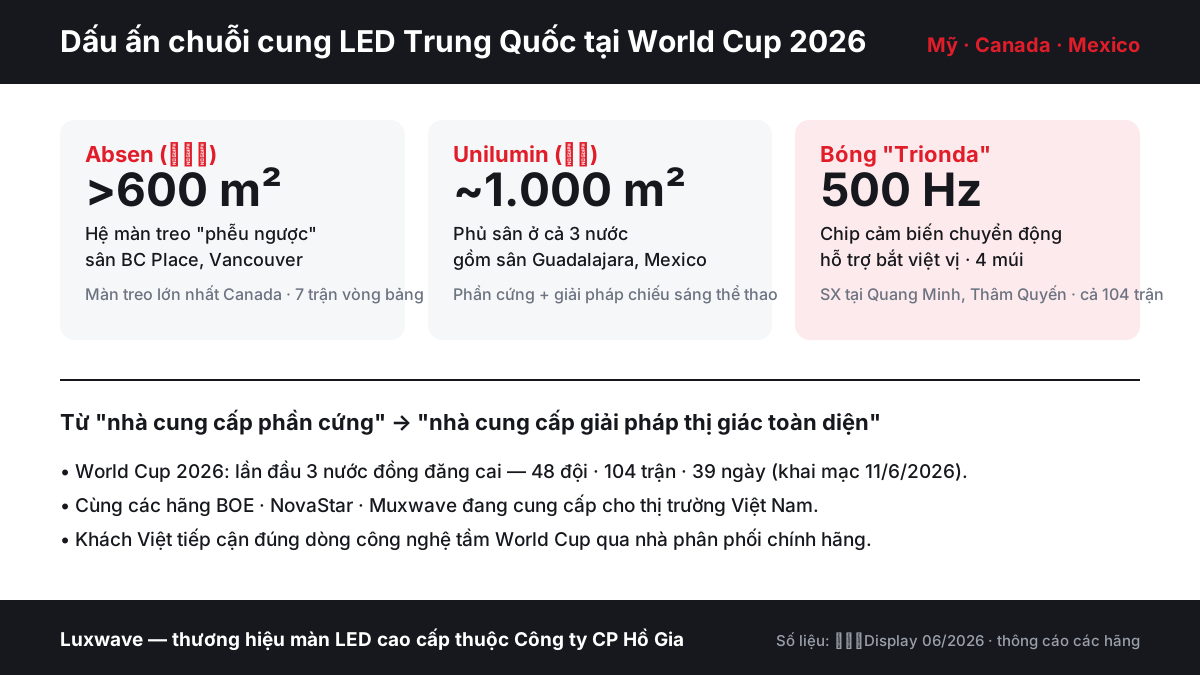
According to 行家说Display, brands like Absen and Unilumin are featured in the display and visual solution categories for the 2026 World Cup stadiums. This signals that China's LED supply chain has moved beyond being purely a "manufacturing workshop." When a brand can participate in North American stadiums, handling requirements for display, advertising, lighting, and event operations, its competitive edge shifts from cost to system stability. For the Vietnamese market, this closely aligns with the rapidly growing scale of stadium LED screens and outdoor DOOH billboards projects.
Why is BC Place the Most Notable Example?
BC Place stadium in Vancouver, Canada, stands out as Absen supplied a central hanging screen system totaling over 600m². This "inverted funnel" design, dubbed Canada's largest hanging screen system, will serve 7 matches (5 group stage + 2 knockout) of the 2026 World Cup. Functionally, the screen will display match footage, advertisements, and operational content to create atmosphere for the crowd. For a large stadium, the central hanging screen is the primary viewing point for tens of thousands of spectators, making any color, signal, or latency errors highly visible.
!Inverted funnel LED hanging screen system at BC Place Vancouver Canada
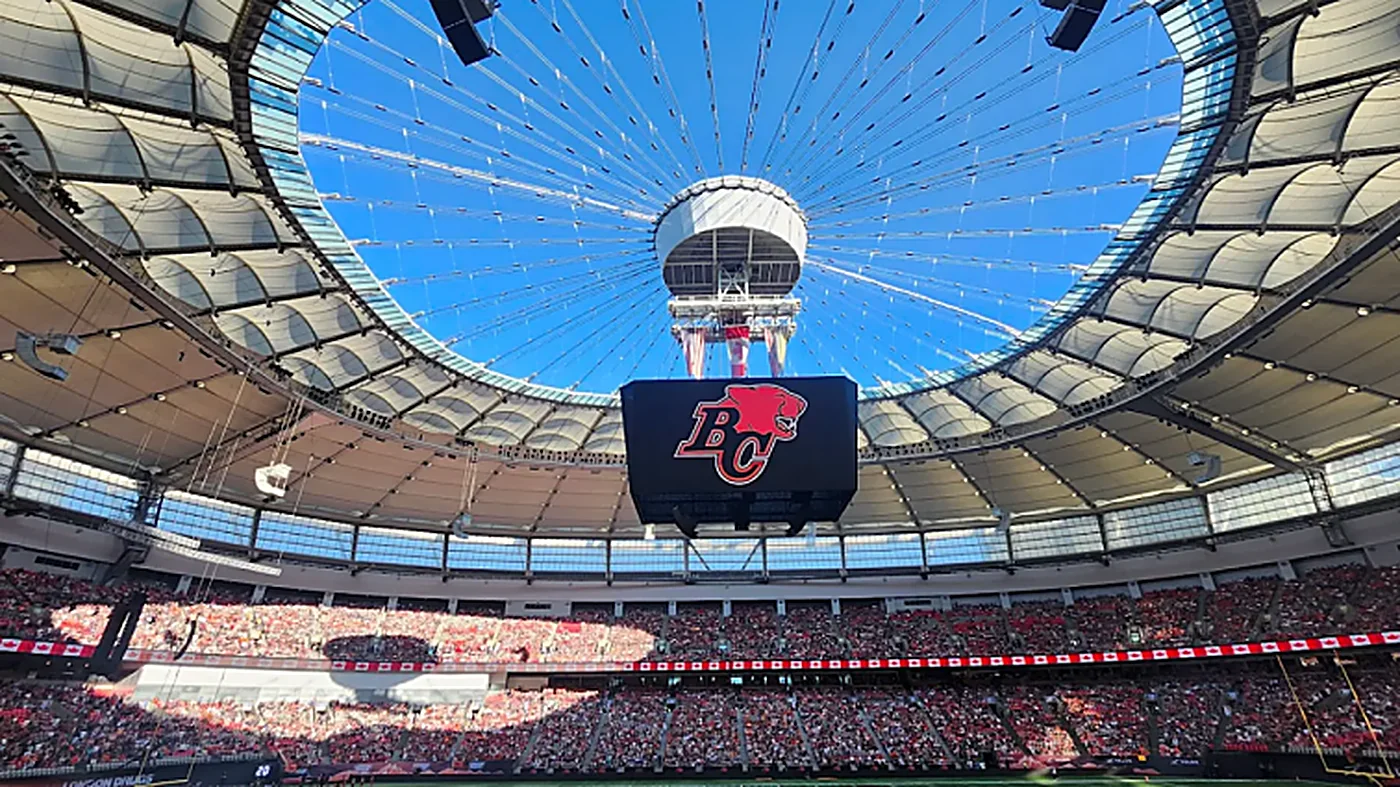
The key takeaway isn't just the 600m² figure, but the installation's form factor. The inverted funnel design creates multiple viewing faces, ensuring spectators at various angles can access the content. This demands high standards for color uniformity, viewing angles, brightness, mounting structure, and signal control. For Vietnamese projects, new stadiums or multi-purpose arenas should not view the central screen as just a large LED panel hung high up; it must be designed as an integral part of the competition, advertising, and event operation experience.
A notable impact of the 2026 World Cup is that LED displays are becoming experiential infrastructure, no longer auxiliary equipment placed backstage or at the sidelines.

What Does Unilumin's Presence Across Multiple Stadiums in Three Countries Indicate?
Unilumin is noted for its presence across stadiums in the USA, Canada, and Mexico, with a total screen area of nearly 1,000m², including the Guadalajara stadium in Mexico. A supplier operating in multiple locations across different countries must address challenges beyond the product itself: construction schedules, safety standards, operational synchronization, maintenance, and compatibility with international event protocols. While Absen at BC Place showcased capability in a prominent hanging screen configuration, Unilumin demonstrates network deployment capability.
More importantly, Unilumin provides not only hardware but also sports lighting solutions and software. This represents a clear shift for the Chinese LED industry: from modules, cabinets, power supplies, and receiving cards to a comprehensive visual solution package. When software, lighting, and displays are designed as a unified system, organizers can more smoothly coordinate replays, advertisements, crowd effects, and ceremonial sequences. This is why Vietnamese projects should consider control systems like NovaStar VX1000, rather than just asking about the screen's square footage.
From Hardware to Visual Solutions: Where Lies the Lesson?
For years, the advantage of Chinese manufacturers was often seen in price, production volume, and delivery speed. The 2026 World Cup reveals a different level of capability: participation in top-tier sporting events with extremely stringent operational requirements. Stadium LED screens must be bright enough to be clearly visible under strong lighting, have a high enough refresh rate to avoid camera moiré, and maintain signal stability to prevent image loss during critical moments. A minor fault on a street advertisement might be a mere inconvenience; a failure on a central stadium screen during a World Cup match could become a global media incident.
Therefore, the evaluation criteria for suppliers must also change. It's insufficient to compare pixel pitch, price per square meter, and warranty period to finalize a configuration. One must examine solution capabilities: image processors, color calibration, backup plans, technical services, and experience with fast-moving content. Articles about Leyard's 2,200m² LED screen for the 2026 World Cup and LED screens for the 2026 World Cup also indicate a shift in the game from "who has the biggest screen" to "who can reliably operate a large display system."
What Does the Trionda Ball Say About Shenzhen's Manufacturing Prowess?
The "Made in China" mark at the 2026 World Cup extends beyond screens. The official match ball, Trionda (Chinese name: 三重浪), is manufactured by an Adidas factory in Guangming District, Shenzhen. The ball features a 4-panel design and is equipped with a 500Hz motion sensor chip to aid in offside detection, used for all 104 matches. This Shenzhen-based enterprise has previously produced official balls for 5 World Cups and 4 European Championships, demonstrating accumulated precision manufacturing capabilities in sports equipment through major tournaments.
The Trionda ball is significant because it reflects the same logic as the LED industry: physical hardware is increasingly integrated with sensors, data, and software. A ball no longer just needs to fly stably; it must also generate data quickly enough to support referee technology. A display screen no longer just needs to be bright; it must synchronize with cameras, control systems, advertising, audio, and lighting. Viewing the 2026 World Cup as an ecosystem reveals China's presence across multiple layers of the event supply chain, from display materials to data-enabled sports equipment.
How Should Vietnam Interpret This Signal?
For Vietnam, the key is to avoid interpreting the 2026 World Cup as a distant story solely for international stadiums. The very brands within this ecosystem—BOE, NovaStar, Muxwave, Absen, Unilumin—are crucial suppliers to the domestic market. Luxwave, a premium LED display brand under Ho Gia Corporation, is an authorized distributor for BOE, NovaStar, and Muxwave in Vietnam. This ensures customers access the right technology, proper warranty channels, and accurate configuration advice. It should be clarified: Luxwave does not claim to supply for the 2026 World Cup but views this event as a technological benchmark.
For projects involving stadiums, public squares, convention centers, or outdoor advertising, the right question isn't "Can I use World Cup-grade equipment?" The correct question is whether the project's operational requirements mirror those of sports and event scenarios: Is there broadcasting involved? Is there strong lighting? Is there fast-moving content? Does it require continuous long-hour operation? Is advertising synchronization needed? If so, the configuration must align with sports standards: sufficient brightness, high refresh rate, stable color, reliable control, and durable cabinets. Products like BOE BYB Plus P4.4 should be considered within this overall context, not just on a price list.
What Are the Lessons for Vietnamese Stadiums and Events?
The first lesson is that sports display standards must originate from the real-world environment. Outdoor stadiums require sufficient brightness for spectators to see clearly both in daylight and under stadium lights. Simultaneously, the image must appear clean on camera, without banding or flickering during slow-motion replays or camera pans. This is why refresh rate and signal processing are as critical as pixel pitch. An LED screen that looks good to the naked eye but shows banding on camera is the wrong configuration for a sports project.
The second lesson is the need for system-level design. The main screen, ribbon LEDs, advertising boards, processors, media servers, playback sources, and operational staff must operate under a unified plan, rather than being purchased separately and integrated later. Chinese brands have advanced to become solution providers because they understand this pain point: major events cannot tolerate devices operating independently. In Vietnam, project owners should request signal diagrams, backup plans, and operational procedures from the configuration proposal stage, especially for stadiums, arenas, and large festivals.
Conclusion: What Does the 2026 World Cup Leave for Vietnam's LED Industry?
The 2026 World Cup serves as a clear reminder: modern sports LED displays are not just about display area but are the visual infrastructure for the entire event. For Vietnam, the practical value lies in translating international standards into appropriate configuration criteria for each stadium, project, and budget.
- Don't just buy hardware: evaluate the control system, software, color calibration, signal plan, and after-sales technical service.
- Don't isolate the screen from broadcasting context: projects involving cameras, replays, and television must consider refresh rate, brightness, color, and signal stability.
- Don't confuse 'World Cup standard reference' with supply commitment: Luxwave uses these standards to advise Vietnamese projects, not to claim supply participation in the 2026 World Cup.
As the Chinese supply chain enters World Cup stadiums with comprehensive visual solutions, Vietnamese customers gain an additional benchmark for asking the right questions. Not all screens that are brighter, larger, or cheaper are better. The appropriate screen is one configured according to the project's environment, content, operational procedures, and communication objectives.
Pitfalls
Common mistakes
- Comparing price per square meter while overlooking the controller, software, and color calibration—elements that determine actual display quality.
- Selecting configurations based on catalogs instead of the installation environment (brightness, sun direction, viewing distance), leading to non-compliant screens from the start.
- Ignoring refresh rate and signal stability for projects involving broadcasting—screens that look good visually but show banding or flicker on camera.
- Confusing 'World Cup standard reference' with supply commitment—choosing authorized distributors for clear origin and warranty.
FAQ
Frequently asked questions
What's special about the 2026 World Cup for the LED display industry?
The 2026 World Cup is the first tournament co-hosted by three nations—the USA, Canada, and Mexico—featuring 48 teams and 104 matches over 39 days starting June 11, 2026. This scale significantly increases the demand for stadium displays, advertising, replays, and visual coordination, creating a major stage for LED suppliers.
What category does Absen participate in at the 2026 World Cup?
According to 行家说Display, Absen supplied a hanging screen system at BC Place stadium in Vancouver, Canada. The system has a total area of over 600m², features an inverted funnel design, and is recognized as Canada's largest hanging screen system. It will serve 7 matches (5 group stage + 2 knockout) with match content, advertisements, and atmosphere creation.
What is Unilumin's role at the 2026 World Cup stadiums?
Unilumin is noted for its presence across stadiums in the USA, Canada, and Mexico, with a total screen area of nearly 1,000m², including the Guadalajara stadium in Mexico. Notably, the company provides not only LED display hardware but also integrated sports lighting solutions and accompanying software.
Does Luxwave supply screens for the 2026 World Cup?
The article does not state that Luxwave supplies for the 2026 World Cup. Luxwave's perspective, as an authorized distributor in Vietnam under Ho Gia Corporation, is to help domestic customers access the right technology ecosystem from brands like BOE, NovaStar, Muxwave, and other international LED manufacturers.
What should stadium projects in Vietnam learn from the 2026 World Cup?
The key lesson is not to select stadium screens based solely on area and price. Projects must consider outdoor brightness, refresh rates for broadcasting, durable operational capabilities, and synchronized visual control. Sports displays must serve both on-site spectators and broadcast cameras.
What is the connection between the Trionda ball and the Chinese supply chain?
The Trionda is the official match ball for the 2026 World Cup, manufactured by an Adidas factory in Guangming District, Shenzhen. The ball features a 4-panel design with a 500Hz motion sensor chip for offside detection and will be used for all 104 matches of the tournament.
References
- 1.News行家说Display — Made in China at World Cup 2026
- 2.NewsXinhua / News.cn — World Cup 2026
- 3.ManufacturerAbsen — LED Display Solutions
- 4.ManufacturerUnilumin — Sports LED Display Solutions