

InfoComm 2026 will take place from June 17-19, 2026, at the Las Vegas Convention Center, USA, featuring over 750 exhibitors, including more than 130 Chinese companies. While ISLE 2026 is where the Chinese LED industry showcases its strength domestically, InfoComm presents a tougher test: entering the North American market with the same technology, facing professional AV, integration, event, broadcast, and retail clients. For Vietnam, where almost the entire LED display supply chain is imported from China, the density of Chinese companies at InfoComm 2026 is a signal that requires careful interpretation—not to chase new names, but to forecast supply and pricing trends for the next 12-24 months.
This article synthesizes data from 新浪科技/Sina, AVNetwork, InfoComm/AVIXA, and BOE, re-contextualized from the perspective of a Vietnamese distributor. Names like Leyard, BOE, Kinglight, Nationstar, Rayto, Ledman, Unilumin, and Absen appear frequently, but the practical questions remain: which technologies have entered mass production, which product lines are suitable for Vietnamese projects, and whether price reductions stem from genuine competition or merely exhibition hype.
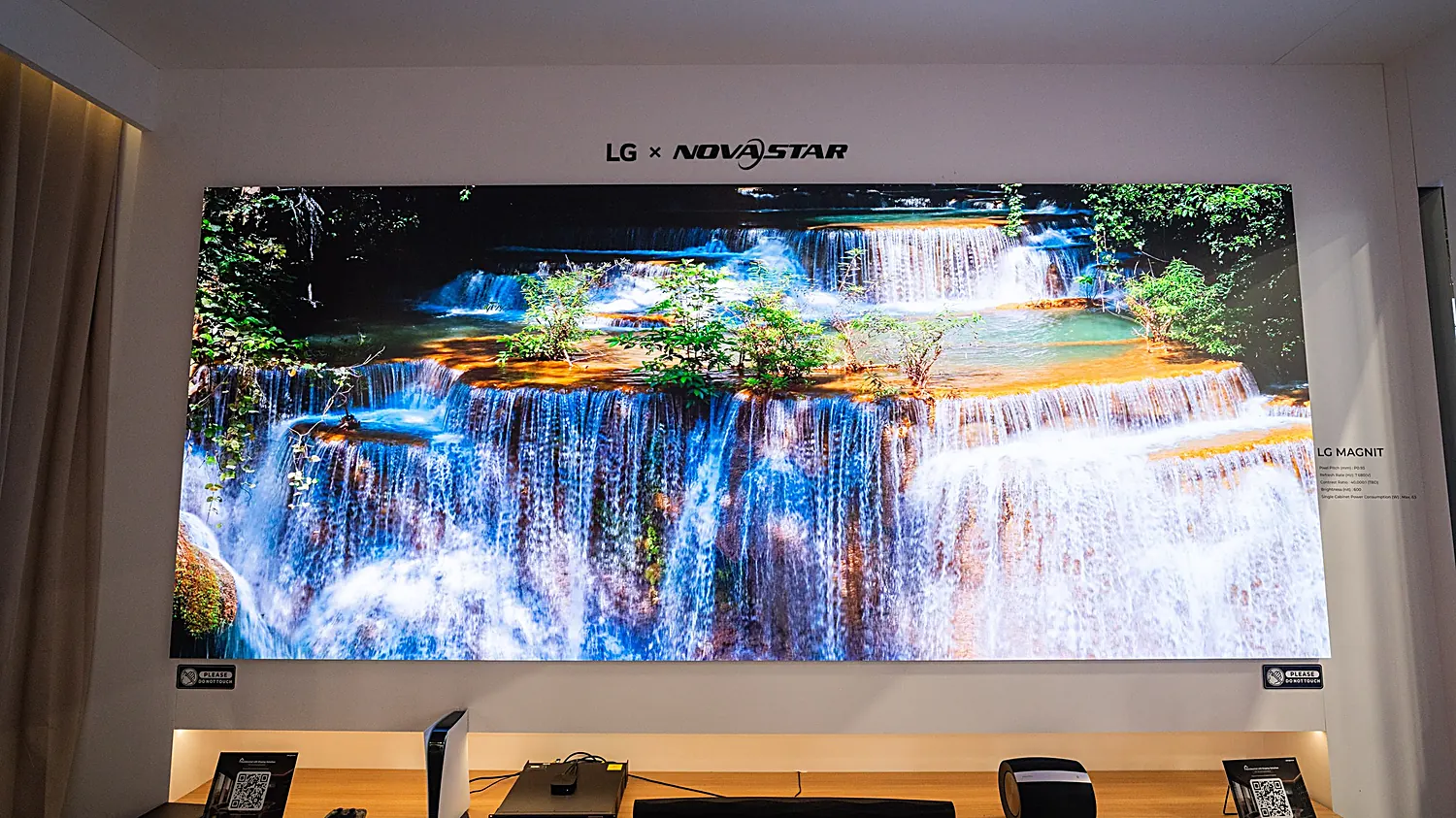
!International visitors surround the Nationstar booth at InfoComm 2026
Why is the presence of over 130 Chinese companies a significant signal?
The presence of over 130 Chinese companies among the total 750+ exhibitors at InfoComm 2026 is more than just a participation number. It signifies that the Chinese LED supply chain has evolved into a comprehensive ecosystem: encompassing complete display manufacturers, LED packaging houses, module producers, rental, outdoor, Micro-LED, COB, MiP, and integrated solutions for conference rooms, stadiums, and outdoor advertising. According to the official InfoComm/AVIXA website, the event is a convergence point for the professional AV industry, meaning a large presence here indicates that Chinese companies are penetrating the integration ecosystem, not just exporting standalone products.
A key difference from previous years is that companies are no longer competing solely on cabinet price. Leyard launched EverPixel/TruMicro and the Cobra 0.6mm; BOE presented COG P0.9 MicroLED and BYH Ultra P0.9; Kinglight announced mass production of MiP P0.4-P1.2, TF2727 ceramic packaging, and 20000-nit outdoor solutions; Nationstar at booth C9484 demonstrated MIP P0.93/P0.78 for 4K/8K and 4.2mm soft modules; Rayto at booth C9957 featured LEX II/TES II PRO 10000-nit displays; Ledman introduced a 275-inch 8K Micro-LED for the 2026 Winter Olympics broadcast center; Unilumin, Absen, and other brands also showcased their specific configurations.
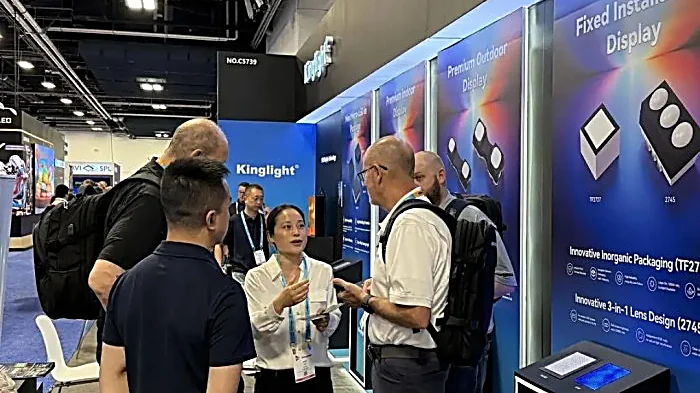
!Kinglight 晶台 booth attracts visitors at InfoComm 2026

How does this supply chain impact the Vietnamese market?
For the Vietnamese market, the most significant impact is not from individual display models but from the breadth of the supply chain. When packaging chip manufacturers, module makers, complete display brands, and rental/outdoor companies simultaneously launch products at InfoComm, the final cost will face pressure from multiple levels. A project for a conference room, stadium, or outdoor DOOH billboard in Vietnam is not purchased directly at the exhibition, but will be influenced by new models, replacement parts, dealer policies, and pricing benchmarks in the subsequent 12-24 months.
As nearly the entire LED display supply chain in Vietnam is imported from China, every advancement at InfoComm has the potential to become a product offered domestically. Mainstream COB from major brands may descend into more accessible market segments; MiP is transitioning from the experimental phase into commercialization; high-brightness outdoor lines will offer more choices for billboards and stadiums. However, the timeline for these products to reach Vietnam varies. A technology in mass production might have clear pricing and component availability within a few quarters, while flagship demos may require minimum orders, specific lead times, and tailored purchasing conditions.
As a distributor, Luxwave views InfoComm as a barometer of supply. When numerous brands push COB/MiP simultaneously, increased competition will ease pricing pressure for smaller pixel pitches, particularly in the P0.9-P1.25 range for high-end conference rooms, small studios, and control centers. However, lower prices are only meaningful if accompanied by robust warranty, color calibration, spare parts availability, and post-delivery accountability. Projects like the Optupus International Library demonstrate that for near-view displays, operational stability is as crucial as catalog specifications.

How mature are COB and MiP after InfoComm 2026?
COB and MiP are frequently mentioned at InfoComm 2026 because they address a common challenge: enabling smaller pixel pitch displays to be finer, more durable, and producible at larger scales. BOE emphasized its COG P0.9 MicroLED and BYH Ultra P0.9; Kinglight announced mass production of MiP P0.4-P1.2; Nationstar discussed MIP P0.93/P0.78 for 4K/8K displays; and 芯映光电 (Xin Ying Guang Dian) presented MiP with a 99% black ratio. These data points should not be interpreted as an assertion of immediate availability for all configurations, but they clearly indicate the industry's commercial direction.
COB is currently the more predictable option for many Vietnamese projects due to its flat surface, better impact resistance than SMD at small pitches, and established commercial product lines. For BOE MLED, configurations like BOE COB P0.9 and BOE BYH012 COB P1.25 are suitable for boardrooms, executive meeting rooms, training centers, and spaces requiring fine imagery at close viewing distances. This technology category is recommended for realistic budgeting, especially when clients need to balance image quality with local warranty capabilities in Vietnam.
MiP warrants closer monitoring in the next cycle. According to data from Sina and Kinglight, both brands are making MiP a central theme at InfoComm 2026, highlighting its small pixel pitch range and 4K/8K applications. For Vietnam, MiP could potentially reduce prices in the ultra-small pixel pitch segment if the production chain stabilizes. However, investors must inquire thoroughly: Is it in mass production? What is the process for replacement modules? How are dead pixel rates handled? And does the distributor have adequate warranty capabilities? The article What is MiP Micro LED in Package provides a good foundation for distinguishing MiP from various Micro-LED labels on the market.
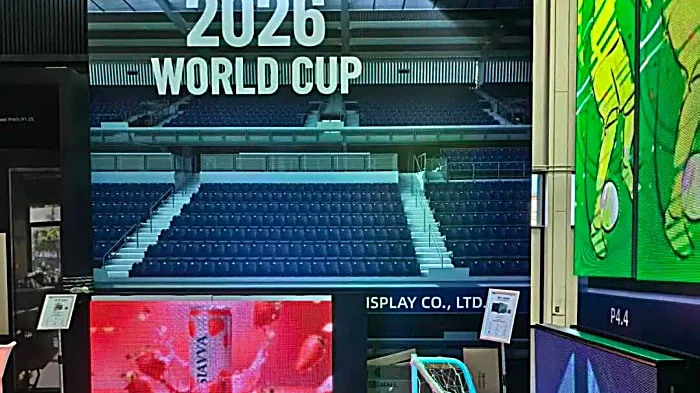
!Rayto LED poster displaying World Cup 2026 content
How do outdoor, rental, and stadium segments benefit?
InfoComm 2026 is not solely focused on indoor small pixel pitch displays. The outdoor, rental, and stadium segments also benefit from the high concentration of Chinese exhibitors, as these are sectors requiring large production volumes, high brightness, continuous operation, and controlled component replacement costs. Rayto at booth C9957 presented its LEX II/TES II PRO with a 10000-nit specification; Kinglight discussed 20000-nit outdoor solutions; Nationstar featured 4.2mm soft modules; and Ledman demonstrated a 275-inch 8K Micro-LED linked to the 2026 Winter Olympics broadcast center. These details indicate that high-performance segments are being driven forward across multiple tiers of the supply chain.
For Vietnam, the outdoor DOOH billboard and stadium segments do not typically require the smallest pixel pitch but prioritize suitable brightness, weather resistance, camera refresh rates, color uniformity, and rapid module replacement. Information from Rayto or Kinglight is relevant as it signals competition in brightness and outdoor packaging, but actual pricing must be verified per model. A nit specification at an exhibition cannot substitute for a datasheet, warranty terms, and environmental testing for installation in Vietnam.
This is also where the Chinese supply chain is shifting from "cheap goods" to "solution systems." Articles on Made in China and the 2026 World Cup highlight that stadiums, advertising, and broadcast are increasingly demanding LED displays as visual infrastructure, not just display panels. When Vietnamese investors select displays for stadiums, public squares, events, or rental purposes, the scope of inquiry should expand to include processors, signal management, power redundancy, operational teams, and maintenance schedules. Cabinet price is only one component of the overall equation.
What should Vietnamese investors be cautious about after InfoComm 2026?
The most critical point of caution following InfoComm 2026 is the gap between "launch" and "purchase availability." According to 新浪科技/Sina and AVNetwork, many companies showcased impressive products, from Leyard's EverPixel/TruMicro and Cobra 0.6mm to Absen's M54 Micro-LED at booth C7236 and Unilumin's COB UTV SC. While this information is highly valuable for reference, it does not replace the project due diligence process: commercial model confirmation, shipping documentation, lead times, spare parts, warranty policies, and the responsible party in Vietnam.
The best signal from InfoComm 2026 is not the proliferation of new technologies, but that more technologies are gaining clearer commercial pathways; the distributor's role is to distinguish these pathways from exhibition hype.
Investors should also not confuse supply competition with an immediate need to purchase. With over 130 Chinese companies present, price pressure typically increases, especially for mainstream COB and maturing MiP. However, if a project's content, viewing distance, ambient lighting, or camera requirements are not yet clearly defined, committing based solely on low prices could lead to significantly higher correction costs. The article Vietnam LED Prices Q2/2026 should be read in conjunction with InfoComm news to differentiate market trends from project-specific quotes.
From a distributor's perspective, Luxwave prioritizes three questions before proposing a configuration: Is the technology commercialized? Does the brand have an official support channel? And is the after-sales service in Vietnam sufficiently clear? For brands within our portfolio, such as BOE, Leyard, and Ledman, the evaluation extends beyond brand name to product lines, applications, and warranty records. For brands outside our portfolio, like Kinglight, Nationstar, Rayto, Unilumin, or Absen, exhibition information is useful for understanding the supply chain but should not be included in procurement documents as a distribution commitment without an official channel.
Conclusion: Which technologies should be prioritized?
InfoComm 2026 confirms a clear trend: the Chinese LED industry is not only large in number but also deeply integrated across the supply chain, from packaging to complete displays. For Vietnam, this benefits supply and pricing, particularly for commercial COB/MiP and small pixel pitch configurations. However, these benefits translate into real value only when investors select the right technology for the right application, verify production status, and secure a distributor responsible for post-delivery support.
Technologies to prioritize are mainstream COB and MiP configurations proven in mass production. For conference rooms, boardrooms, and near-view spaces, BOE COB P0.9 or BOE BYH012 COB P1.25 are more practical for budgeting than Micro-LED demos. For iconic spaces like Optupus International Library or high-end showrooms, more advanced configurations can be considered, but the due diligence discipline remains: model, lead-time, warranty, and total cost of ownership.
Ultra-small pitch demos, flagship Micro-LEDs, or extremely high outdoor specifications should be viewed as directional signals, not as default purchase orders. In a market with numerous suppliers, the advantage lies not with the lowest bidder, but with the entity that selects the right brand, understands the application correctly, and ensures post-delivery operation. This is the most practical interpretation of InfoComm 2026 for the Vietnamese LED display market.
Pitfalls
Common mistakes
- Treating all products launched at InfoComm 2026 as immediately available for order in Vietnam, when some configurations are still demos or have specific commercial conditions.
- Comparing prices solely per square meter while overlooking the origin of chips, packaging, controllers, spare parts, and post-delivery warranty responsibilities.
- Including brands not within the distribution portfolio in procurement documents as supply commitments, instead of requesting specific models, lead times, and technical support policies.
- Choosing overly new technologies for standard conference rooms or advertising when commercialized COB/MiP might offer a better balance of cost and risk.
FAQ
Frequently asked questions
Where is InfoComm 2026 taking place, and why is it significant for the LED industry?
InfoComm 2026 will be held from June 17-19, 2026, at the Las Vegas Convention Center, USA, not Orlando. The event features over 750 exhibitors, including more than 130 Chinese companies. For the Vietnamese LED industry, this is a crucial signal as many technologies, component prices, and commercial configurations typically influence the Vietnamese market within 12-24 months post-exhibition.
Will the presence of over 130 Chinese companies immediately reduce LED display prices in Vietnam?
Prices are unlikely to drop immediately after the exhibition. The actual impact usually materializes over a 12-24 month cycle, as launched products achieve stable production, establish distribution channels, and build component inventory. However, the intense competition among Chinese companies does create clearer downward price pressure for mainstream COB, MiP, and commercial small pixel pitch models.
How should COB and MiP be understood in the context of InfoComm 2026 news?
COB involves direct chip bonding and surface encapsulation, suitable for small pixel pitch displays requiring durability and fine image quality. MiP integrates micro-chips into very small packages for more flexible manufacturing, sorting, and repair. When interpreting exhibition news, it's essential to ascertain if the technology is in mass production, as impressive demos do not necessarily equate to stable commercial pricing.
Which Chinese brands should Vietnamese companies prioritize after InfoComm 2026?
Selection should not be based solely on brands exhibited at the event. Vietnamese projects should prioritize brands with suitable models, clear technical documentation, official distribution channels, readily available spare parts, and local warranty support teams. For Luxwave, brands like BOE, Leyard, and Ledman are evaluated based on their commercial product lines, not just their prominence at the event.
What impact will this trend have on outdoor and stadium LED displays?
Outdoor and stadium segments benefit from increased competition in brightness, durability, outdoor packaging, and stable control systems. Information such as Kinglight's 20000-nit solutions, Rayto's LEX II/TES II PRO 10000-nit series, and Ledman's 275-inch 8K Micro-LED demonstration indicate a more dynamic high-performance segment. Specific project configurations still require verification.
Does Luxwave view InfoComm 2026 as a buying signal or a reference signal?
Luxwave considers InfoComm 2026 a reference signal for forecasting supply, technology, and pricing trends, not an immediate recommendation to purchase. For Vietnamese clients, decisions should be based on display needs, viewing distance, installation environment, operational budget, and after-sales service. New technologies are only advisable when commercial models, lead times, and warranty policies are clearly established.
References