

InfoComm 2026, held from June 17-19, 2026, at the Las Vegas Convention Center, USA, featured over 750 exhibitors, including more than 130 Chinese companies. Amidst pervasive themes of Agentic AI, IPMX, and Micro-LED across the exhibition floor, MiP emerged as a noteworthy technical keyword, positioned at the intersection of small-chip technology and commercial manufacturing capabilities. According to 新浪科技/Sina, Kinglight, Nationstar, and 芯映光电 all leveraged InfoComm 2026 to highlight their MiP product lines, spanning ultra-fine indoor pitches to outdoor applications and curved modules.
This article explains MiP from a buyer's perspective in Vietnam: what it is, how it differs from SMD/COB/Micro-LED, its pros and cons affecting project budgeting, and when to consider it in 2026. The practical takeaway is to view MiP as a commercialization pathway for Micro-LED, holding significant potential for small pixel pitches, but still requiring verification based on model, warranty, and local deployment capabilities.
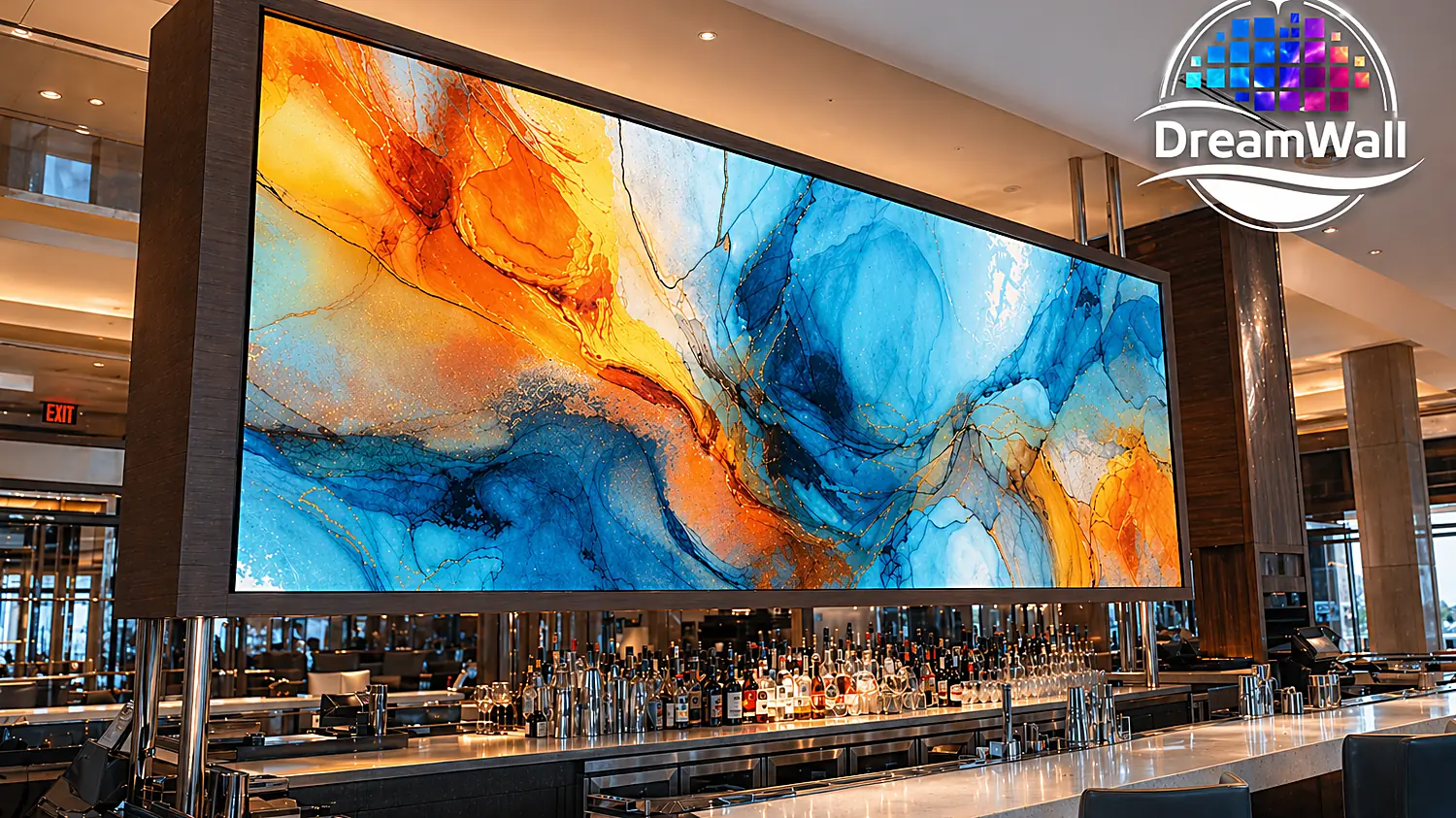
!Nationstar MiP LED screen displaying Infinite Vision content at InfoComm 2026
What is MiP in LED Displays?
MiP, short for Micro LED in Package, is a packaging method where Micro-LED chips are placed into an ultra-small package before being mounted onto a PCB using SMT lines, similar to the familiar SMD process. The key innovation is that MiP not only miniaturizes components but also aims to combine the durability and display capabilities of micro-chip arrays with the manufacturing flexibility the LED industry has utilized for years. Consequently, MiP is often positioned as an intermediate step between current commercial COB technology and the long-term goal of true Micro-LED.
From a buyer's standpoint, MiP addresses two issues simultaneously. Firstly, as pixel pitches continue to shrink, traditional SMD struggles to maintain surface durability. Secondly, while COB offers durability and flatness, pixel-level repairs or post-production color calibration can be more complex depending on the design. MiP encapsulates each pixel in a small package, theoretically simplifying color sorting, replacement, and production scaling.
At InfoComm 2026, Kinglight 晶台 announced mass production of its P0.4-P1.2 MiP series, emphasizing color uniformity, full greyscale, and whole-panel yield, as reported by 新浪科技/Sina. Nationstar 国星光电 showcased its IP65 rated MiP screens, P0.93/P0.78 micro-pitch modules for 4K/8K, and a 4.2mm thin MiP soft module. These announcements indicate that MiP is no longer just a laboratory concept.
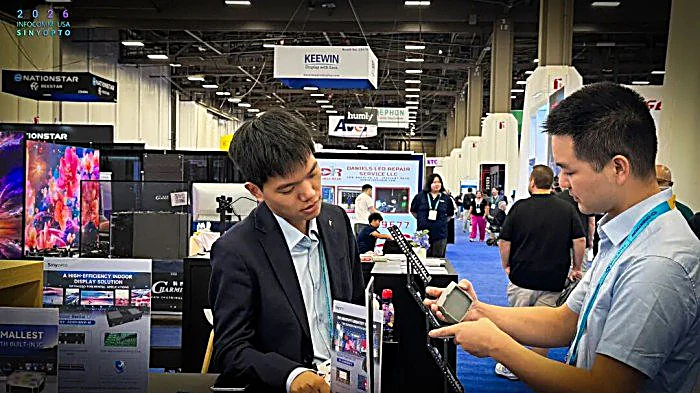
!Visitor examining a MiP panel at the 芯映光电 booth

How Does MiP Differ from SMD, COB, and Micro-LED?
SMD, COB, MiP, and Micro-LED are often grouped in quotations, but they represent different concepts. SMD and COB are packaging methods, MiP is also a packaging method, while Micro-LED refers to the technology of very small, self-emissive chips. An optimal LED project selection should not be based on the newest terminology but on understanding how the display surface is constructed, the susceptibility of pixels to damage, repairability, and image stability when viewed up close or captured by a camera.
Traditional SMD mounts chip packages onto a PCB. This technology is cost-effective, mature, widely available, and remains economical for larger pixel pitches, especially for outdoor billboards or distant viewing in auditoriums. Its drawback is that as pixel pitches drop below approximately P1.5, the LED dots become smaller and denser, making the surface more vulnerable, increasing the risk of dislodged pixels or visible color deviations. Therefore, SMD is not disappearing but is shifting towards applications where cost-effectiveness and longer viewing distances are prioritized.
COB involves placing chips directly onto the PCB and then encapsulating them with resin to create a seamless, flat surface. This is why COB is favored for meeting rooms, control rooms, and studios requiring a durable surface, high contrast, and cleaner camera footage. Configurations like BOE COB P0.9 or BOE COB P1.25 offer advantages as they are closer to commercial market demands in Vietnam.
MiP sits in between: micro-chips are packaged into small units and then mounted onto the PCB like SMD. This approach aims for durability close to COB, with more flexible pixel repairability and easier pre-assembly color matching. Micro-LED represents the ultimate goal for pixel density and display quality, and MiP is one of the pathways to bring micro-chips into mass production. In essence, MiP does not negate COB; it creates an additional competitive branch in the ultra-fine pitch segment.
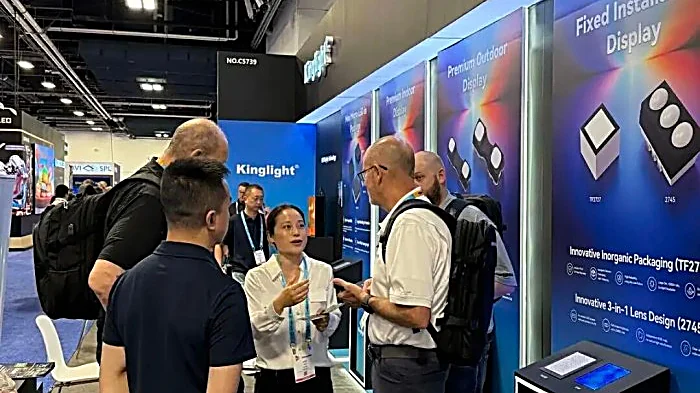
!Kinglight 晶台's MiP area at InfoComm 2026

Why Was MiP Heavily Featured at InfoComm 2026?
MiP garnered significant attention at InfoComm 2026 because the LED industry is entering a phase where ultra-fine pixel pitches cannot be achieved with old methods alone. When displays need to show 4K/8K content in moderate sizes, or are used in boardrooms, studios, and XR environments, the increased pixel density makes even minor flaws in color, greyscale, surface uniformity, and failure rates more apparent. MiP is attractive because it promises to retain flexible SMT production lines while moving closer to Micro-LED quality.
According to 新浪科技/Sina, Kinglight 晶台 stated that its P0.4-P1.2 MiP series is in mass production (量产), emphasizing color uniformity, full greyscale, and whole-panel yield. For buyers, these three aspects are more critical than just looking at the pixel pitch. Poor greyscale reveals flaws in dark areas; inconsistent colors make image areas appear 'dirty'; low yield increases costs, lead times, and warranty risks.
Nationstar 国星光电 at booth C9484 announced IP65-rated MiP screens with impact resistance for both indoor and outdoor use, alongside P0.93/P0.78 micro-pitch modules targeting 4K/8K. The company also presented a 4.2mm thin MiP soft module, indicating MiP is not only for indoor flat panels in meeting rooms but also paving the way for creative LED applications, showrooms, brand lobbies, high-end control rooms, and XR stages.
芯映光电 Xinying at booth C8976 highlighted its MiP panels using Black Underfill and nano-coating, achieving a 99% black ratio, 175° viewing angle, and seamless color edges, according to Sina. These details suggest the MiP competition is not just about chip size but also about black level processing, viewing angles, and panel-to-panel uniformity. These are practical factors during acceptance testing, as clients often notice issues at panel seams, in dark areas, and at off-angles before focusing on the technology's name.
What are the Advantages and Risks of MiP?
The primary advantage of MiP is that it allows the LED industry to pursue ultra-fine pixel pitches through a more manufacturable pathway. With each micro-chip encapsulated individually, manufacturers gain an additional step for sorting, color matching, and quality control before mounting onto the panel. This can lead to better display uniformity, especially for content with gradients, dark scenes, technical drawings, or camera-based productions. This is why MiP is noteworthy for broadcast studios, control rooms, and premium AV spaces.
The second advantage is potentially more flexible maintenance than COB in certain designs. COB's seamless resin surface offers good impact resistance and ease of cleaning, but pixel failures require specific module structures and specialized equipment for repair. MiP retains a logic closer to SMT assembly, potentially simplifying replacement or fault isolation. However, customers still need to inquire about spare parts availability and repair turnaround times in Vietnam.
The biggest risk is that MiP is commercializing rapidly, leading to varying levels of maturity across brands, pitches, and indoor/outdoor product lines. Announcements from Kinglight regarding 3500-6000nit outdoor MiP, Nationstar's IP65 rating, or Xinying's transparent indoor-outdoor MiP solutions are positive signals, but they do not replace individual model assessments. For outdoor projects in Vietnam, factors like heat, humidity, rain, and extended operating hours require more rigorous testing than exhibition environments.
Packaging technology is only valuable when it translates into an acceptable final display: uniform color, serviceable, with available spare parts, and stable operation under real-world conditions.
What Applications is MiP Suitable For in Vietnam in 2026?
In Vietnam in 2026, MiP is best suited for projects with three conditions: close viewing distances, high image quality requirements, and a sufficient budget for evaluating new technologies. This category includes executive boardrooms, control rooms, broadcast studios, product demonstration centers, XR stages, or technology showrooms. In these contexts, small pixel pitch, color uniformity, deep black levels, and camera performance offer tangible value. If the display is primarily for distant viewing, MiP typically does not offer a significant enough benefit to justify the cost.
For meeting rooms, a prudent approach is to compare MiP against COB for the specific use case, rather than comparing by technology name alone. If the room has front rows very close to the screen, frequently displays spreadsheets, technical designs, or high-level video conferences, MiP might be worth including in the technical proposal. For reliable deployment in 2026, commercial COB lines from BOE MLED remain easier to justify in investment proposals due to their established product ranges, policies, and installation experience.
For control rooms, MiP is attractive when high resolution is needed in a moderate size, with long operating hours and detailed data display. However, this is an application where downtime is critical, demanding stricter maintenance requirements than meeting rooms. Investors should inquire about spare modules, replacement times, recalibration procedures, and guarantees of batch-to-batch color consistency.
For outdoor applications, SMD remains the economical choice for most billboards, DOOH, and large-pitch screens. MiP for outdoor use is showing development signals, such as Kinglight's 3500-6000nit brightness and Nationstar's IP65 rating, but purchasing decisions must be based on specific models, not general categories. If the goal is a distant-viewing advertising screen, the benefits of MiP may not outweigh the cost. If the objective is a premium facade or a close-viewing outdoor screen, MiP warrants deeper investigation.
Should MiP Be Chosen Over COB for Projects in 2026?
It's not a question of whether MiP will replace COB, as both technologies will coexist in 2026, serving different risk profiles. COB is the more predictable choice for many Vietnamese projects due to its established commercial products, installation processes, and after-sales support. MiP is a technology worth monitoring or including in comparative proposals when clients require extremely small pixel pitches, very high image quality demands, or are preparing for a long-term Micro-LED roadmap.
If a project requires quick acceptance, has a defined budget, and low risk tolerance, COB remains a good starting point. BOE COB P0.9 is suitable for boardrooms, small studios, and close-viewing spaces; BOE COB P1.25 offers a better balance for slightly longer viewing distances or when budget control is key. You can use the articles on how to choose LED pixel pitch and COB vs SMD comparison as a foundation before requesting quotes.
If the project involves an experience center, a high-level control room, or a studio demanding distinct visual performance, MiP could be an upgrade option. In such cases, the technical specifications should clearly state the pitch, brightness, protection rating (if for outdoor use), maintenance procedures, lead time, spare modules, and warranty conditions. Premium brands like Leyard demonstrate that this segment is poised for rapid growth, but buyers must still differentiate technological claims from deployment commitments.
Conclusion: MiP Should Be Understood as a Roadmap, Not a Slogan
MiP is a noteworthy technology because it directly addresses a major question in the LED industry: how to bring micro-chips and ultra-fine pixel pitches into more controlled production, rather than remaining mere prototypes. Announcements at InfoComm 2026 from Kinglight, Nationstar, and 芯映光电 show MiP advancing rapidly in P0.4-P1.2, P0.93/P0.78 micro-pitch, IP65, curved modules, and black level processing. However, for Vietnamese projects, the right decision must still start with viewing, operational, and maintenance needs.
Luxwave views MiP as a roadmap to follow closely, especially for broadcast studios, control rooms, premium boardrooms, and technology showrooms. For most projects in 2026, COB remains a more balanced choice between image quality, durability, and deployment feasibility; SMD is still suitable for large pitches and outdoor applications where cost is the primary driver. The article on Mini-LED vs Micro-LED differences and the overview of ISLE 2026 can help place MiP within the broader long-term trends of the display industry.
When budgeting for MiP, don't just ask, "Is it the latest technology?" Ask: Is the model commercialized? Is a demo unit available? What is the warranty policy in Vietnam? How long does module replacement take? Is color consistent across batches? And what is the total cost of ownership over three to five years? This is how to transform an exhibition trend into a controllable investment decision.
Pitfalls
Common mistakes
- Calling every small-pitch screen Micro-LED — MiP is a packaging method, not synonymous with a fully commercialized Micro-LED system.
- Choosing MiP solely based on P0.4 or P0.6 specs — viewing distance, content, lead time, warranty, and module replacement capability in Vietnam must be verified.
- Comparing MiP with COB based on single panel price alone — total cost includes processors, color calibration, spare parts, installation, and downtime during maintenance.
- Deploying MiP outdoors without verifying brightness, IP rating, and thermal performance — InfoComm announcements indicate outdoor potential, but each model requires individual assessment.
FAQ
Frequently asked questions
What is MiP in LED displays?
MiP stands for Micro LED in Package. It means Micro-LED chips are placed into a very small package before being mounted onto a PCB using SMT lines. This approach maintains the flexibility of SMD manufacturing while aiming for better durability, pixel density, and uniformity in small-pitch LED screens.
How does MiP differ from COB?
COB places chips directly onto the PCB, then encapsulates them with resin to form a seamless, flat, and durable surface. MiP packages micro-chips into small units before mounting them onto the PCB like SMD. Therefore, MiP offers advantages in pixel repair and flexible color matching, while COB is currently easier to implement commercially for many projects in Vietnam.
Is MiP the same as Micro-LED?
MiP is closely related to Micro-LED but should not be equated. Micro-LED is a technology direction for very small self-emissive chips; MiP is a packaging method to commercialize these small chips. A MiP display can be a step towards Micro-LED, but its configuration, chips, drivers, and actual production status must be examined.
Should I choose MiP for meeting rooms in 2026?
MiP is worth considering for high-end meeting rooms requiring very small pixel pitches, smooth image quality, and a sufficient budget to validate new technologies. For most corporate meeting rooms in 2026, COB solutions like BOE P0.9 or P1.25 remain more predictable for budgeting due to their established products, warranties, and deployment processes.
Can MiP be used outdoors?
Some announcements at InfoComm 2026 indicate MiP is being developed for outdoor use, such as Kinglight's mention of 3500-6000nit outdoor MiP series and Nationstar's IP65-rated MiP screens. However, outdoor projects in Vietnam must still undergo individual assessment for brightness, protection rating, temperature resistance, and maintenance capabilities for each specific model.
Will MiP replace SMD in outdoor billboards?
MiP should not yet be considered a mainstream replacement for outdoor billboards in 2026. For large pixel pitches and long viewing distances, SMD retains advantages in cost, supply chain maturity, and familiar maintenance. MiP is more suitable when small pixel pitch, fine image quality, and high uniformity are prioritized over cost per square meter.
References