

Muxwave is a Chinese brand specializing in transparent LED screens since 2012, focusing on transparent and holographic categories rather than a broad range of LED displays. For the Vietnamese market, the key question isn't just "how transparent is the screen?" but rather, can this technology add brand value to glass doors, showrooms, lobbies, or building facades? This article explains Muxwave from a project buyer's perspective: principles, product lines, applications, trade-offs, and how Luxwave consults on genuine configurations in Vietnam.
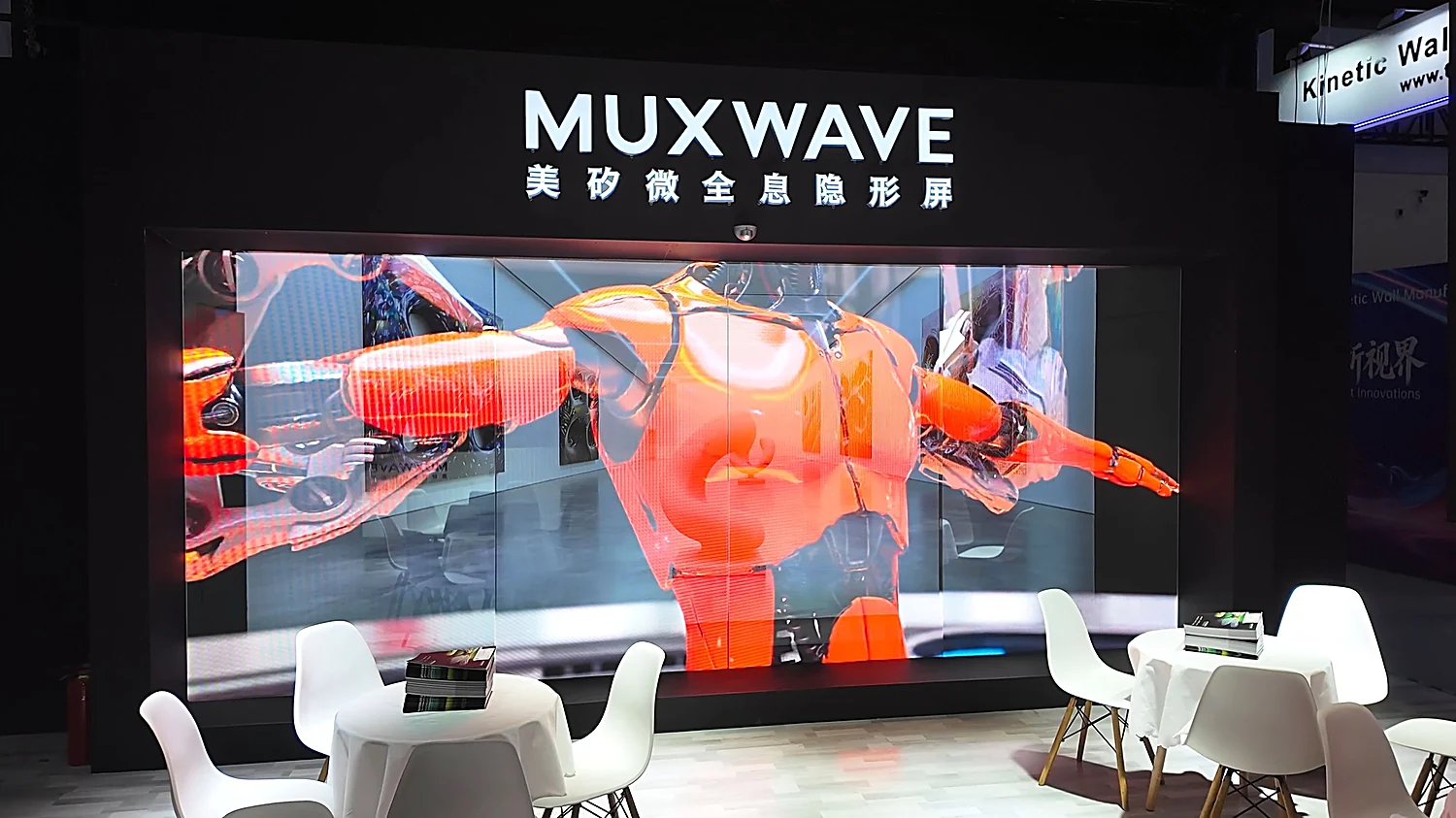
!Muxwave transparent LED screen displaying vivid holographic images, allowing see-through
What is a Muxwave Transparent LED Screen?
A Muxwave transparent LED screen is a type of display that uses thin, sparsely placed LED strips with gaps, allowing light and vision to pass through. When displaying content, images appear to float on the glass or hover in front of the background. When turned off, the screen obstructs the space less than a solid LED screen. According to Muxwave, their transparent/holographic models offer a transparency range of 85–95%, depending on the configuration and installation method.
It's important to understand that "transparent" doesn't mean the screen completely disappears. This technology creates openness by reducing the density of light-emitting materials per square meter, meaning LEDs are arranged in strips with open space in between. The more open space, the better the see-through effect, but the image quality becomes more dependent on viewing distance, background brightness, and content design. Therefore, Muxwave screens should be viewed as a layer of visual effects on glass, not as a primary content display replacing all other scenarios.
For Vietnamese buyers, the practical approach is to consider: Is there glass? How far will viewers be? Is it necessary to read small text? And is the content primarily brand effects or detailed information? If the project involves retail glass doors, product experience zones, hotel lobbies, or building facades, Muxwave offers compelling reasons for inclusion in the budget. If the project is for meeting rooms, classrooms, or control centers, compare it with solid LED screens first.
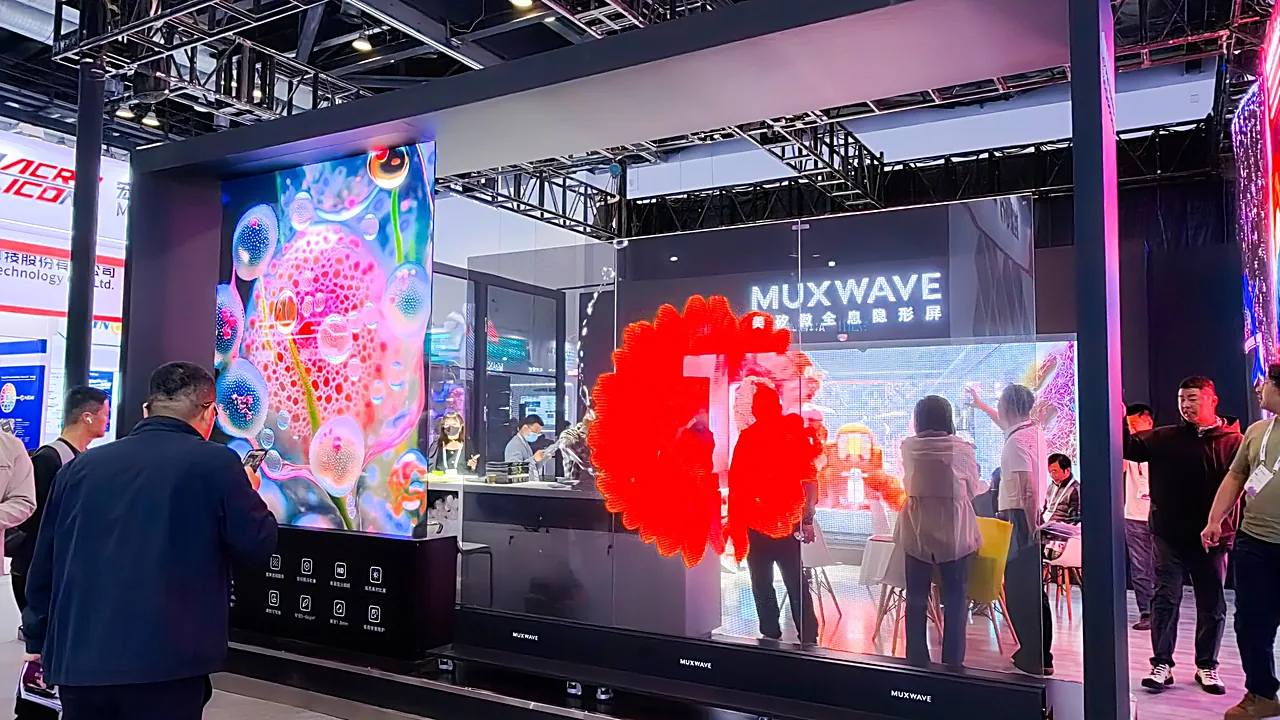
!Muxwave transparent LED screen projecting a holographic flower at an exhibition booth

How Does the See-Through Principle Work?
The principle of transparent screens relies on sparse LED strips and the gaps between them to maintain natural light, visibility, and spatial depth. The LED sections are responsible for displaying images, while the open spaces allow people in front or behind the screen to see the actual background. This is also why Muxwave images are often described as holographic: the content doesn't appear on a solid wall but floats on the glass or in front of real products.
The trade-off is inherent in this principle. Increasing LED density for a finer image reduces transparency. Prioritizing high transparency results in a more pixelated image, unsuitable for small text at close distances. Therefore, a high transparency rating isn't always better; it's only beneficial when the project goal is to maintain a clear view through the glass. For content requiring detailed reading, stable contrast, and solid images, traditional LED screens remain a more logical choice.
The background also significantly impacts perception. A video of a flower, a large logo, or light animations can be very striking against a dark glass or a showroom with depth. Conversely, content with a lot of text placed against a bright, reflective background, or harsh sunlight, will be difficult to read. This is why Luxwave often requests testing sample content under near-real conditions, rather than relying solely on exhibition videos or manufacturer catalogs.

What Muxwave Product Lines Are Available?
Muxwave's product catalog is categorized by installation method and usage context, not just by pixel pitch. For buyers, this categorization is more practical as each glass project has different constraints: some require direct glass mounting, others hanging, some need quick assembly for exhibitions, and some are large-scale glass curtain walls. According to Muxwave, the M, M6-Pro, P, F, S, and U series cater to various needs within the transparent screen category.
!Multiple Muxwave transparent LED screen panels assembled for product display
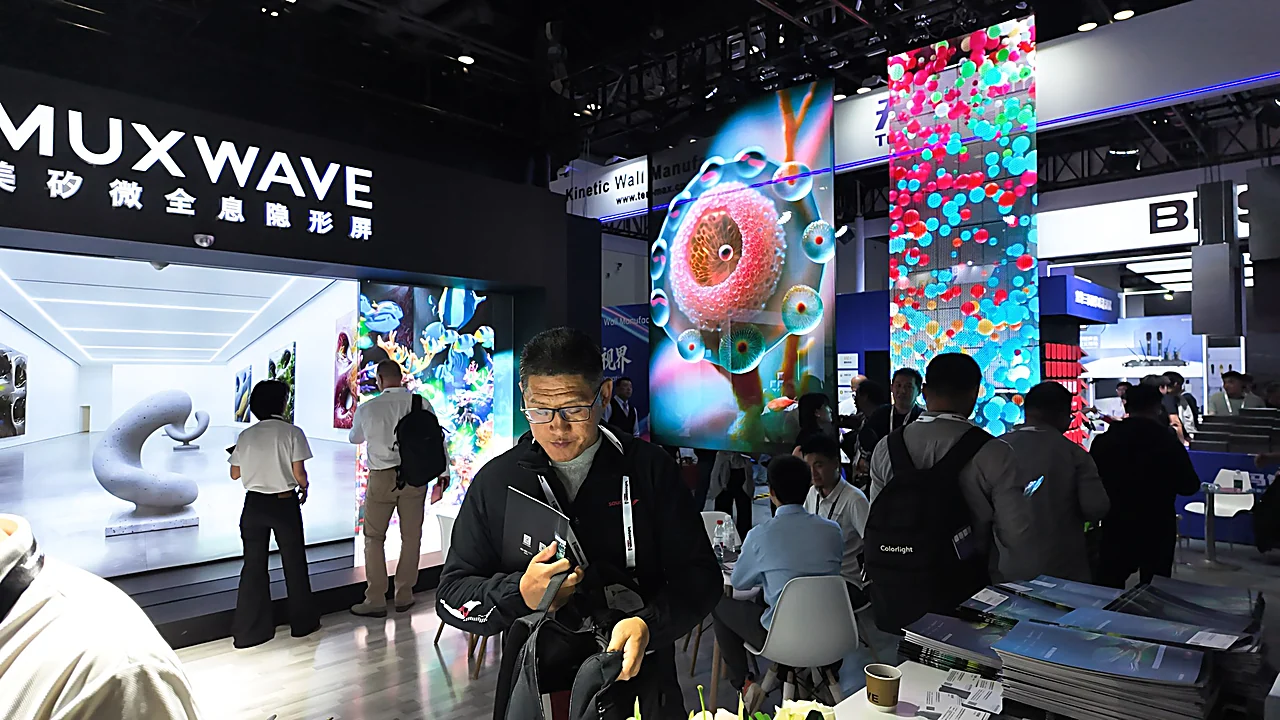
Muxwave M Series is an ultra-thin series, 1.8mm thick, weighing around 6kg/m², and can be directly adhered to store glass. This is the most intuitive category for retail glass doors, small showrooms, or display areas where maintaining the glass's presence is crucial. Muxwave M6-Pro is the flagship transparent series, offering up to 90% transparency, a brightness of approximately 3,500 nits, and available in module lengths of 4.22m or 6.75m, suitable for large surfaces requiring a more prominent effect.
The P Series is designed to be frameless, featuring a 3-point quick-lock system, ideal for retail and exhibition booths requiring rapid assembly and disassembly. The F Series is a hanging model with a 7.5mm bezel, supporting L-shape, 45°, or curved installations, making it suitable for more creative spaces beyond simple flat glass surfaces. Muxwave S Series is intended for glass curtain walls and building glass facades. The U series includes U3 (P3.91 with ~92% transparency) and U6 (P6.25 with ~95% transparency), both emphasizing an ultra-thin 1.8mm holographic design.
With transparent LED screens, the first question shouldn't be "which model is the most beautiful?" but rather "how much of the view does this glass surface need to retain, and where will the viewers be located?"
Which Applications in Vietnam Are Most Suitable for Muxwave?
Muxwave is best suited for spaces with glass, customer traffic, and a need for brand emphasis without obscuring products or interior design. This includes retail glass doors, automotive showrooms, product experience zones, hotel lobbies, exhibition booths, and building glass facades. In these contexts, the screen doesn't replace the entire signage system; it acts as a dynamic visual layer that brings glass doors or facades to life.
In retail, transparent screens can display seasonal campaigns, product motion graphics, logos, or brand activation effects while still allowing customers to see merchandise inside. At exhibition showrooms, holographic content creates a backdrop for physical products, enabling customers to take photos and remember the space without needing a large, solid screen. For hospitality, Muxwave can be installed in lobbies or glass partitions to create a premium focal point while maintaining architectural openness.
Glass facades require more detailed site surveys. Muxwave S Series is designed for glass curtain walls, but facade projects in Vietnam also depend on sun direction, glass structure, wiring paths, maintenance access (internal or external), lighting operation regulations, and nighttime content display. If the sole objective is a highly visible billboard from a distance, a solid outdoor LED screen might be more economical. If the goal is to transform the glass surface into a communicative layer that remains see-through, Muxwave is worth considering.
How Does Muxwave Differ from Solid LED Screens?
Muxwave transparent screens and solid LED screens address different needs. Solid LED screens optimize image quality: high pixel density, strong brightness, rich colors, and the ability to display detailed text, slides, and videos. Muxwave optimizes lightness, thinness, and see-through capability: content appears to float on the glass, transforming storefronts or facades from solid walls into dynamic displays. Therefore, the correct comparison isn't "which is better?" but "does the project require image quality or an on-glass experience?"
If the need is to display presentations, data tables, meeting room cameras, training content, or dashboards, fine-pitch solid LED screens offer a clear advantage. If the goal is to create a brand effect on the glass layer, maintain natural light, and allow passersby to see inside, Muxwave is more suitable. The transparent LED screen article explains the general technology; this article focuses on how to interpret the Muxwave catalog based on applications.
Another difference lies in content. Solid LED screens can play various common video formats; transparent screens require content that is less detailed, has clear bright areas, good contrast, and is designed for a see-through background. 3D or holographic effects can be impressive, but they should not be confused with glasses-free 3D LED screens, as glasses-free 3D relies on viewing angles, perspective, and different display surfaces. With Muxwave, the primary advantage remains the layer of imagery on the glass.
Which M, M6-Pro, P, F, or S Series Should Be Chosen Based on What Criteria?
Choosing a Muxwave series should start with the installation surface, not the brochure. If the location is a glass door or a flat glass partition within a store, the M Series is a natural candidate due to its 1.8mm ultra-thin design, ~6kg/m² weight, and direct adhesion capability. If a large surface requires very high transparency, ~3,500 nits brightness, and long modules, the M6-Pro should be considered for comparison. If the project involves frequently changing exhibition booths, the frameless P Series with its 3-point quick-lock system offers operational advantages.
If the space requires hanging, angled, or shaped installations, the F Series is more suitable due to its hanging structure, 7.5mm bezel, and support for L-shape, 45°, or curved installations. For building glass facades, the S Series is the group to examine first, as it is clearly oriented towards glass curtain walls. The U3 and U6 are suitable when the project aims for an ultra-thin holographic effect, with U3 being P3.91 (~92% transparent) and U6 being P6.25 (~95% transparent), according to Muxwave's provided data.
From a budgeting perspective, each choice entails different costs: panels, power supplies, controllers, structures, content creation, glass installation, and maintenance. Do not just ask for the price per square meter without determining the wiring path, sun exposure, rear access, and operating schedule. For multi-location projects, factor in content management for campaigns. For facades, simulate daytime transparency and nighttime image prominence before finalizing the area.
Conclusion: Who Should Choose Muxwave Transparent LED Screens?
Choose Muxwave when the project has attractive glass surfaces, aims to preserve spatial depth, and requires a brand effect layer distinct from solid LED screens. The most suitable groups include high-end retail, automotive showrooms, exhibition booths, hotel lobbies, and glass curtain walls. Avoid choosing if the primary goal is small text, high close-up sharpness, or a main display screen in meeting rooms and control centers.
Luxwave is an authorized Muxwave distributor in Vietnam, providing all M, M6-Pro, P, F, S, and U series genuinely based on project specifications. The consultation process involves surveying the glass, ambient light, viewing distance, customer traffic, and content; only then is a choice made between M Series, M6-Pro, P Series, F Series, S Series, or U. This approach helps investors budget accurately: paying for the see-through effect when it delivers real value, and opting for solid LED screens when the task requires primary imagery.
InfoComm 2026 at the Las Vegas Convention Center, held June 17–19, 2026, indicates that MiP, Micro-LED, and transparent screens continue to expand their presence in the display industry. The article Transparent LED Screens & Concepts at InfoComm 2026 places Muxwave within the broader exhibition landscape; this article serves as a manufacturer-specific guide for Vietnamese procurement teams to correctly interpret products, ask the right questions, and avoid misconceptions when transforming glass into a dynamic communication layer.
Pitfalls
Common mistakes
- Choosing based solely on the highest transparency ratio while neglecting content: greater see-through clarity means lower pixel density and less suitability for small text.
- Using transparent screens like solid LED screens: Muxwave is best as an on-glass effect layer, not a primary display for meeting rooms, dashboards, or content requiring close reading.
- Ignoring ambient light and glass reflections: facades with harsh sunlight or very bright backgrounds require a demo with actual content before finalizing the configuration.
- Not determining the installation method from the outset: glass mounting, hanging, frameless, or glass curtain wall installations lead to vastly different structural, wiring, and maintenance requirements.
- Forgetting content costs: holographic effects require videos with minimal detail, good contrast, and specifically designed for transparent backgrounds.
FAQ
Frequently asked questions
What is a Muxwave transparent LED screen?
Muxwave transparent LED screens are a type of transparent or holographic LED that uses thin, sparsely placed LED strips to allow light and vision to pass through. When on, the screen creates images that appear to float on the glass; when off, it minimally obstructs the background. This technology is more suitable for retail glass, showrooms, lobbies, and facades than for primary content displays.
How does Muxwave differ from a standard solid LED screen?
Solid LED screens cover the entire surface to optimize brightness, smoothness, and the display of detailed content. Muxwave transparent screens leave large areas open to maintain visibility through the glass, giving images a light and floating appearance. In return, the sharpness and perceived brightness cannot be expected to match that of a solid LED screen of the same size.
Which Muxwave model is suitable for retail glass doors?
For retail glass doors, the M Series is often the starting point due to its ultra-thin 1.8mm design, ~6kg/m² weight, and direct adhesion capability onto store glass. If very high transparency or long modules for large surfaces are needed, the M6-Pro can be considered based on content requirements, viewing distance, and glass structure.
What projects is Muxwave's M6-Pro suitable for?
The M6-Pro is Muxwave's flagship transparent series, emphasizing up to 90% transparency, ~3,500 nits brightness, and long modules. It is suitable for projects requiring large glass surfaces, clear holographic effects, and prominent imagery in commercial spaces. Investors still need to check actual lighting conditions and test content before finalizing.
Can Muxwave be used for building glass facades?
Yes, but it should be chosen according to the specific installation type. Muxwave's S Series is designed for glass curtain walls and building glass facades, where large areas need coverage while maintaining transparency. Facade projects require assessment of the glass structure, sun exposure, wiring paths, maintenance access, and site-specific operational regulations.
Can Muxwave transparent screens replace main advertising screens?
Muxwave transparent screens should not be considered primary advertising screens if the content requires small text, extreme sharpness, or very high brightness. They are more suitable as a visual effect layer on glass, adding depth to the space and maintaining visibility. For primary content, solid LED screens or fine-pitch COB displays are usually easier to achieve satisfactory results with.
What criteria does Luxwave use to consult on Muxwave in Vietnam?
Luxwave, as an authorized Muxwave distributor in Vietnam, consults based on genuine models, glass surface, viewing distance, ambient light, and installation method. The process typically begins with a site survey, defining content objectives, selecting between the M, M6-Pro, P, F, S, or U series, and then budgeting for panels, structure, control systems, and maintenance.
References
- 1.ManufacturerMuxwave — Official Website
- 2.DatasheetMuxwave M Series — Ultra-thin 1.8mm (spec)
- 3.ManufacturerMuxwave M6-Pro — ISLE 2026 Review
- 4.DatasheetMuxwave S Series — Glass Curtain Wall