

Why is World Cup 2026 Turning DOOH into a Mind-Share Battleground?
World Cup 2026 is a large-scale event significant enough to elevate digital out-of-home advertising beyond its role as a "pretty display screen" and establish it as a battleground for brand mind-share. The tournament takes place across 3 countries—the USA, Canada, and Mexico—featuring 16 host cities, 48 teams, and 104 matches over 39 days. As foot traffic, fan emotions, and the urge to share converge, outdoor advertising LED screens become irreplaceable touchpoints.
!Outdoor DOOH LED screen and World Cup 2026 fan-zone with cheering crowds
The unique aspect of a global football tournament is that advertising no longer stands alone. Viewers are passing through city centers, heading to airports, moving towards stadiums, gathering in fan-zones, or re-watching moments post-match. Each context carries a different mood, allowing the same brand to appear as a greeting, a reminder, an encouragement, or a call to action. This is why industry messaging calls it a "battle for mind-share": shifting from mere visibility to presence, from recognition to trust, and transforming contextual connection into global reach.
SEVENS (赛文思) claims ownership of over 200 landmark screens globally, covering outdoor scenarios, home viewing, and fan-zones for World Cup 2026 (according to Chinadaily). This data is noteworthy not for the sheer number of screens, but because it reveals how the DOOH industry is thinking in terms of an experiential network. A screen in a public square is no longer isolated from screens near stadiums or in commercial areas; they all participate in an extended cognitive journey before, during, and after the matches.
How Does DOOH Differ from Static Billboards During a Major Tournament?
DOOH differs from static billboards in its ability to change content based on time, location, and event progression. A static billboard excels at capturing visual space but struggles to react when a goal is scored, when crowds are leaving the stadium, or when a city area suddenly becomes busy. With outdoor DOOH billboards, the value lies in its programmability, update capabilities, and targeted measurement.
!Large outdoor LED billboard displaying advertising in an urban setting
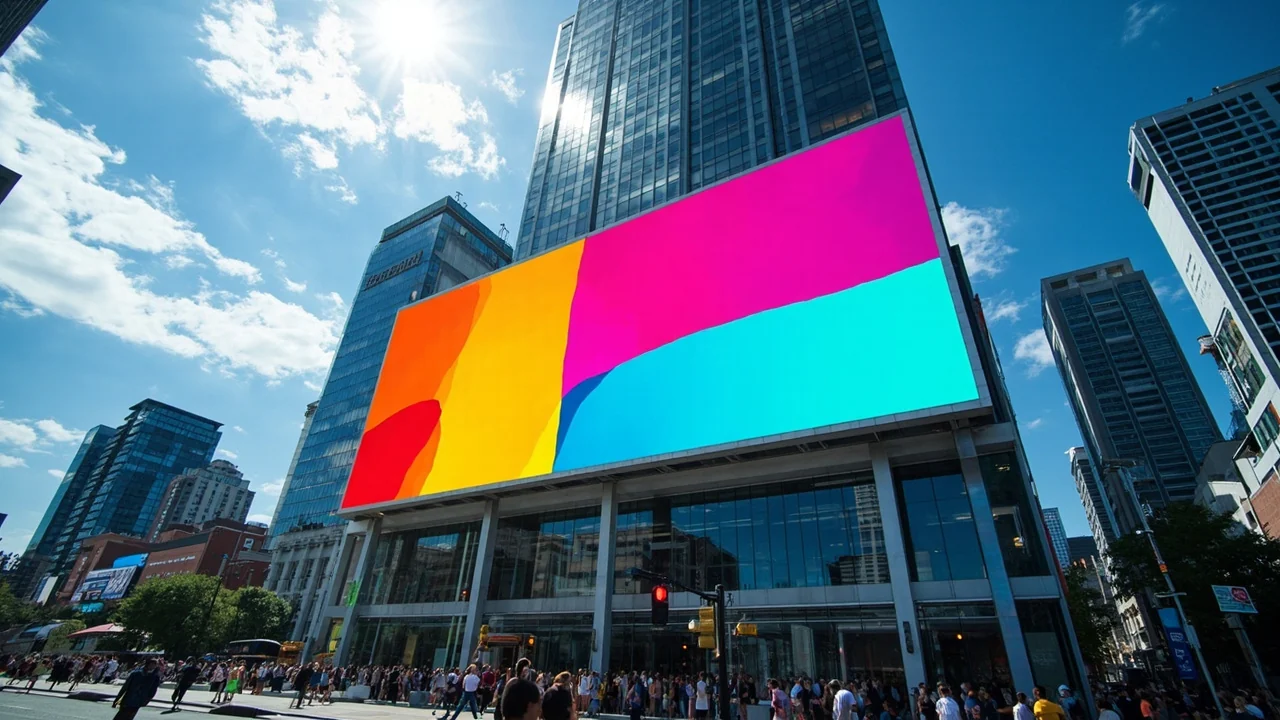
During World Cup 2026, the prominent trend is real-time content updates synchronized with match progression. Instead of a single message repeated all day, screens can switch from pre-match countdowns to in-game cheers, then to congratulatory messages, special offers, store visit invitations, or community content post-match. This makes advertising feel less like an intrusive overlay and more like an integral part of the event's rhythm.
The second difference is location-based targeting. Geo-targeted advertising allows content in shopping malls, transportation hubs, around stadiums, and in fan-zones to be distinct. Even mobile screens, such as those on Uber vehicles, can participate in the communication layer around crowded areas. With the same content production budget, brands can create multiple message variations that follow the viewer's journey, rather than forcing everyone to see a single design.
The third difference is measurement and hourly programming. DOOH enables brands to ask more specific questions: which time slots are busiest, what content is suitable before a match, which areas need brand awareness messages, and which need calls to action. When combined with remote content management, as discussed in the article on remote LED screen management via cloud, outdoor screens become flexible communication infrastructure, not just display assets.

What is the Purpose of the Four Layers of Screen Placements Around World Cup 2026?
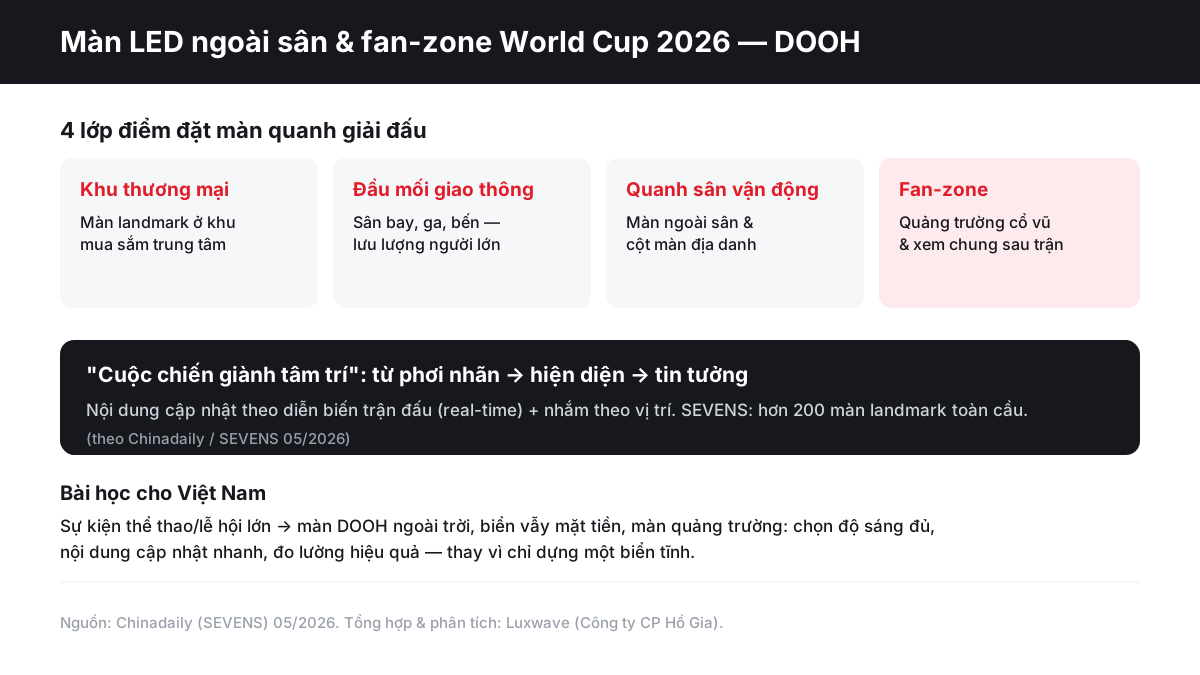
The four layers of screen placements around the tournament include central commercial areas, transportation hubs, areas around stadiums, and fan-zones. These four layers should not be viewed merely as a list of advertising rental locations. Each layer represents a different state of viewer attention: shoppers, commuters, those approaching the stadium, and those immersed in the cheering community. Therefore, content objectives must be distinct.
The first layer is the central commercial area. This is where brands establish urban coverage and build the "city entering the football season" atmosphere. Content in this layer should be easily recognizable from a distance, have a strong repetition rhythm, and prioritize brand imagery aligned with the tournament's vibe. The objective isn't necessarily immediate sales, but to build foundational awareness before viewers encounter the brand at other touchpoints.
The second layer is transportation hubs like airports, train stations, and bus terminals. Viewers here are in transit, with short attention spans but high traffic volume. Messages should be clear, concise, include local cues, and be adaptable to time of day. This layer is suitable for schedule reminders, directions, nearby offers, or guiding viewers to their next experience in the city.
The third layer is the area surrounding stadiums. Here, pre-match emotions are high, but crowd flow is dispersed and hurried. Screens require visually strong content that updates quickly and doesn't demand extensive reading. For sponsorship campaigns, this is the zone for direct brand association with sporting moments. For event organizers, it's where LED screens assist in information coordination, crowd management, and communication safety.
The fourth layer is the fan-zone, i.e., public squares for cheering and post-match viewing. This layer holds the greatest emotional value as viewers don't just pass through; they stay, cheer, record videos, and share. Brand content needs to be more nuanced: scoreboards, cheering moments, congratulations, community interactions, or messages tailored to fan groups. When done correctly, fan-zones transform screens into memory backdrops, not just advertising spaces.
Why are Fan-Zones Where DOOH Shifts from Exposure to Presence?
Fan-zones are where DOOH shifts from exposure to presence because viewers don't just see the brand; they stand in the same space with the brand during moments of high emotion. Exposure is when a brand is presented to passersby. Presence is the feeling that the brand is there, at the right time, sharing moments of victory, disappointment, anticipation, or celebration with the community.
In fan-zones, LED screens shouldn't just play TVCs. They can serve as main screens for communal viewing, secondary screens for information display, interactive screens for the audience, or clusters of screens around dining, check-in, and merchandise areas. When content aligns with the match and the crowd, the brand becomes part of photos, short videos, and attendees' natural conversations. This impact isn't solely measured by playback counts but by the extent to which the brand becomes part of the context.
This is also why the message "recognition to trust" is meaningful. Viewers might have recognized a logo before, but when it consistently appears at well-organized touchpoints—bright, clear, non-intrusive, and matching the mood—perceptions of professionalism increase. For major events, trust isn't built with a slogan; it's built by the brand playing the right role throughout the entire journey.
What Lessons Can Brands and Organizers in Vietnam Learn?
The lesson for Vietnam is that there's no need to wait for a World Cup-scale event to adopt contextual DOOH thinking. Festivals, sporting events, openings, countdowns, shopping weeks, running races, concerts, or local events all share three common elements: crowd flow, concentrated emotion, and timeliness. When these three factors converge, outdoor LED screens can perform far better than static billboards that have been up for a long time.
For retail brands, storefront facade signs can become a touchpoint near the store: changing content based on peak hours, daily promotions, or pedestrian traffic. For shopping malls and public squares, large outdoor screens can schedule content by time slots: awareness during the day, activation in the evening, and community interaction during peak hours. For event organizers, screens are not just for playback but for setting the pace, coordinating information, and keeping the audience engaged in a cohesive experience.
A critical technical prerequisite is sufficient outdoor brightness. A screen that looks great in a showroom can fail if washed out by sunlight, while a screen that's too bright at night can cause glare and be off-putting. Therefore, screen placement must be matched with factors like those discussed in the article how many nits are enough for LED screen brightness, sun direction, viewing distance, and content density. Screens should not be purchased solely by area; they must be bought based on display function.
Operational conditions are equally important. If event content needs rapid updates but the file change process is slow, the DOOH advantage is lost. Control systems and video processors, such as the NovaStar VX1000, must be selected based on the number of screens, resolution, signal sources, and actual operational needs. For multi-location campaigns, centralized content management reduces errors and maintains message consistency across storefronts, billboards, public squares, and points of sale.
In Which Capacity Should Luxwave Be Considered a DOOH LED Screen Partner?
Luxwave should be considered a solutions partner for site surveys, configuration, control system integration, and content operation, not just a vendor quoting prices per square meter. For outdoor DOOH, the same screen area placed on a facade, in a public square, or on a traffic artery requires different brightness, pitch, structure, and control systems. A single incorrect parameter can render a campaign ineffective throughout its entire lifecycle.
As a premium LED screen brand under Ho Gia JSC, the official distributor of BOE, NovaStar, and Muxwave in Vietnam, Luxwave excels at connecting display hardware with control systems and operational challenges. With outdoor screen lines like BOE BYB for outdoor applications and NovaStar processing systems for signal control, the project team can advise on configurations based on viewing distance, sun exposure, content resolution, and campaign update needs.
A successful DOOH project should begin with a touchpoint map. Identify which layer creates awareness, which triggers action, and which sustains post-event emotions. Only then should screen size, pixel pitch, brightness, structure, power supply, control, and content schedule be determined. This approach helps brands avoid the trap of "buying the largest screen possible" without a content deployment strategy. For events in Vietnam, a smaller screen placed correctly and updated with timely content often provides more value than a large screen running a single advertisement all day.
Conclusion: What Principles Emerge from the DOOH World Cup 2026?
DOOH around World Cup 2026 leaves a clear principle: outdoor LED screens are effective when they transform location into context and context into brand presence. SEVENS speaks of a network of over 200 landmark screens and scenarios covering outdoor, home viewing, and fan-zones (according to SEVENS); the takeaway is the mindset of covering the entire journey, not just chasing screen quantity.
For brands and organizers in Vietnam, the first question should not be "how many square meters of screen" but "what is the viewer's state of mind when they see the screen." If they are moving, content must be brief. If they are waiting, content can be more explanatory. If they are cheering, content must align with the emotion. Answering these questions allows outdoor DOOH LED screens, storefront facade signs, and public square screens to become rhythmic, measurable communication infrastructure capable of building trust.
Luxwave can assist from site survey, brightness selection, pixel pitch choice, BOE/NovaStar configuration, to designing content update workflows for outdoor campaigns. World Cup 2026 is a global example, but the lessons are immediately applicable in Vietnam: right place, right time, right emotion, right technical specifications. When these four elements align, DOOH transcends being just an advertising display; it becomes how a brand is present in moments when viewers are truly paying attention.
Pitfalls
Common mistakes
- Viewing DOOH as merely brighter billboards, missing its true value in changing content based on matches, time slots, and viewer location
- Placing screens in crowded areas without clear objectives for each touchpoint layer—shopping malls, transportation hubs, stadium vicinities, and fan-zones require different messages
- Using outdoor screens with insufficient brightness or manual content management—campaigns lose rhythm precisely when traffic and emotions peak
- Measuring effectiveness solely by playback counts—should be cross-referenced with time slots, locations, content, QR scans, and sales feedback to understand true impact
FAQ
Frequently asked questions
How does DOOH at World Cup 2026 fan-zones differ from regular billboards?
DOOH at fan-zones doesn't just play fixed advertisements; it adapts to the crowd's mood, match schedules, and emotional moments. Screens can change content based on pre-match, mid-match, or post-match timing, or according to the team being cheered. While regular billboards primarily build recognition, event-based DOOH creates a sense of brand presence within the shared experience.
How should the four layers of screen placements around the tournament be understood?
The four layers include central commercial areas, transportation hubs, areas around stadiums, and fan-zones. Each layer serves a distinct purpose: establishing urban awareness, capturing commuter traffic, activating pre-game excitement, and extending post-match emotions. A successful campaign does not use a single content strategy for all placement points.
What can Vietnamese brands learn from World Cup 2026?
The key lesson is to plan screen deployment contextually, not just rent prime locations. For festivals, sports events, openings, or urban events in Vietnam, outdoor DOOH screens, storefront facade signs, and public square screens can be used to change content by the hour, measure responses, and maintain communication rhythm at crowded points.
What parameters should be prioritized for outdoor DOOH LED screens?
Prioritized parameters include sufficient outdoor brightness, weather resistance, pixel pitch suitable for viewing distance, and a stable control system. Screens placed in public squares or on facades must be clearly visible during the day, not overly glaring at night, and have a rapid content update process to prevent campaign delays.
Why is real-time content updating important?
Sports events generate emotions that evolve moment by moment: anticipation before the match, tension during, and celebration or disappointment after. Real-time content allows brands to speak to the viewers' current state. When messages align with the context, advertising is more likely to be remembered as part of the experience.
What support does Luxwave offer for outdoor DOOH campaigns?
Luxwave can provide consultation on configuring LED advertising screens, storefront facade signs, and control systems suitable for various installation locations. As a premium LED screen brand under Ho Gia JSC, the official distributor of BOE, NovaStar, and Muxwave in Vietnam, Luxwave focuses on site surveys, configuration, and practical content operation.
References