

What Standards Does the World Cup 2026 Set for Stadium LED Displays?
The World Cup 2026 will be a rigorous test for sports display infrastructure, with the tournament hosted across three countries—the USA, Canada, and Mexico—spanning 16 cities, featuring 48 teams and 104 matches over 39 days. Given this high density of matches and broadcasting scale, stadium LED displays are more than just advertising equipment; they become integral to the spectator experience, match operations, live broadcasting, and commercial sponsorships.
A modern stadium typically requires at least four distinct types of displays. The main or center/main display is used for scores, replays, match graphics, and audience announcements. Perimeter displays, located close to the field, primarily serve sponsors and broadcasters. Ribbon displays run along spectator tiers to create continuous content loops. Outdoor screens are situated in fan zones, entrances, or commercial areas for crowd guidance and event content.
The difference between these display types lies not just in being "outdoor LED screens" but in their operational risks. Main displays need large sizes and stable images for distant viewers. Ribbon displays require synchronized, long-form content and wide viewing angles. Outdoor screens endure weather like billboards. Perimeter displays, however, must be positioned directly adjacent to the field, appear constantly on camera, and risk player collisions. Consequently, they present the greatest challenge in selecting the correct configuration.
Why is the Perimeter Display the Most Challenging Type in a Stadium?
Perimeter displays are more demanding than outdoor billboards because they must simultaneously meet three objectives that often pull specifications in different directions: sufficient brightness to overcome sunlight and floodlights, image clarity for broadcast cameras, and safety to prevent serious injury to players in collisions. A display mounted on a building facade only needs to be clearly visible to passersby. A stadium perimeter display, however, must cater to the human eye, camera lenses, video referees, sponsors, and sports medical staff within a single system.
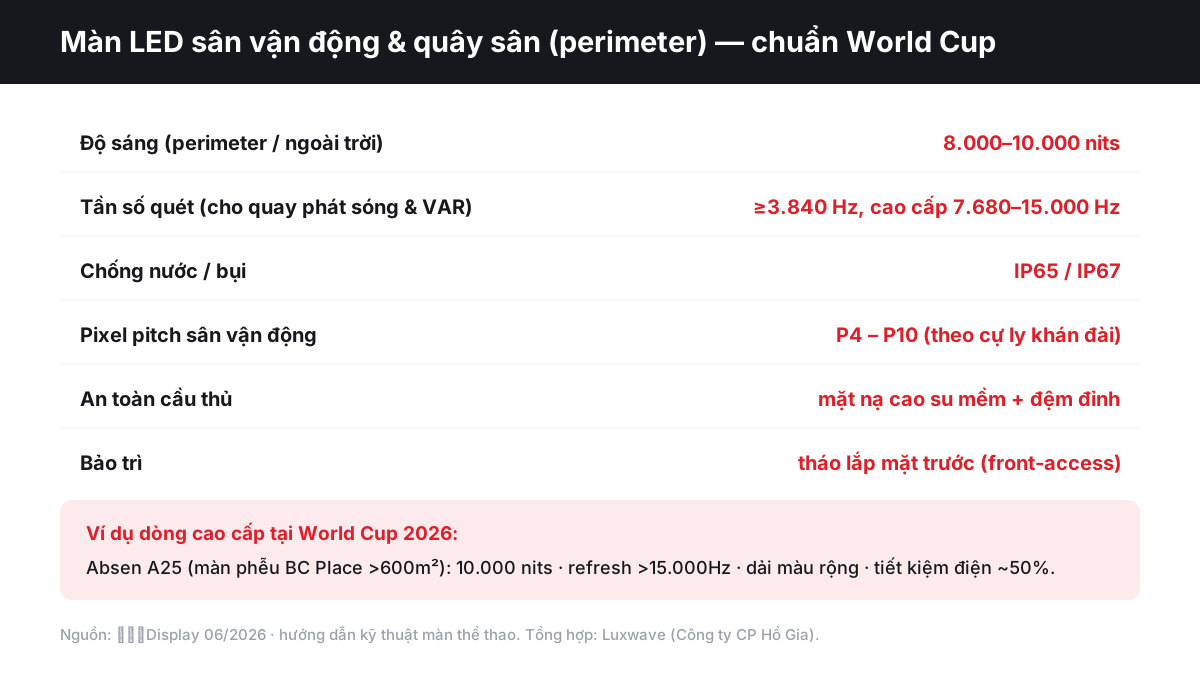
In terms of visual performance, perimeter displays typically require brightness levels of 8,000–10,000 nits. This is significantly higher than most indoor applications and at the demanding end of outdoor specifications, as the screens must contend with bright daylight, luminous grass, reflective team jerseys, and powerful evening floodlights. When sponsor content scrolls continuously, insufficient nits can cause logos to be obscured on camera, while excessive brightness at night can glare at spectators if the control system doesn't adjust it contextually.
Structurally, perimeter displays require soft rubber masks and padded tops, often referred to as pillowcases or cushions. These are not mere decorative elements. When a player slides near the boundary line, the initial point of contact might be the top edge or the front of the cabinet. The soft rubber layer helps absorb impact forces, while the top padding prevents hard edges from directly contacting a person. This protective layer also reduces the risk of LED bulbs breaking upon impact.
For maintenance, stadiums have limited downtime for removing entire cabinet rows from the rear. A front-access design allows technicians to remove modules, power supplies, or cards from the front, enabling quick repairs during operational intervals. For tournaments with multiple matches or extended events, front-access maintenance is not a convenience but a necessity for maintaining system stability when the space behind the screen is restricted by pitch-side areas, technical barriers, or broadcasting equipment.

How Does High Refresh Rate Ensure Clear Images for Cameras and VAR?
The refresh rate of an LED display is the number of times the pixel status is updated per second. While the human eye may perceive the screen as stable, cameras scan images based on their own shutter speeds, frame rates, and algorithms. When the display's refresh rate is out of sync with the camera's recording rhythm, the video may exhibit banding, horizontal lines, flickering, or uneven brightness zones. In sports, these issues are often magnified because cameras frequently pan rapidly, zoom intensely, and utilize slow-motion playback.
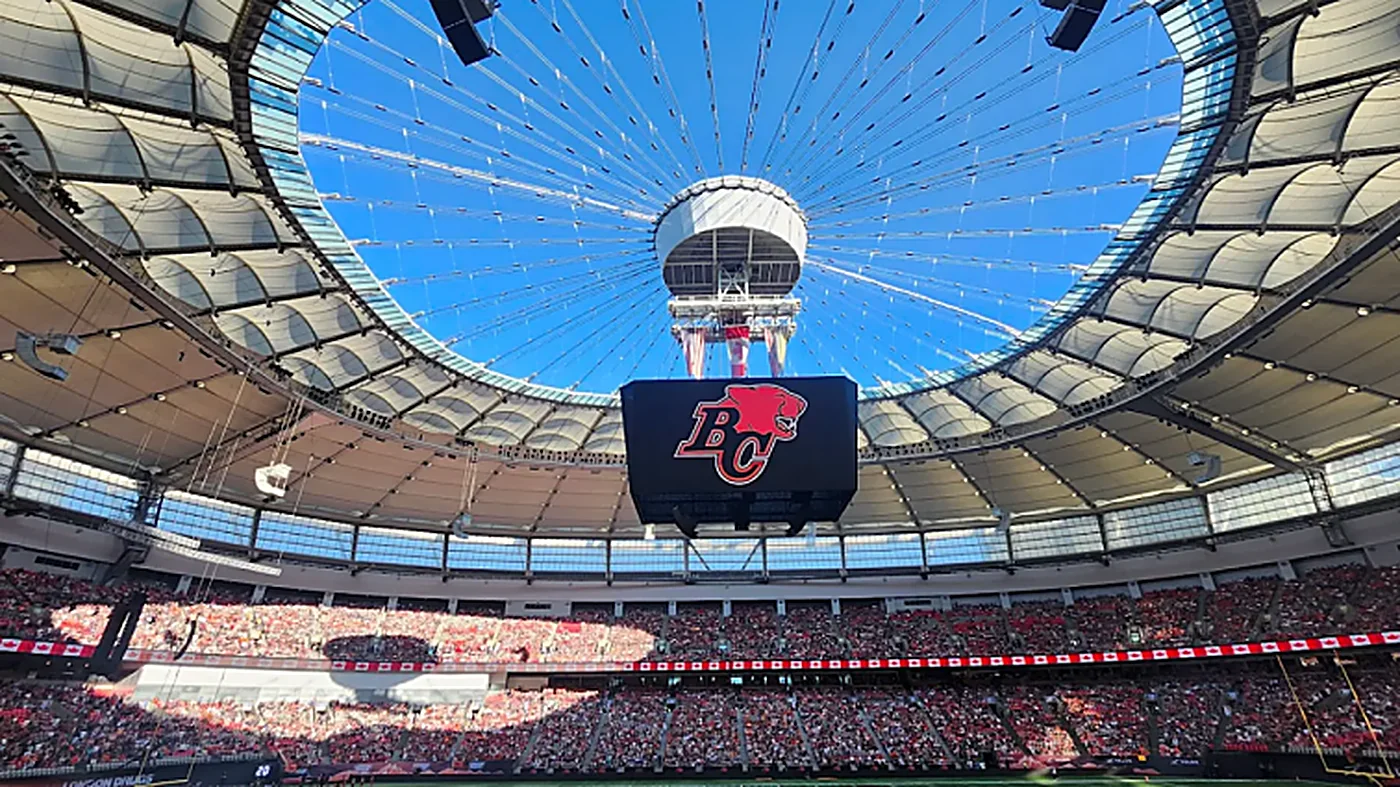
!Funnel LED display at BC Place Vancouver serving World Cup 2026 *The over 600m² funnel display at BC Place Vancouver uses the Absen A25 series. (Photo: 行家说Display)*
The commonly cited minimum threshold for stadium displays is around 3,840 Hz. For high-end systems, 7,680 Hz or higher provides a better margin for various camera types, especially for international broadcasts that must accommodate multiple recording standards and camera angles. Some products can achieve refresh rates exceeding 15,000 Hz. The article LED Refresh Rate 3840Hz and Camera Shooting explains in more detail why this seemingly technical figure directly impacts broadcast quality.
VAR (Video Assistant Referee) further emphasizes this requirement. When the video referee reviews an incident, the image must be clear for viewers to focus on the ball's trajectory, players' feet, the goal line, or contact points. If the perimeter display behind the action shows lines or flickers during a replay, it may not necessarily lead to an incorrect decision, but it creates visual noise and diminishes the professional quality of the broadcast signal. For sports sponsorships, logos exhibiting banding on camera also represent a loss of display value, even if they appear normal to spectators off-field.
A notable example for the World Cup 2026 is the over 600m² funnel display at BC Place in Vancouver, utilizing the Absen A25 series. According to 行家说Display, this display system boasts 10,000 nits brightness, a refresh rate over 15,000 Hz, a wide color gamut, and approximately 50% energy savings compared to traditional solutions. While this is an in-stadium funnel display and not a definitive statement for all tournament perimeter screens, it indicates a trend toward higher standards: high brightness, very high refresh rates, and energy efficiency simultaneously.
What Should Be the Standards for Water Resistance, Pixel Pitch, and Maintenance?
The baseline specifications for stadium LED displays must consider the environment: outdoors, dusty, high humidity, rain exposure, vibrations, hot floodlights, and extended operational schedules. Therefore, IP65 to IP67 is a reasonable range for technical requirements, depending on the installation location and exposure level. IEC 60529 is the reference standard for IP protection ratings, while the article IP Rating LED Outdoor IP65, IP66, IP67 helps interpret these ratings in the context of LED displays.
Common pixel pitches for stadiums range from P4 to P10, but selection should not be based on the assumption that "smaller pitch equals higher quality." Perimeter and ribbon displays, viewed at close range and displaying sponsor logos, team names, or scrolling graphics, typically require smaller pitches within this range. Large main displays for distant stands can use larger pitches while remaining clear, provided the nearest seating distance is accurately calculated. For domestic stadiums, calculating actual spectator distances is more crucial than replicating configurations from international venues.
Brightness must also be considered within the complete picture. Perimeter and stadium outdoor displays require 8,000–10,000 nits, but optimal operation doesn't mean running at full brightness constantly. The control system should allow for adjustments based on time of day, content, and ambient lighting conditions to prevent nighttime glare, reduce power consumption, and extend lifespan. Refer to the article How Much LED Screen Brightness (Nits) is Enough? before finalizing specifications based on a single number.
Front-access maintenance should be explicitly included in technical specifications. Stadiums often have cable runs, cameras, auxiliary signage, soft barriers, and operational personnel around the display areas. If rear access is required for every minor issue, repair times will be extended and could disrupt match schedules. For perimeter screens, front-module removal capability allows for quicker inspection of LED bulbs, power supplies, receiving cards, and signal cables, especially when only a few hours are available between rehearsals, matches, or rented events.
What Are the Lessons for Vietnamese Sports Projects?
The most significant lesson for football stadiums, indoor arenas, and sports events in Vietnam is to avoid using standard outdoor advertising screens as perimeter solutions placed close to the field. Billboard screens might offer sufficient brightness and water resistance but often lack collision-safe designs, top padding, camera optimization, and adequate refresh rates for broadcasting. For stadiums with live streaming, television broadcasts, or internal replays, the gap between "visible" and "meeting sports standards" is substantial.
A practical set of criteria should begin with the display's location. For main stadium screens viewed by spectators, prioritize size, pitch based on seating distance, and replay capabilities. For perimeter displays, mandatory requirements should include player safety, soft rubber masks, top padding, high refresh rates, and front-access maintenance. For ribbon displays, focus on long-form content synchronization, viewing angles, and color uniformity. For outdoor screens, revert to the familiar outdoor challenge: nits, IP rating, structural integrity, sun orientation, and operational control.
For projects involving video production, NovaStar VX1000 or equivalent processing systems should be considered integral components, not afterthoughts. The controller dictates signal reception, image scaling, synchronization, color calibration, and brightness control. Luxwave is an authorized distributor of NovaStar in Vietnam and also provides BOE LED solutions for outdoor applications, such as the BOE BYB Plus P4.4. This highlights domestic project capabilities and does not imply Luxwave's involvement in the World Cup.
Vietnamese stadiums also face unique conditions: hot and humid climates, seasonal heavy rainfall, and many venues with limited space behind the screens. Therefore, IP65–IP67 ratings, front-access, and compact cable design should be decided from the outset rather than as add-ons. If a stadium requires content production capabilities similar to a studio, control room, or commentary area, experience from broadcast studios should be incorporated to ensure synchronization of color, refresh rate, and signals between indoor and outdoor displays.
Conclusion: What Standard Should Be Applied to Sports LED Displays?
Sports LED displays should be procured based on stadium operational standards, not standard advertising signage criteria. For perimeter displays, a suitable configuration must simultaneously cover 8,000–10,000 nits brightness, a minimum refresh rate of approximately 3,840 Hz (preferably 7,680 Hz or higher), IP65–IP67 protection, front-access maintenance, soft rubber masks, and top padding. Omitting any of these elements may result in a system that is bright but not necessarily safe, clear, or durable for a demanding match schedule.
Luxwave, a premium LED display brand under Ho Gia JSC, can support domestic stadium projects with site surveys, pitch selection (P4–P10 based on spectator distance), brightness settings tailored to the environment, NovaStar control system design, and guidance on suitable BOE LED series. The correct approach is to clearly differentiate main displays, perimeter screens, ribbon displays, and outdoor screens from the beginning, then set specifications according to each area's role rather than using a single configuration for the entire venue.
Pitfalls
Common mistakes
- Using standard outdoor advertising screens for perimeter areas—lacking soft rubber masks, top padding, and designed for high-speed player collisions.
- Selecting low refresh rates because they appear stable to the naked eye—leading to horizontal lines, flickering, and uneven brightness zones on camera, during slow-motion, or VAR replays.
- Focusing solely on brightness while neglecting IP rating, front-access, and maintenance design—leading to difficult-to-resolve issues during prolonged operation in rain, dust, under floodlights, and with tight schedules.
- Choosing pixel pitches that are too small or too large without measuring spectator distances—resulting in unnecessary cost increases or pixelated scores, sponsor logos, and replays for nearby seats.
FAQ
Frequently asked questions
What brightness level is required for World Cup 2026 stadium LED displays?
Outdoor stadium areas and perimeter displays typically require 8,000–10,000 nits to combat strong sunlight, powerful floodlights, and the high reflectivity of the field. This brightness ensures that advertising content, scores, and graphics remain legible in challenging lighting conditions, especially when stable images are needed for broadcast cameras.
Why do perimeter displays need a minimum refresh rate of approximately 3,840 Hz?
A refresh rate of around 3,840 Hz is a practical threshold for reducing lines, flickering, and banding when cameras scan LED displays. For sports broadcasting, particularly slow-motion and VAR replays, higher-end rates of 7,680 Hz and above offer a better safety margin as cameras capture more frames than the human eye perceives.
What is the purpose of the soft rubber mask on perimeter stadium screens?
The soft rubber mask helps absorb impact forces when players slide, fall, or collide with the screen at high speeds. This structure also protects the LED bulbs from breaking upon direct impact from people, balls, or equipment. Therefore, sports perimeter displays differ from standard outdoor advertising screens in their mechanical safety requirements.
What pixel pitch should stadium LED displays use?
The common range for stadiums is P4–P10, depending on spectator distance, screen size, and displayed content. Seats closer to the display, ribbon screens, or perimeter displays require smaller pitches for clear sponsor logos and match information; larger screens viewed from a distance can use larger pitches to optimize costs.
How do IP65, IP66, and IP67 ratings differ for stadium LED displays?
According to the IEC 60529 IP system, ratings from IP65 to IP67 all aim for dust and water protection but withstand different conditions. For stadiums, IP65 provides a baseline for outdoor use, while IP66 or IP67 is more suitable for direct rain exposure, cleaning, high humidity, or extended operation during major events.
Does Luxwave supply LED displays for the World Cup 2026?
This article analyzes technical specifications and lessons learned from the World Cup 2026; it does not confirm Luxwave's supply for the tournament. In Vietnam, Luxwave, part of Ho Gia JSC, is an authorized distributor of BOE, NovaStar, and Muxwave for domestic LED projects, including stadium and sports applications.
References