

What is Naked-Eye 3D LED Display?
A naked-eye 3D LED display, or naked-eye 3D, is an LED screen that allows viewers to perceive volumetric, depth-filled images with the naked eye, without needing any 3D glasses. Unlike 3D cinemas that use polarized glasses, the illusion of depth here is created by custom-designed content for a fixed viewing angle, combined with the screen's installation method. This is a content presentation technique on LED panels, not a separate type of LED panel.
!Naked-eye 3D LED display at a building corner in a plaza
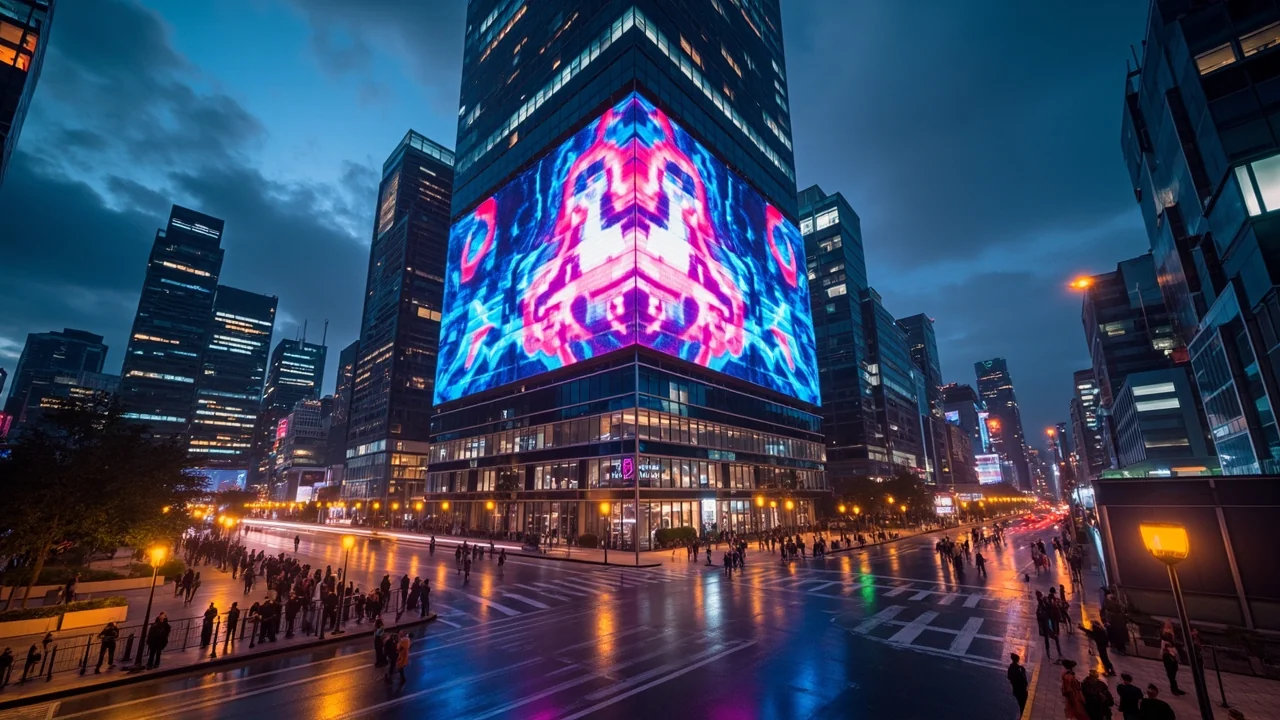
What needs to be understood from the outset is that there are three distinct layers. The hardware layer consists of the LED panels and the controller — typically outdoor panels with a large pixel pitch and high brightness. The installation layer is the screen structure, most commonly wrapping around a building corner. The content layer is the intentionally designed video to trick the viewer's perception. The "3D" effect only appears when all three layers align, so you cannot simply buy "a 3D LED panel" and expect depth immediately.
How Does a Naked-Eye 3D LED Display Create a Volumetric Effect?
The volumetric effect comes from perspective calculated for a fixed viewing point, known as the sweet spot. The creative team designs the 3D video, distorting the image according to the screen's dimensions and curvature, so that when a person stands at the designed viewing point and looks up, the screen edges and the simulated depth trick the brain into perceiving objects extending out of the frame. The human eye naturally infers depth from perspective and occlusion, so when these signals are skillfully arranged, we "see" 3D even though the surface remains flat.
In other words, the technology lies in the content, not the pixels. With the same LED panel, if it displays normal flat video, it's just a regular billboard; if it displays 3D content designed with the correct perspective, it appears "volumetric." Because it relies on a specific viewing point, the effect is strongest within a certain viewing area and diminishes as the viewer moves off-center or too close — this is an inherent limitation of this technique.
Why Are 3D LED Screens Often Installed at Building Corners or as Curved Screens?
Naked-eye 3D LED screens are often installed wrapping around building corners because the 90-degree fold itself acts as a "prop" to create depth. When content is designed for this folded structure, the seam between the two screen faces becomes the edge of a virtual space, making objects appear to emerge from or recede into the actual corner. A single flat surface can also achieve 3D, but a curved corner provides a much stronger and more natural illusion, making it a classic composition for this genre.
!Curved outdoor LED advertising screen wrapping a building corner, with a seamless surface
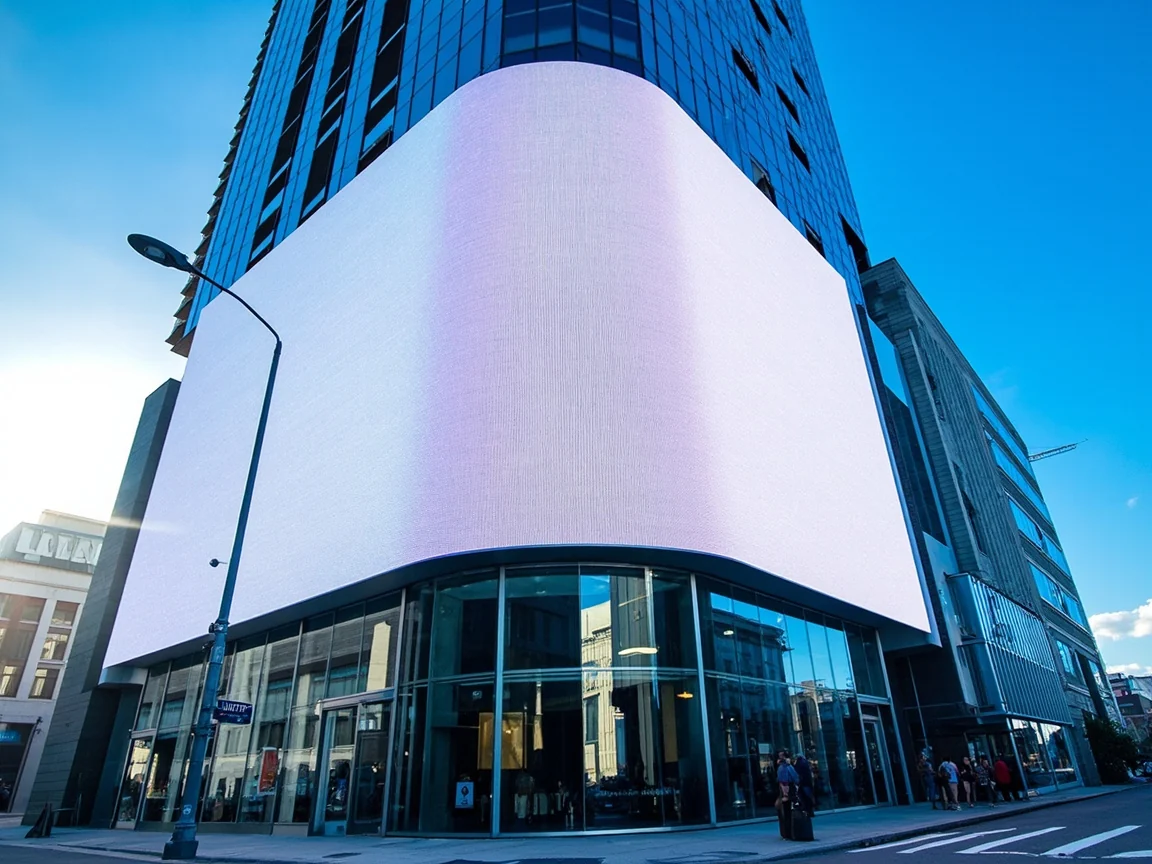
The building corner composition also fits well within urban contexts: it's located on traffic routes, visible from plazas or intersections, and has a primary approach direction for placing the sweet spot. This is why many naked-eye 3D projects appear in large commercial squares. In terms of solutions, this is closely related to building facade LED screens and shopfront fascia signs — both utilize architectural surfaces for display, differing mainly in the degree of perspective rendering.
What Parameters Are Needed for Naked-Eye 3D LED Screens (Pixel Pitch, Brightness, Refresh Rate)?
Since most 3D screens are installed outdoors, they use the parameter range of outdoor advertising: pixel pitch around P6–P20 and brightness from 5,000 nits upwards, according to industry application reference tables. For screens directly exposed to sunlight, even higher brightness is needed — potentially up to around 10,000 nits, a level that outdoor series like BOE BYB can achieve in peak mode (as announced by BOE at InfoComm 2025). Selecting the correct pitch and nits for the environment is crucial for the 3D effect to maintain contrast and depth during the day.
Pixel pitch should align with the actual viewing distance. According to common reference rules, the minimum viewing distance in meters is approximately equal to the pixel pitch value in millimeters — for example, P6 provides a smooth image from about 6 meters away. Outdoor screens are often viewed from tens of meters, so a larger pitch is still sufficiently smooth and cost-effective; details on balancing this can be found in the article How to Choose LED Pixel Pitch 2026. The brightness threshold for different environments is analyzed in detail in the article How Many Nits Are Enough for LED Screen Brightness.
Regarding control, a high refresh rate and good signal synchronization ensure smooth 3D video playback and excellent camera capture for viral clips — a common goal for many campaigns. This aspect is handled by the processor: according to NovaStar, a company that makes controllers and video processors rather than LED panels or modules, the signal chain goes from the sending card via Ethernet or fiber optic cable to the receiving card in the cabinet and then to the LED modules (NovaStar announcement).
Do Naked-Eye 3D LED Screens Use Special or Standard LED Panels?
Naked-eye 3D LED screens use standard LED panels, not a separate "3D" panel line. This is the most common misconception: many people assume a module capable of creating depth must be purchased, whereas in reality, the hardware is identical to regular outdoor advertising screens. What creates the 3D effect is content designed with perspective and an installation layout that wraps around a corner, not the chip itself or the LED packaging method.
It's also important to distinguish naked-eye 3D from packaging technology concepts. COB or SMD refers to how LED chips are mounted on a substrate — they determine surface smoothness and durability, not whether the screen appears "volumetric"; a clear distinction between these two packaging methods can be found in the article COB vs. SMD Comparison 2026. A large-pitch outdoor 3D screen typically uses outdoor SMD, but this is a choice based on environment and cost, completely independent of the 3D effect.
Where Are Naked-Eye 3D LED Screens Applied, and What Are the Market Trends?
The most prominent application is high-end outdoor advertising in commercial plazas, central intersections, and on the facades of large buildings — where a captivating 3D clip can easily go viral on social media. This is the choice for brands wanting to differentiate themselves from traditional flat billboards. In terms of layout, it falls under the category of Outdoor DOOH and Billboard Advertising Solutions, but is enhanced with a layer of perspective-rendered content.
According to research from 行家说 (hangjianet.com, research unverified), a 1,300m² naked-eye 3D screen in Changzhou (China) was described as using 2727 LED chips, meaning a pixel pitch of approximately 2.7mm, and the article references earlier famous 3D screens in Chengdu in 2021 and Zhengzhou in 2023. These figures come from industry sources and should be understood as market references for scale, not parameters independently verified by Luxwave.
Also according to 行家说 (research unverified), Lianjian Optoelectronics (联建光电) participated in the WOO 2026 outdoor advertising conference in London to introduce their naked-eye 3D screen solution and is reported to have deployed over 100 3D screen blocks with a total area exceeding 40,000 m². The overall picture suggests that naked-eye 3D is a noteworthy investment direction for the global outdoor advertising industry, although specific figures need verification before commercial use.
What Should Be Considered for Content and Cost When Deploying Naked-Eye 3D LED Screens?
When deploying, clearly separate the two investment components. Hardware — LED panels, corner-wrapping frame structure, controller — is a one-time cost, depending on the area, pixel pitch, brightness, and complexity of the curved frame. The 3D content is a recurring creative cost for each campaign, as each video must be individually rendered for the specific viewing point and screen curvature. Overlooking the second component is a common mistake that leads to a 3D screen displaying flat content after installation, losing its unique value.
Technically, the two factors determining success or failure are the designed viewing point and the ambient brightness. The sweet spot must be chosen based on pedestrian flow and the primary approach direction; if placed incorrectly, most viewers will be off-center and won't see the effect. Brightness must be sufficient to prevent the image from being washed out by sunlight during the day, as reduced contrast also weakens the sense of depth. Both require on-site surveys rather than applying general figures.
As a brand under Ho Gia Company, the official distributor for BOE, NovaStar, and Muxwave, Luxwave approaches naked-eye 3D screens as a system problem: selecting outdoor panels with the correct pitch and brightness range, pairing them with a NovaStar processor with sufficient bandwidth for multi-cabinet curved frames, and collaborating with the content creation team to finalize the viewing point from the initial survey stage. This approach avoids the situation where the correct hardware is purchased, but the 3D effect fails due to mismatched content and installation location.
Conclusion: How Should Naked-Eye 3D LED Screens Be Understood Before Investing?
Remember that a naked-eye 3D LED screen is not a magical type of LED panel, but a combination of three layers: standard outdoor LED panels with the correct pitch and brightness, an installation structure wrapping around a building corner, and custom-designed content for a fixed viewing point. Omitting any layer will result in an incomplete volumetric effect. If you are considering an investment, start by identifying the location, viewer flow, and primary viewing point, then select the hardware configuration and plan for recurring content budget. This is how an outdoor 3D screen can be visually impressive and maintain long-term advertising value, rather than just being a one-time sensation that becomes an expensive flat billboard.
Pitfalls
Common mistakes
- Mistaking naked-eye 3D LED screens for a special type of LED panel — in reality, they use standard LED panels, with the effect derived from the content design and installation location.
- Ignoring the designed viewing point (sweet spot) — standing off-center from the intended viewpoint causes the volumetric illusion to weaken or disappear.
- Choosing a pixel pitch inappropriate for the viewing distance — outdoor screens viewed from afar with too small a pitch are wasteful, while too large a pitch appears pixelated at the actual viewing distance.
- Underestimating the brightness needed for outdoor environments — screens exposed to sunlight require significantly higher brightness than indoor ones; insufficient nits result in washed-out images during the day and a weakened 3D effect.
- Forgetting the content budget — the creation of 3D videos for specific viewpoints is a recurring creative service, not a one-time cost like the hardware.
FAQ
Frequently asked questions
Do naked-eye 3D LED screens require 3D glasses?
No. The appeal of naked-eye 3D lies in the "naked-eye" aspect — the natural eye. Passersby looking up at the screen immediately see objects appearing to emerge from the frame, without needing polarized or shutter glasses. In return, the sense of depth is only complete when standing within the designed viewing area for the content, rather than from all angles.
Is a naked-eye 3D LED screen a special type of LED panel?
Not exactly. The hardware remains standard LED panels and controllers, typically outdoor types with large pixel pitch and high brightness. What creates the 3D effect is custom-designed content for a specific viewing angle, along with an installation method that wraps around a building corner. In other words, naked-eye 3D is a presentation method, not a separate hardware product line.
Why is the 3D effect only clear when standing at specific positions?
Because the 3D content is designed for a fixed viewing point, known as the sweet spot. The image is intentionally distorted so that when viewed from that point, the curved screen edges and perspective trick the brain into perceiving depth. Standing too far off to the side or too close disrupts the perspective, causing the volumetric illusion to weaken or disappear.
What pixel pitch and brightness are needed for naked-eye 3D LED screens?
Since most 3D screens are installed outdoors, they use the parameter range of outdoor advertising: pixel pitch around P6–P20 and brightness from 5,000 nits upwards, according to industry reference tables. Screens directly exposed to sunlight require even higher brightness, potentially up to around 10,000 nits. Specific figures depend on viewing distance and sun exposure, necessitating a site survey.
How is content for naked-eye 3D LED screens created?
Creative teams use graphic software to design 3D videos, calculating perspective according to the screen's dimensions, curvature, and the viewing point of passersby. They simulate the screen edges wrapping a building corner and then render the image so that objects appear to extend beyond the frame. This is a custom creative service, updated periodically, not a pre-set parameter of the LED panel.
Can naked-eye 3D LED screens be installed indoors?
Yes, the principle can be applied to large lobbies, showrooms, or shopping malls if there is a corner or curved screen and a primary viewing point. The difference is that indoor installations use smaller pixel pitches and lower brightness than outdoor ones because viewers are closer and ambient light is less intense. The key factors remain the viewing point and correctly rendered perspective content.
What factors influence the cost of creating a naked-eye 3D LED screen?
There are two cost categories. Hardware costs depend on screen area, pixel pitch, brightness, the corner-wrapping frame structure, and the controller — smaller pitch and higher brightness increase the cost per square meter. The 3D content is a recurring creative cost for each campaign. The price per square meter in Vietnam varies by configuration, so project-specific quotes are necessary.
References
- 1.ManufacturerRecommended Pixel Pitch & Brightness by Application (Industry Reference Table)
- 2.ManufacturerBOE — BYB outdoor brightness range at InfoComm 2025 (up to 10,000 nits peak)
- 3.ManufacturerNovaStar — Controllers & Video Processors for LED Screens
- 4.Research行家说 (hangjianet.com) — 1,300m² Changzhou naked-eye 3D screen using 2727 LED chips
- 5.Research行家说 (hangjianet.com) — Lianjian Optoelectronics at WOO 2026, naked-eye 3D screen solution