

What is an LED Sphere Display and Why is it Called a Freeform Display?
An LED sphere display is an LED screen system arranged on the surface of a sphere, hemisphere, or dome, rather than a flat rectangular surface. In Chinese, common terms include 球幕 or LED dome/sphere; in Vietnam, it may be called a màn cầu LED, màn hình LED hình cầu, or vòm LED depending on the actual shape. This is an important branch of freeform LED displays, where the geometry of the structure is as critical as the pixel pitch specifications.
!Map of typical LED sphere and dome projects worldwide
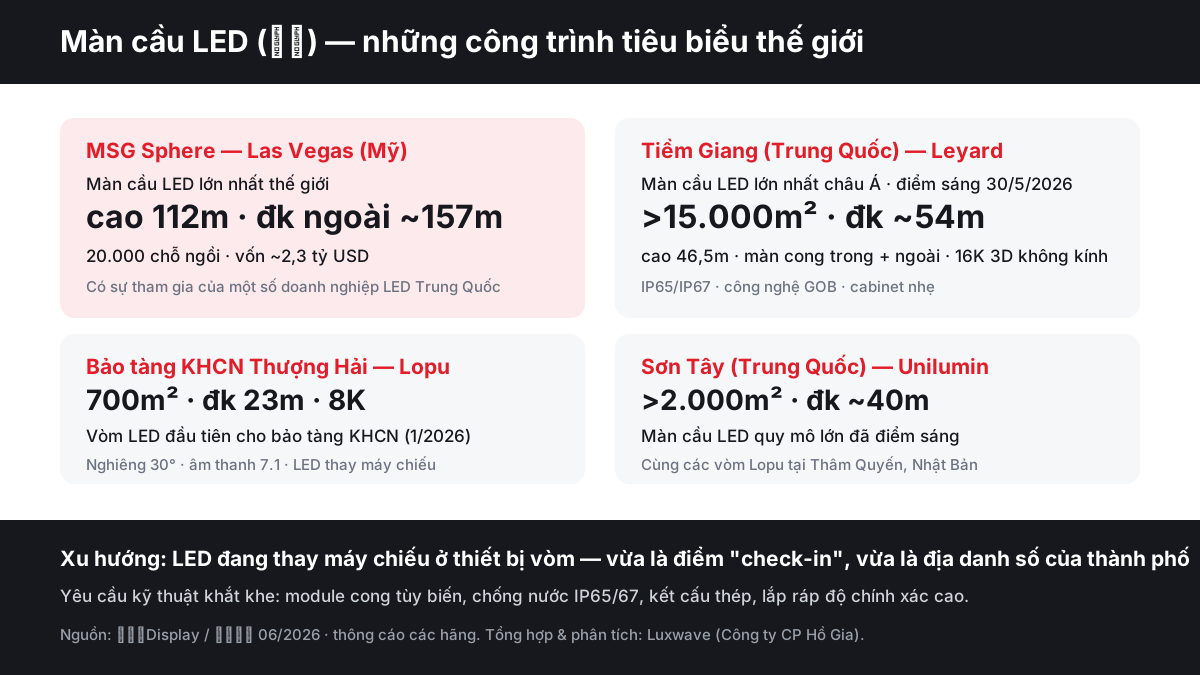
The biggest difference lies in the viewer experience: instead of looking at a flat surface, viewers step into or stand before a form that envelops their vision. When the content is properly produced, a sphere display can evoke feelings of planets, oceans, space data, light explosions, or glasses-free 3D LED displays with profound depth. Therefore, an LED sphere serves as both a display device and a communication architecture. A sufficiently large project can become a "city business card," a visual identity for the metropolis.
Within the freeform display category, LED spheres present a difficult challenge because every point on the surface has a unique coordinate. LED modules cannot be installed like tiles on a flat wall; each curved section must be divided, positioned, numbered, and mapped with content according to specific longitude, latitude, or a custom technical grid. For outdoor projects, challenges also include load capacity, wind, rain, corrosion resistance, and maintenance. This is why LED sphere displays are typically found in cultural, tourism, museum, experience center projects, or iconic structures with substantial budgets.

Why is Installing an LED Sphere Display More Difficult Than a Flat Screen?
Flat LED screens face challenges in uniformity, color, power, and signal; LED sphere displays add geometric complexity. A flat cabinet can be joined row by row, column by column, whereas a sphere display requires forming many small curved segments to cover a true radius. If custom curved modules are used, the manufacturer must control the position of each pixel so that when assembled, the seams are not gapped, broken, or distorted. A small, repeated error on the spherical surface can magnify into a noticeable line when displaying motion content.
!Outdoor LED sphere under construction on a large steel grid frame *(Photo: 行家说Display)*
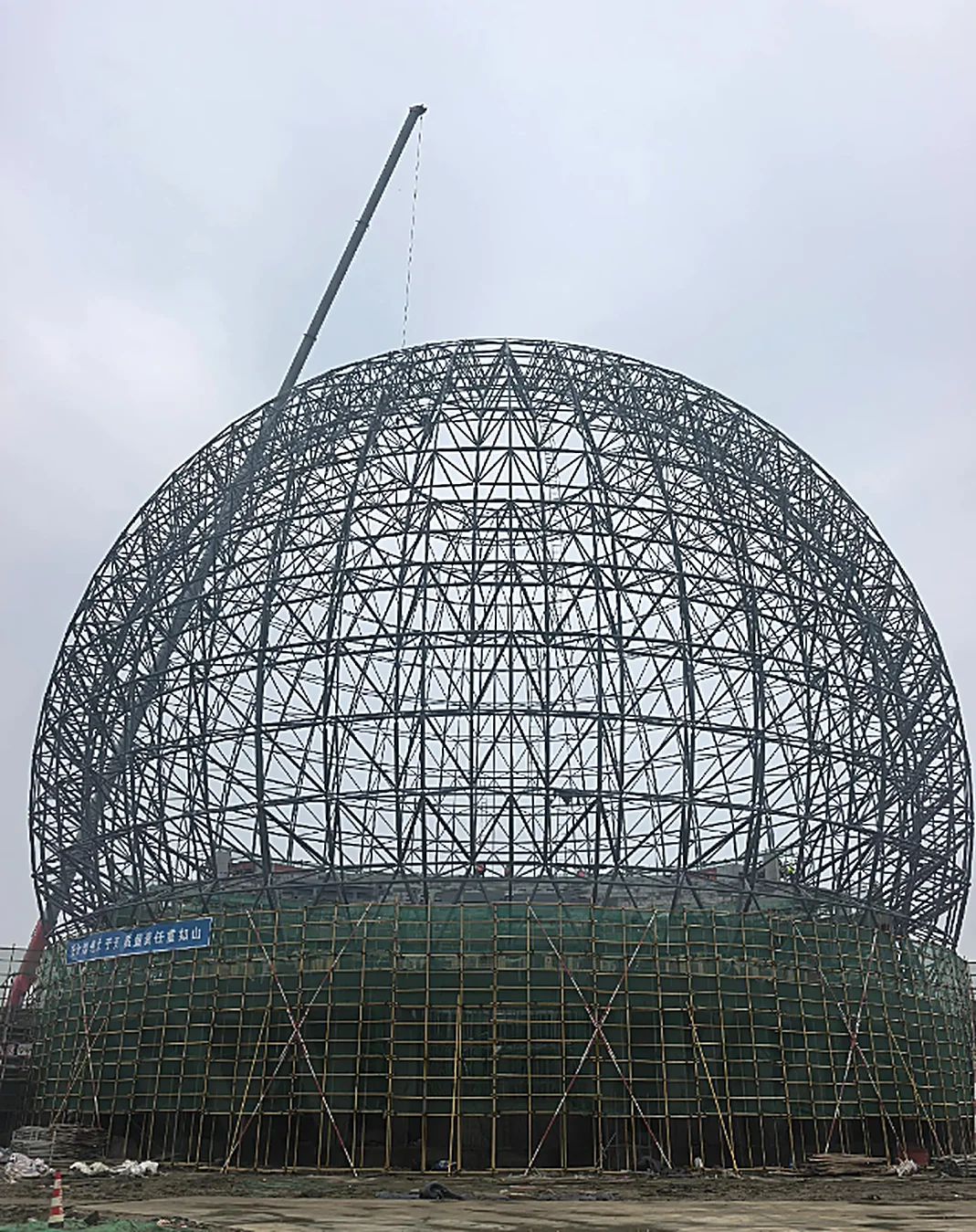
The case of Tiền Giang, China, clearly illustrates this complexity. According to 行家说Display, the project built by Leyard, illuminated on May 30, 2026, is part of a cultural-tourism initiative and is touted as Asia's largest LED sphere. The sphere structure uses a steel grid frame 46.5m high, with a diameter of approximately 50-54m. It features a double-layered inner and outer curved LED screen with a total area exceeding 15,000m²; each layer is about 7,850m². The system supports 16K resolution, glasses-free 3D (naked-eye 3D) experience, and requires IP65/IP67 waterproofing.
When dimensions reach tens of meters, lightweight cabinets become a critical requirement, not just a cost optimization. Outdoor sphere LED cabinets typically need to weigh under 20kg/m² to reduce the load on the steel structure, especially when the entire screen surface spans thousands of square meters. It's highly probable that such projects utilize GOB (Glue-On-Board) surface technology to enhance impact resistance and moisture protection for the LED chips. However, regardless of module quality, the project still requires BIM simulation, supporting scaffolding, installation maps, and point-by-point acceptance procedures.

Why are LEDs Replacing Projectors in Domes and Museums?
Projectors were once the familiar choice for planetariums, dome theaters, and science museums due to their ease of projecting images onto curved surfaces. The weaknesses of projectors include limited brightness, color degradation influenced by the environment, black levels dependent on room lighting, and the continuous calibration required for blending multiple projectors. LEDs address most of these weaknesses with active light sources at each pixel: brighter images, higher contrast, more saturated colors, and no need for projection through air. For experience spaces with moving visitors, LEDs also reduce the risk of people walking through the projection beam.
!Indoor LED dome space for immersive projection in a museum *(Photo: 行家说Display)*
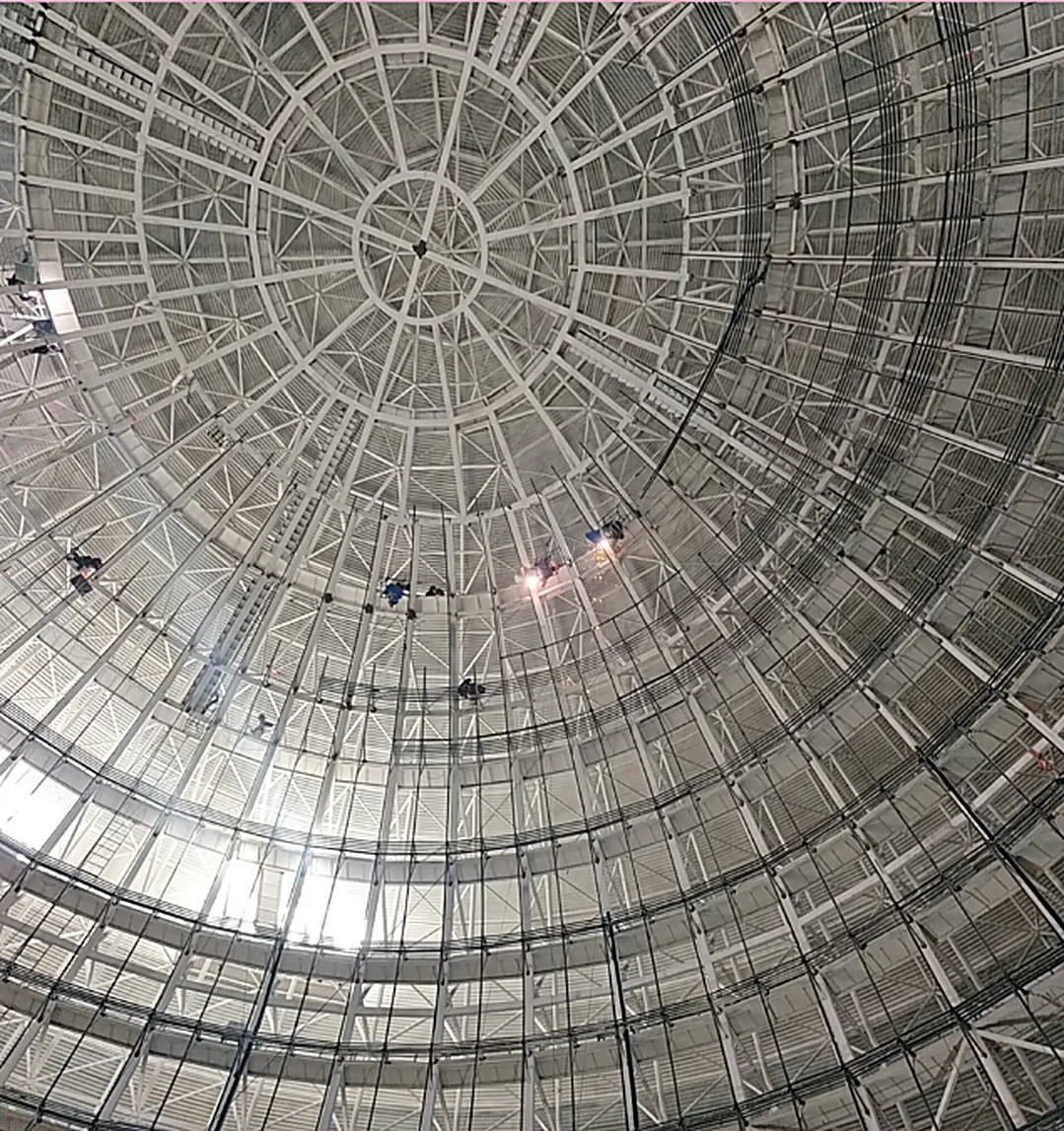
The Shanghai Science and Technology Museum is a notable milestone. According to 屏显时代, a 700m² LED dome built by Nanjing Lopu, inaugurated in January 2026, has a diameter of 23m, a 30° tilt, 8K resolution, and 7.1 surround sound. It's introduced as the first LED dome in China applied for science popularization facilities, marking a shift from projector-based dome equipment to LED-based dome equipment. Lopu has also implemented domes for the Longgang International Art Center in Shenzhen and planetariums in Nagoya and Yokohama.
This replacement doesn't mean projectors will disappear entirely. For some traditional planetariums, requirements for absolute black levels, light paths, budget, and operational habits still give projectors a place. However, in immersive spaces, new museums, commercial experience centers, or immersive CAVE environments, LEDs have a clear advantage due to sufficient brightness for large crowds and easy synchronization with sensors, audio, stage lighting, and real-time content control systems.

What Trends Do Typical LED Sphere Display Projects Indicate?
Looking at large-scale projects, it's evident that most high-scale LED spheres and domes are designed, manufactured, or installed by Chinese companies. Tiền Giang is a recent example in Asia with its colossal sphere structure, double-layered inner and outer screens, and focus on culture and tourism. Unilumin also has an LED dome in Shanxi with an area over 2,000m² and a diameter of about 40m. These figures show that the Chinese LED industry is not just selling modules but is delving into project capabilities: structure, geometry, content, and operation.
On a global scale, the MSG Sphere in Las Vegas is the most recognizable icon. This project features the world's largest LED sphere, approximately 112m high, with an outer diameter of about 157m, a capacity of 20,000 spectators, and an investment of around $2.3 billion USD. The supply chain also includes several Chinese LED companies. The value of the MSG Sphere lies not only in its screen area but in how the display transforms the entire building into an urban media platform. When content runs on the exterior, the structure itself becomes an event.
The general trend is that LED sphere displays are moving in two directions simultaneously. One direction is "consumer/entertainment": performance venues, immersive shows, 3D advertising, cultural events, and ticketed experiences. The other direction is "landmark": projects that create identity for cities, tourist areas, commercial centers, or public squares. This differs from outdoor flat screens or building facades; LED spheres not only display content but also create a form that is photographed, shared, and remembered.
How Can Vietnam View LED Sphere Displays as an Opportunity?
In Vietnam, LED sphere displays don't need to start with mega-projects. More practical opportunities lie in science museums, cultural-tourism centers, urban exhibition halls, indoor amusement parks, real estate showrooms, brand experience centers, and destinations requiring a strong visual identity. A moderately sized LED dome, with compelling content, can create a more effective immersive experience than a very large flat screen merely playing standard advertisements.
It's noteworthy that the Vietnamese market has a high demand for "check-in" attractions, yet many projects still settle for large screens instead of designing experiences. LED sphere displays compel investors to think differently: where do viewers stand, how long do they watch, does the content revolve around the viewer, does the audio accompany the visuals, where are the exits and maintenance access points? Simply buying screens by the square meter can lead to expensive but uninspired projects. Designing around the visitor journey, however, can make an LED sphere a true highlight.
Luxwave can participate in consulting and implementing freeform LED systems, curved screens, control systems, and immersive spaces tailored to Vietnam's conditions. This does not imply Luxwave is the implementer of the international projects mentioned; the international examples serve as reference data to understand industry direction. For domestic projects, control platforms like NovaStar VX1000 or larger processing series like the H series should be selected based on pixel count, signal structure, content resolution, and operational scenarios, rather than familiar device names.
What to Ask When Choosing an LED Sphere Contractor?
The first question should not be "how much per square meter," but whether the contractor can control the entire chain of design - manufacturing - structure - installation - calibration - warranty. LED sphere displays have numerous intersections between mechanics and display; if each party handles a separate part, errors often only appear after installation. At that point, repairs become very costly, requiring module removal, signal map changes, or even structural adjustments.
Investors should request proposals for module division based on curvature, structural drawings, estimated loads, waterproofing standards, power and signal routing, maintenance access methods, and image calibration procedures. For outdoor screens, clarify cabinet weight per m², IP rating for specific locations, surface protection solutions, and whether sideways rain is considered. For indoor screens, inquire about viewing distance, operating brightness, heat dissipation, acoustics, and safety when audiences are close to the LED surface.
Content is as crucial as hardware. A 16K sphere or 8K dome is only meaningful if the content pipeline, media server, and video processor can deliver the correct resolution, mapping, and refresh rate. For complex configurations, the NovaStar ecosystem is often considered for its processing, scaling, and management capabilities across multiple display zones. However, control equipment is only one part; the implementation team must understand the pixel map of the curved surface to avoid image distortion, misaligned horizons, or incorrect viewing angles.
Conclusion: Which Projects are LED Sphere Displays For?
LED sphere displays are not a mass-market choice for every project, but they are a noteworthy direction if a project requires an iconic experience. Unlike flat screens primarily for content display, LED spheres and domes sell immersive experiences and landmark value. Therefore, investment decisions must consider content, structure, and audience flow, not just display area. Here's a quick summary of criteria before budgeting:
- Recommended for: Museums, planetariums, cultural-tourism centers, immersive spaces, experience showrooms, and projects aiming to become landmarks.
- Preparation required: Geometric design, steel structure, curved modules, waterproofing, control systems, high-resolution content, and maintenance plans.
- Proceed with caution: If the budget only covers screens by the square meter, content scenarios are unclear, viewing distances are not defined, or a comprehensive contractor has not been selected.
For the Vietnamese market, the greatest value of LED sphere displays lies not in chasing record-breaking sizes, but in transforming a space into a destination. When designed correctly, LED spheres can be combined with transparent LED screens, curved screens, audio, and lighting to create a new layer of experience for museums, tourism, and commerce. The key is to start with the desired experience, then determine the radius, pixel pitch, structure, and control system.
Pitfalls
Common mistakes
- Treating LED spheres merely as bent flat LED screens—ignoring geometric errors, pixel mapping, and the unique curvature of each section
- Separating LED design from steel structure—lightweight cabinets are insufficient; total load, wind, maintenance, and scaffolding determine project safety
- Choosing contractors strong only in module supply, lacking capabilities in simulation, calibration, content processing, and post-installation warranty
- Investing in very high resolution without adequate control systems, content, and calibration processes to leverage true 3D or immersive experiences
FAQ
Frequently asked questions
How is an LED sphere display different from a regular curved LED screen?
An LED sphere display covers part or all of a spherical surface, requiring each module to follow a specific radius and pixel map. Regular curved LED screens typically bend along a single axis, like a curved facade or a stage arc. With a sphere, minor errors at individual points can distort the image across the entire form.
Why is installing an LED sphere display more difficult than a flat LED screen?
LED sphere displays are challenging because there's no standard flat plane for mass module alignment. Installation teams must manage the steel frame, individual point coordinates, lightweight cabinets, waterproofing, heat dissipation, and maintenance access on a curved surface. Large projects often require BIM simulation, custom modules, and supporting scaffolding throughout the installation process.
Can LEDs replace projectors in planetariums?
LEDs are increasingly replacing projectors in some domes due to better brightness, contrast, and color, especially when the space requires vibrant imagery or interactive content. However, not all planetariums should switch to LED; factors like dome radius, viewing distance, required resolution, audio, and operational budget need evaluation.
What waterproofing standards are needed for outdoor LED spheres?
Large outdoor LED sphere projects typically aim for high waterproofing levels like IP65 or IP67, depending on the location and cabinet structure. Because the curved surface is exposed to rain, wind, and dust from multiple directions, investors should carefully review standards for modules, power supplies, cables, connection points, and maintenance access, not just rely on a general IP label.
Where can LED sphere displays be applied in Vietnam?
In Vietnam, LED sphere displays are suitable for science museums, cultural-tourism centers, amusement parks, public squares, immersive showrooms, and projects aiming to become urban landmarks. The scale may not need to be as extreme as international projects; the key is selecting the right content scenarios, viewing distances, and operational costs.
What criteria are important when choosing an LED sphere contractor?
An LED sphere contractor must demonstrate capabilities in geometric design, manufacturing suitable curved modules or cabinets, coordinating with steel structures, safe installation, image calibration, and long-term warranty. For large projects, request drawings, simulations, maintenance plans, and a comprehensive package deal rather than just a per-square-meter quote.
References