

Why LED Lobby Displays Have Become Brand Feature Walls
Lobby LED displays are more than just video surfaces; they are the first touchpoint between a brand and guests entering a hotel, office building, or premium showroom. In this area, the display needs to create a welcoming atmosphere, provide guidance, and immerse visitors in a space with a distinct identity. Therefore, lobby displays should be designed as architectural feature walls, not indoor billboards.
!Seamless LED feature wall in a luxury hotel lobby with subtle branding content
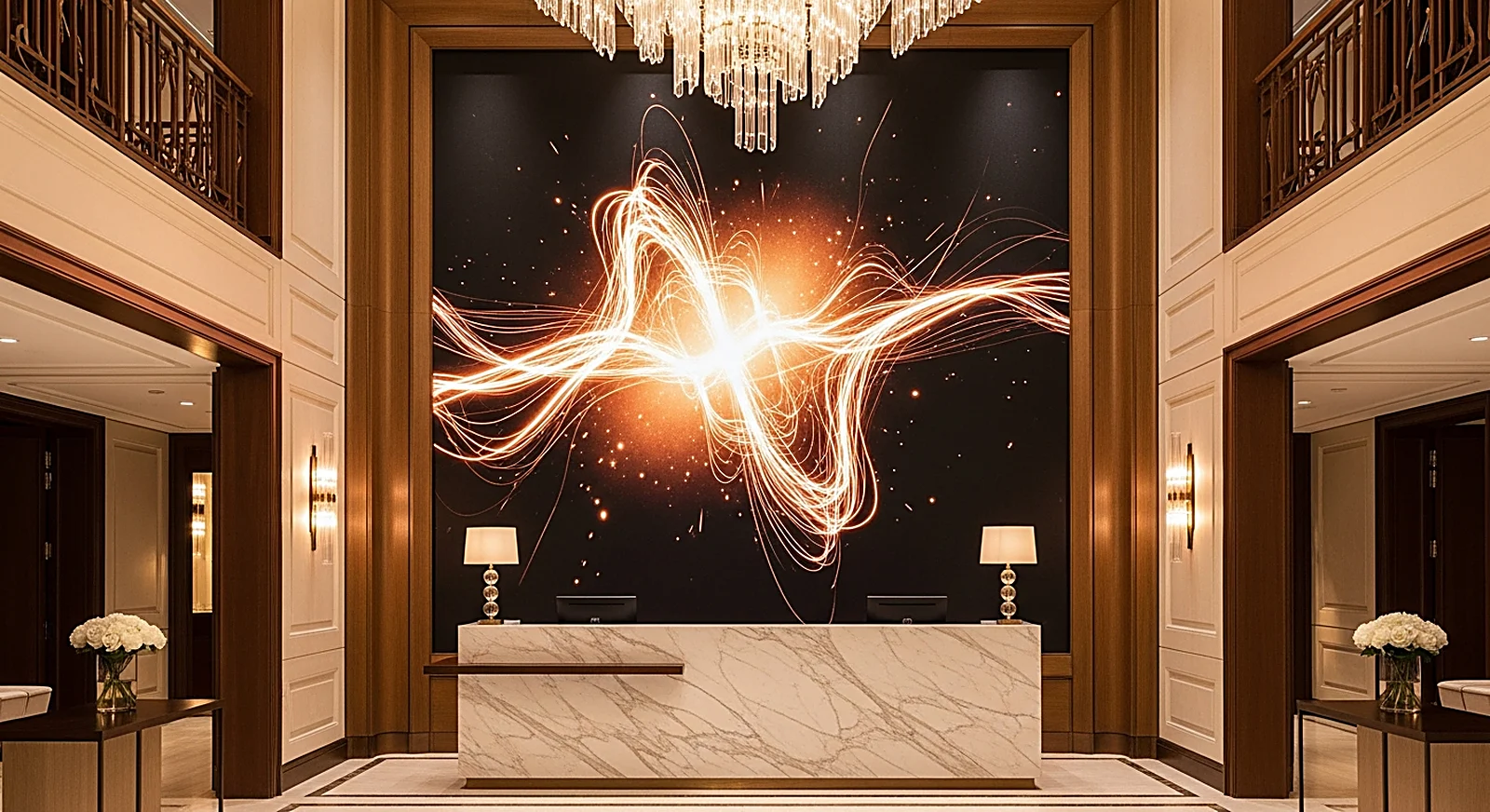
Unlike sales screens in shopping malls, lobby displays typically serve three purposes: showcasing brand identity, creating a dynamic artistic backdrop for the space, and welcoming guests or special events. A hotel might display slow-moving scenery, local motifs, or conference group greetings; a Grade-A office might show brand films, achievement data, or a guest reception schedule. Luxwave's /giai-phap/sanh-lobby solutions focus precisely on this experiential layer: prominent enough to be memorable, yet subtle enough not to overwhelm those in the lobby.

What Pixel Pitch Should Be Chosen for Lobby LED Displays for Close Viewing?
For lobby areas, the pixel pitch should be within the P1.2-P2.5 range, as viewers are typically much closer to the screen than they would be with outdoor billboards. Guests might be standing at the check-in counter, in the waiting area, near the elevators, or in front of a photo backdrop, meaning viewing distances are only about 1.5-4m. According to the principle of selecting pitch based on viewing distance, a smaller P value results in a smoother image at close range; the article /kien-thuc-led/cach-chon-pixel-pitch-led-2026 analyzes this rule in more detail.
If the screen is located directly behind the reception desk, displaying logos, small text, or intricate patterns, P1.2-P1.5 is a recommended range. If the screen is further away, serving as an artistic backdrop or a large welcome wall, P1.8-P2.5 might be more appropriate, balancing smoothness and budget. For very high-end projects, fine-pitch COB series like /products/boe-byh009-ultra allow for higher pixel densities, but should only be chosen when viewing distance and aesthetic requirements truly necessitate it.
How Many Nits of Brightness Are Appropriate for Hotel and Office Lobbies?
Lobby LED displays typically require a brightness of around 600-1200 nits, significantly lower than outdoor advertising screens. Lobbies are indoor spaces with ceilings, controlled lighting, and numerous reflective surfaces like stone, glass, stainless steel, or glossy paint. If a screen is too bright, the image can overpower the reception desk, cause glare in waiting areas, and detract from the luxurious ambiance the interior designer aims to create.
The key is not just high nits, but the ability to maintain beautiful color reproduction at moderate brightness levels. A good system requires calibrated white balance, gamma, low grayscale, and dimming schedules for different times of day. Processors like /products/novastar-vx1000 help manage signals, scale content, and ensure stable display calibration for indoor LED walls. For lobbies with large glass facades, Luxwave surveys sun direction, ambient glare, and lighting scenarios before determining optimal operating brightness.
Why is Seamlessness More Important Than Extreme Brightness?
In premium lobbies, viewers not only observe the overall image but also examine the surface, bezels, module gaps, and how the screen integrates with walls, ceilings, stone, or wood up close. A bright screen that reveals seams, has thick bezels, or an uneven surface will degrade the perceived quality of the entire feature wall. Therefore, seamlessness is often more critical than peak brightness specifications in lobby projects.
!Lobby LED screen in a real project within the reception and guest welcome area
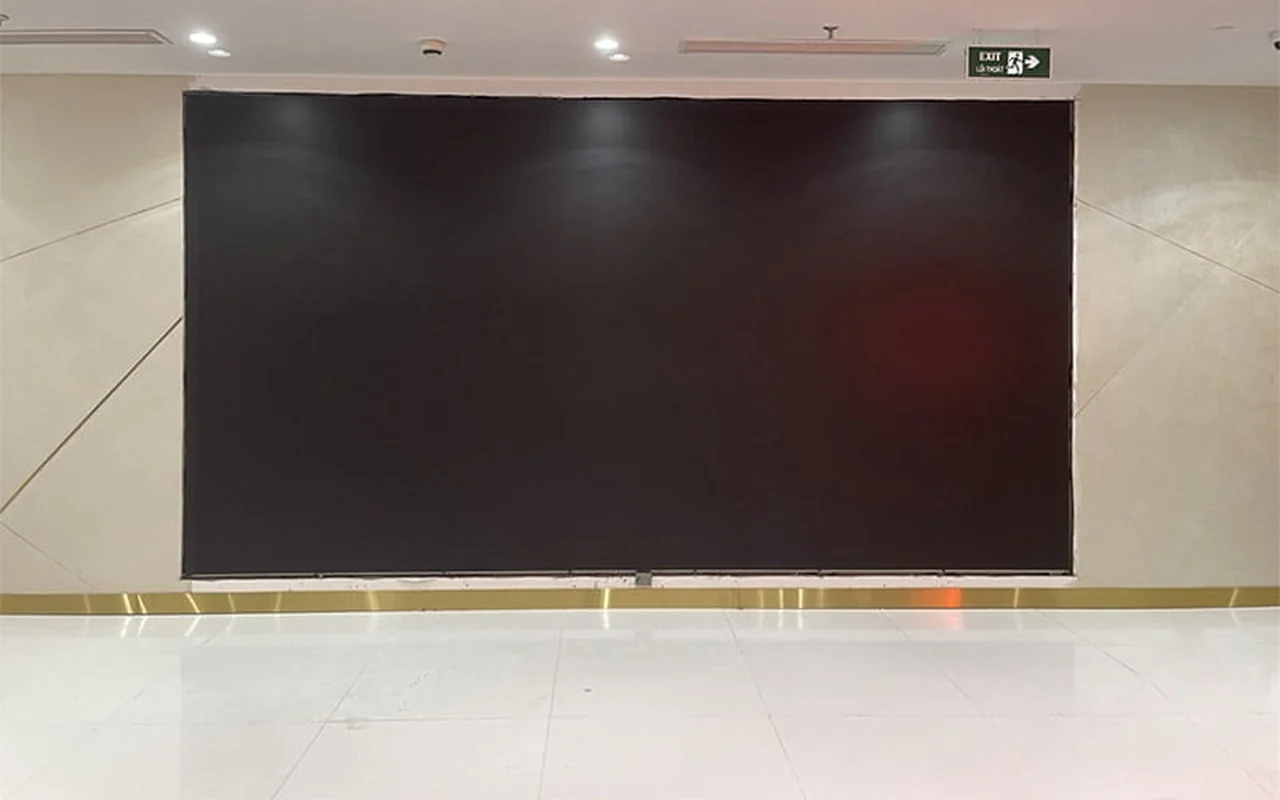
COB is a noteworthy option because its surface coating makes the screen appear flat, clean, and less pixelated when viewed up close. BOE is a major display manufacturer with fine-pitch display technologies, while Muxwave is known for transparent LED and architecturally integrated display surfaces. Depending on the interior design concept, a project might use monolithic COB LED for the main wall or Muxwave's solutions for glass areas, storefronts, showrooms, and spaces requiring transparency. The article /so-sanh/cob-vs-lcd-video-wall-phong-dieu-hanh also highlights why a borderless surface is a significant advantage over LCD video walls.
What Content is Suitable for Lobby LED Displays?
Effective content for lobby LED displays should have a slow pace, controlled colors, minimal text, and a clear role in the guest reception journey. An LED wall doesn't need to constantly sell; it needs to help guests understand where they are, feel the brand's style, and know they are welcome. Effective content categories include short brand films, abstract animations aligned with brand identity, conference schedules, VIP greetings, and tastefully curated seasonal or festive themes.
A common mistake is using overly aggressive advertising content: fast-moving text, high contrast, flashing effects, or prolonged saturated red or blue colors. Such content might be suitable for street-facing facades but can create tension in a lobby and clash with interior materials. For hotels, a content schedule by time of day is recommended: soft and bright in the morning, warmer in the afternoon, and dimmed in the evening. For offices, content can rotate between brand identity, event information, company achievements, and slow-moving background visuals to keep the screen dynamic but not overwhelming.
What Needs to Be Considered for Architectural Integration Before Installation?
Lobby LED displays must be incorporated into interior design plans early on, as the challenge lies not just in the LED panels themselves but in how they integrate with the architecture. Key decisions include flush-mounting or surface-mounting, corner finishing (rounded or flat), integration with curved walls, front or rear maintenance access, placement of power and signal cabling, heat dissipation, and whether the finishing trim matches surrounding materials like stone, wood, or metal.
For hotel lobbies, requirements also include low noise levels, quiet long-term operation, no hot spots, concealed cabling in guest-visible areas, and maintenance plans that do not disrupt reception operations. For Grade-A offices or showrooms, the display might integrate with reception desks, illuminated logos, linear lighting, and conference room AV systems. Similar spaces like /giai-phap/showroom-trien-lam also require this integration mindset: the display is a layer of the spatial experience, not an afterthought.
How Does a Lobby LED Display Differ from a Residential LED Display?
Both lobby LED displays and residential LED displays are installed in high-end environments, but their intended uses differ. Lobby displays serve multiple people, occasions, and brand scenarios; they need to be durable, easy to operate, simple to update content, and sufficiently bright for public spaces. Residential displays are typically more personalized, prioritizing movie watching, entertainment, digital art, and integration with living rooms or private entertainment areas.
The commonality is that neither should be chosen based on outdoor advertising logic. Close viewing distances, high aesthetic requirements, and indoor lighting make pitch, brightness, color, and seamlessness more important than mere size. If you are considering a display for a high-end residence, the article /kien-thuc-led/man-hinh-led-biet-thu-noi-that-cao-cap will be helpful; for hotels and offices, the additional considerations involve guest flow, brand identity, event schedules, and maintenance in a continuous operating environment.
When Should You Contact Luxwave for a Premium Lobby Solution?
You should contact Luxwave when a lobby LED display is intended to be more than just a video screen, but an integral part of the interior design concept, brand identity, and guest reception experience. As a brand under Ho Gia JSC, an authorized distributor of BOE, NovaStar, and Muxwave, Luxwave can collaborate from the initial survey of viewing distances, pitch selection, surface technology, controller configuration, to advising on how the display integrates with the architecture.
A well-configured lobby solution often begins with very specific questions: where do guests stand, how long do they view the screen, what is the primary content, how does the lobby lighting change, how do surrounding materials reflect light, and what process will the operations team use for content updates? Based on this data, Luxwave can then determine the P1.2-P2.5 range, operating brightness, COB or transparent LED options, flush-mount or curved structures, and corner finishing. This approach ensures the lobby LED display becomes a sustainable brand surface, rather than an overly bright advertising screen in a space that demands sophistication.
Pitfalls
Common mistakes
- Selecting screens based on outdoor advertising brightness, causing the lobby to be glaring, with strong reflections on stone, glass, and metal, diminishing the sense of luxury
- Using a pixel pitch that is too large for areas where guests stand close to the reception desk, resulting in small text and logos appearing pixelated at distances of 1.5-3m
- Installing like a surface-mounted billboard, without proper flush-mounting, bezel, maintenance gap, and cable management, causing the screen to disrupt the overall interior design
- Investing in good hardware but lacking a content schedule, leading to the screen only displaying static logos or overly aggressive, repetitive videos in a reception area
FAQ
Frequently asked questions
What pixel pitch should be chosen for a lobby LED display?
Hotel and office lobbies should generally opt for P1.2-P2.5 because guests are quite close to the screen, typically from 1.5-4m. If the screen is behind the reception desk or part of the main feature wall, P1.2-P1.8 provides smoother logos and text. If guests view from a distance across a large space, P2-P2.5 can optimize the budget.
What brightness level (nits) is needed for a lobby LED display?
Lobby LED displays typically only require around 600-1200 nits, much lower than outdoor advertising screens. Lobby spaces have artificial lighting, reflective surfaces like polished stone, glass, and metal, so excessively high brightness can cause glare. More important are good color reproduction, proper gamma calibration, and automatic dimming based on the time of day.
Is COB suitable for LED feature walls in lobbies?
COB is highly suitable for premium feature walls as it offers a seamless surface, less perception of individual modules, and better resistance to minor impacts compared to many standard SMD structures. For close viewing, COB makes images, logos, and dynamic art appear more refined, especially when combined with flush-mounting and slim finishing bezels.
How does a lobby LED display differ from an advertising LED display?
Advertising LED displays prioritize high brightness, long-distance visibility, and outdoor durability. Lobby LED displays prioritize aesthetics, seamlessness, color accuracy, low noise, and interior integration. The content also differs: lobbies typically use dynamic art, brand identity, VIP greetings, and event schedules instead of dense sales messages.
Should lobby hotel LED displays be curved or corner-wrapped?
Curved or corner-wrapped LED displays are worth considering when the lobby architecture features columns, curved walls, wide entrances, or when aiming for a softer visual accent than a flat screen. This design requires early decisions on the curve radius, suitable modules, maintenance access, and specific content. When done correctly, the display becomes an architectural element rather than an added device.
Does Luxwave provide interior design-integrated LED display consultations for lobbies?
Luxwave consults on lobby LED displays considering both technical and aesthetic aspects: viewing distance, pitch, brightness, color, controller, signal source location, mounting structure, and content style. As part of Ho Gia JSC, an authorized distributor of BOE, NovaStar, and Muxwave, Luxwave can propose suitable configurations for premium lobbies.
References
- 1.ManufacturerBOE — Display technology manufacturer
- 2.ManufacturerMuxwave — Transparent LED and display manufacturer
- 3.ResearchLuxwave LED Display Application & Specification Reference 2026
- 4.ManufacturerNovaStar — Video processing and LED control systems