

What is a COB LED Display and How Does Chip-on-Board Packaging Work?
A COB (Chip-on-Board) LED display is a type of screen that uses packaging technology to mount multiple bare LED chips directly onto a ceramic or aluminum substrate, which is then covered with a protective layer to form a flat light-emitting surface. The entire assembly has only two connection points: anode and cathode, as detailed in BOE MLED's technical documentation. This seamless structure allows for excellent heat dissipation and enables micro-pixel pitches below 1.0mm, a level that discrete chip mounting technologies find difficult to stabilize on a large scale.
!Seamless surface of a COB LED display in a corporate meeting room
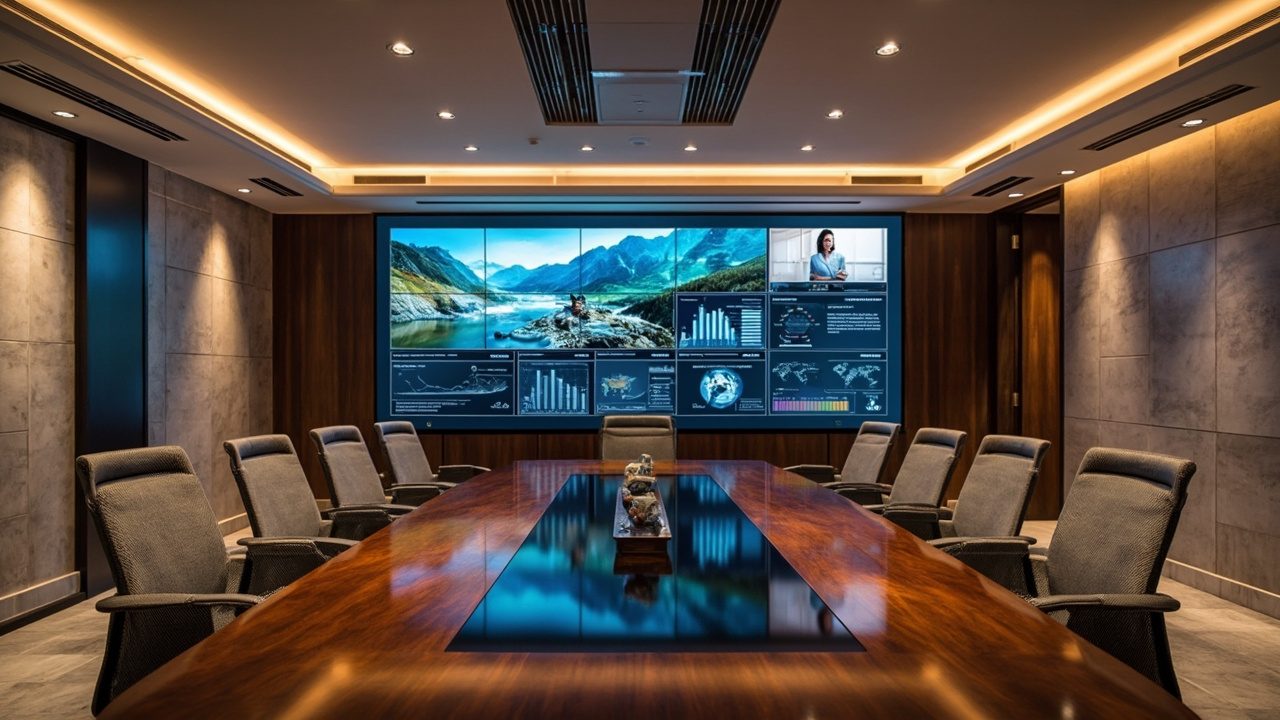
Key takeaway: COB describes HOW chips are mounted onto a circuit board, not a specific resolution or display type. Within BOE MLED's product catalog, the company builds products based on four technologies: COB, COG (Chip-on-Glass), SMD Direct View, and Mini-LED backlit LCDs, with COB being the flagship fine-pitch series. Understanding this "packaging" concept correctly prevents confusion between COB, pixel pitch, and other self-emissive technologies when reading catalogs.
How Do COB and SMD Differ in Structure and Performance?
The core difference lies in the chip mounting method. SMD (Surface-Mount Device) mounts individual, discrete LED chips onto the PCB surface, offering layout flexibility but leaving numerous solder joints and raised components. COB, conversely, mounts bare chips directly onto the substrate and then encapsulates them seamlessly, creating a flat surface with only two connection points. In terms of performance, COB offers better heat dissipation and stable micro-pitches below 1.0mm; at the panel level, SMD can still achieve higher peak brightness. The COB vs SMD comparison in 2026 article provides a detailed breakdown of each criterion.
Why is the Seamless Surface of COB Important?
The flat, seamless surface of COB provides three practical benefits that users can immediately perceive. Firstly, it offers better resistance to impact and dust accumulation because there are no protruding LED components like in SMD. Secondly, it ensures a clean image when viewed up close, free from pixelation or point reflections. Thirdly, it provides higher mechanical durability in environments with frequent human interaction. This is why COB is preferred in locations where viewers stand or sit close to the screen.
What are the Advantages of COB LED Displays?
The most significant advantage of COB is its ability to achieve stable micro-pixel pitches below 1.0mm, something SMD technology struggles with on a large scale. Thanks to bare chips mounted directly onto the substrate with only two connection points, COB offers excellent heat dissipation and a flat, seamless, impact-resistant surface. According to BOE's announcement at InfoComm 2025, the flagship BYH Ultra P0.9 series features a 0.9mm pitch, 7680Hz refresh rate, 2,000 nits (peak) brightness, 99% DCI-P3 color gamut, and a 20,000:1 contrast ratio in ambient light (under 10 lux) — a set of specifications highlighting COB's fine-pitch strengths.
Notable Technical Advantages
Beyond image fineness, COB also excels in mechanical reliability and camera performance. Its seamless surface reduces point reflections when filming or livestreaming, making it suitable for video conferencing rooms. High refresh rates, such as the 7680Hz announced by BOE for the BYH Ultra, ensure stable images in front of the camera. With a wide color gamut coverage of 99% DCI-P3 (as announced by BOE), COB reproduces colors accurately — crucial for showrooms, branding, and content requiring precise color. This is why COB is often the choice for premium spaces.
What are the Disadvantages and Limitations of COB LED Displays?
The most apparent limitation of COB is its higher cost compared to equivalent SMD displays, due to a more complex bare-chip packaging process. Since the chips are seamlessly encapsulated on the substrate, the module layout is less flexible than SMD, which uses discrete chips. COB delivers its best value when viewers are at a close distance; if installed for distant viewing, COB's superior fineness is imperceptible, leading to wasted investment. Pixel pitch selection should be based on the actual viewing distance; refer to how to choose LED pixel pitch in 2026 for guidance.
What Figures Need Verification Before Deciding?
Several important parameters should be confirmed by the supplier for each specific model, rather than relying on generic figures. The specific lifespan in hours for COB modules should be referenced from the manufacturer's specifications for that product line. The cost of replacement and the repairability of individual pixels on the seamless surface should also be clarified, as they differ from SMD. Finally, the price per square meter varies with pitch and production volume, so obtain actual quotes for the exact configuration.
Is COB Mini-LED or Micro-LED?
No, and this is a very common misconception. COB refers to the chip PACKAGING technique onto a substrate, while Mini-LED and Micro-LED refer to the light-emitting chips themselves. According to BOE, Mini-LEDs are ultra-small LEDs used as backlights for LCD panels (full-array or zone dimming) — they still require a backlight, thus not achieving absolute black. Micro-LEDs are chips measuring 10–100µm that emit light individually per pixel, without a backlight, offering absolute black and fast response times. The article Mini-LED vs Micro-LED: What's the Difference clarifies these two concepts.
!Close-up of a COB LED display module with a flat coating encapsulating bare LED chips
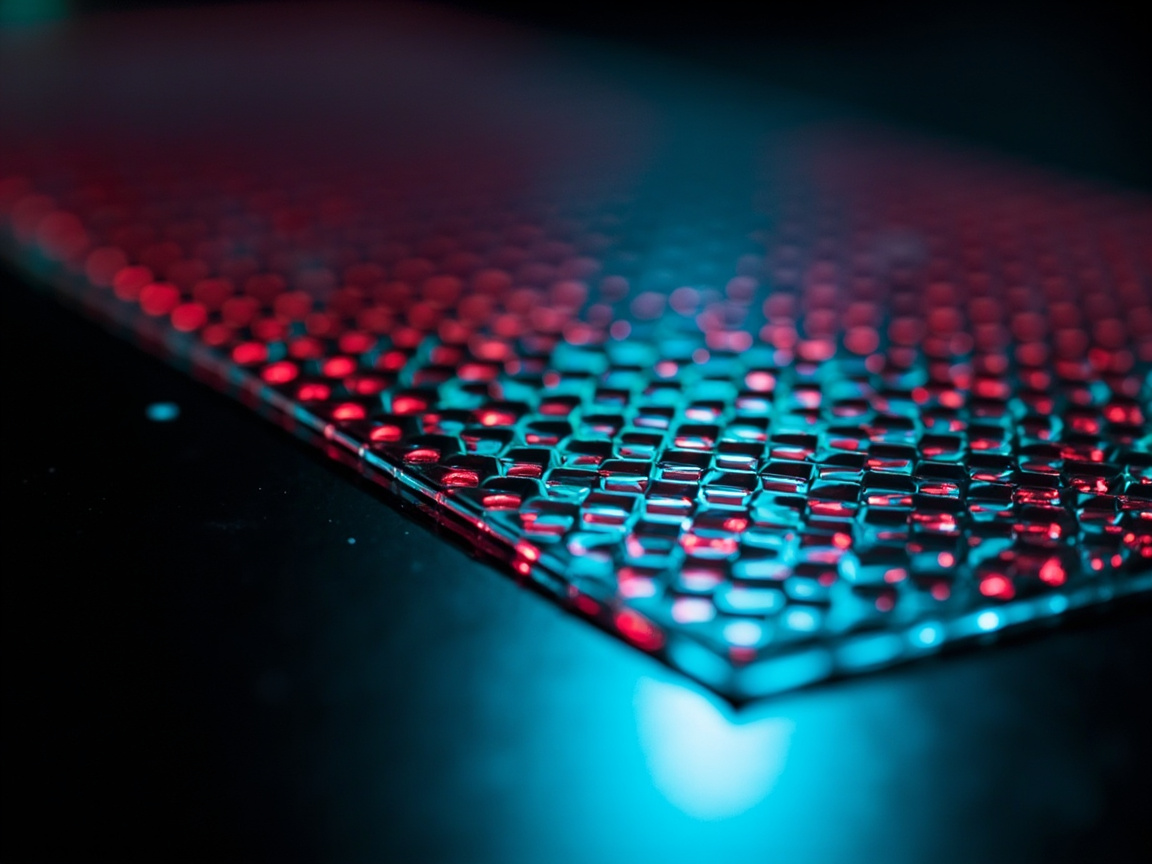
Because BOE uses the term "MLED" as an umbrella term encompassing both Mini-LED and Micro-LED, readers might mistakenly believe COB is a sub-category. In reality, COB can utilize chips of various sizes; it describes the mounting method, not the chip size. When reviewing documentation, it's essential to distinguish between three layers of concepts: chip type (Mini/Micro), packaging method (COB/SMD/COG), and pixel pitch. Confusing these three layers is the source of most product misunderstandings.
When Should You Choose a COB LED Display for Your Project?
Opt for COB when viewers will be seated or standing close to the screen and require a flat, seamless surface without visible components — typical for premium meeting rooms, control centers, and showrooms. Meeting rooms and auditoriums often use pixel pitches from P0.9–P1.5 with brightness around 400–800 nits; command centers use P0.9–P1.2 with 600–1,200 nits; retail and showrooms use P1.2–P3 with 800–1,500 nits. As a general rule of thumb, the minimum viewing distance in meters is approximately equal to the pixel pitch in millimeters — for example, P3 is best viewed from about 3 meters.
COB for Meeting Rooms and Control Centers
These are two areas where COB truly shines. In meeting room solutions, viewers are close and often record content, so COB's flat surface and high refresh rate provide a clean image without moiré. For command center solutions, screens display dense data and operate continuously, making COB's micro-pitch and heat dissipation capabilities highly suitable. Both fall within the P0.9–P1.5 fine-pitch range where COB excels, explaining why it's the default choice for premium environments.
COB for Showrooms and Brand Spaces
Showrooms and brand display areas are where customers interact with the screen at very close distances, so COB's seamless surface and accurate color reproduction create a strong impression. For showroom & exhibition solutions, the P1.2–P3 pitch range and 800–1,500 nits brightness are suitable; COB at the lower end of the pitch range provides a smooth image even up close. For a more cost-balanced option, the BOE BYH012 COB P1.25 (BOE claims 1,200 nits) is a noteworthy fine-pitch choice.
Typical COB Product Lines and Specifications
Within the BOE MLED catalog, the COB pitch range extends from approximately 0.9–4.4mm (as claimed by BOE), covering ultra-fine pitch to larger pitches for wider spaces. The flagship BYH Ultra P0.9 series achieves a 0.9mm pitch, 7680Hz refresh rate, 2,000 nits peak brightness, 99% DCI-P3 color gamut, and a 20,000:1 contrast ratio under 10 lux (as claimed by BOE). Additionally, the BYH COB PRO P0.9 offers a more balanced fine-pitch option at 1,200 nits (as claimed by BOE). For reference, COG is a thin glass-based product approximately 5mm thick and weighing around 12kg/m² — another category within the MLED lineup.
How Luxwave Implements COB in Practice?
As a brand under Ho Gia Joint Stock Company, the official distributor of BOE in Vietnam, Luxwave provides consultation based on official manufacturer specifications combined with practical installation experience for meeting rooms and control centers. In Q1 2026, the technical team delivered two BOE COB P0.9 screen projects, accumulating valuable insights for configuring systems suited to different viewing distances. This experience demonstrates that selecting COB is not just about choosing the smallest pitch, but about balancing viewing distance, ambient lighting, and budget to ensure long-term system stability.
Conclusion: Which Projects Suit COB LED Displays?
Choose COB LED displays if your project involves viewers at close distances requiring a flat, smooth, and impact-resistant surface — such as premium meeting rooms, control centers, showrooms, and brand spaces, where the P0.9–P1.5 fine-pitch range delivers optimal value. COB is also a worthwhile investment when stable micro-pitches below 1.0mm or excellent camera performance are needed. Conversely, if viewers are at a distance, the budget is limited, or flexible module layout is required, SMD remains a more sensible and cost-effective choice. Most importantly, determine the viewing distance and actual lighting environment first, then select the packaging technology and pixel pitch — this approach avoids both over-investment and suboptimal visual performance.
| Criterion | COB (Chip-on-Board) | SMD (Surface-Mount) |
|---|---|---|
| Chip Mounting Method | Bare chips mounted directly onto substrate, then encapsulated | Individual chips mounted onto PCB |
| Surface | Flat, seamless, impact-resistant | Has raised components |
| Micro-pitch below 1.0mm | Achieved stably | Difficult to stabilize |
| Connection Points | Only 2 (anode/cathode) | Multiple discrete solder joints |
| Layout / Flexibility | Fixed by module | More flexible |
| Cost | Higher | Lower |
Pitfalls
Common mistakes
- Confusing COB as a resolution or pixel pitch type — COB is a chip PACKAGING method; pixel pitch is a separate parameter, and the same pitch can be achieved with COB or SMD.
- Confusing COB with Mini-LED or Micro-LED — Mini-LED is a backlight for LCDs, Micro-LED is a self-emissive chip at the micro-scale; COB is a technique for mounting chips onto a substrate.
- Choosing ultra-fine pitch COB for distant viewing — viewers 5m away won't perceive the difference, leading to unnecessary costs.
- Focusing solely on peak brightness (nits) in catalogs while ignoring the installation environment — brightly lit rooms require consideration of actual brightness and contrast.
- Overlooking the controller and signal processing — a beautiful COB display with an underpowered processor will limit resolution and source synchronization.
FAQ
Frequently asked questions
What is a COB LED display?
In brief: COB is a method of mounting bare LED chips directly onto a substrate and then encapsulating them, creating a flat light-emitting panel instead of discrete LED components like SMD. For users, this means a smooth, impact-resistant surface and no visible pixelation up close — the trade-off is typically a higher price than comparable SMD displays. It's the primary fine-pitch series for close-viewing environments.
How do COB and SMD differ?
The difference lies in the chip packaging method. SMD mounts individual LED chips onto a PCB, offering layout flexibility, while COB mounts bare chips directly onto a substrate and encapsulates them to create a flat surface. COB has only two connection points, enabling better heat dissipation and more stable micro-pitches below 1.0mm. While SMD can still achieve high peak brightness, COB excels in surface quality and mechanical durability.
Are COB LED displays more durable than SMD?
Mechanically, COB's flat and seamless surface offers better resistance to impact, dust, and moisture compared to SMD with its raised components. COB also has only two connection points instead of the multiple discrete solder joints found in SMD, leading to better heat dissipation. However, the specific lifespan in hours depends on the product line and operating conditions; always refer to the manufacturer's specifications for each model for precise figures.
Is COB a type of Micro-LED?
No. COB is a chip PACKAGING technique onto a substrate, whereas Micro-LED refers to self-emissive chips measuring 10–100µm for individual pixels, requiring no backlight. Also, don't confuse it with Mini-LED — these are ultra-small LEDs used as backlights for LCD panels, still requiring a backlight. COB can use chips of different sizes; it describes the mounting method, not the chip size.
What is the smallest pixel pitch for COB?
COB can achieve micro-pixel pitches below 1.0mm, which are difficult for SMD to stabilize. According to BOE's claims, their COB pitch range is approximately 0.9–4.4mm, with the flagship BYH Ultra series reaching a 0.9mm pitch. Smaller pitches result in finer images and allow for closer viewing distances, but costs increase accordingly, so selection should be based on the actual viewing distance of the space.
When should I choose a COB LED display over SMD?
Choose COB when viewers will be close to the screen and require a flat, seamless surface without visible components — such as in premium meeting rooms, control centers, or showrooms where customers stand very close. COB is also suitable when micro-pitches below 1.0mm or an impact-resistant surface are needed. For distant viewing, limited budgets, or flexible layout requirements, SMD remains a more sensible and cost-effective option.
Are COB LED displays suitable for meeting rooms and control centers?
Highly suitable. Meeting rooms and auditoriums typically use pixel pitches from P0.9–P1.5 with brightness around 400–800 nits, while command centers use P0.9–P1.2 with 600–1,200 nits — all within the fine-pitch range where COB excels. COB's flat, seamless surface provides a clean image for close viewing and camera recording, making it an ideal environment for this technology.
References
- 1.ManufacturerBOE MLED — COB, COG, SMD Direct View Technology Catalog
- 2.ManufacturerBOE MLED Glossary — COB vs SMD Packaging Principles, Mini-LED vs Micro-LED
- 3.ManufacturerBOE — COB & COG at InfoComm 2025 (BYH Ultra P0.9, COB Pitch Range)
- 4.ManufacturerNovaStar — Video Controllers & Processors for LED Displays