

What Formula is Used to Calculate LED Display Power Consumption?
LED display power consumption is calculated from four main variables: display area, average power consumption per square meter, operating time, and electricity unit price. The quick formula is: Area (m²) × W/m² × Operating Hours × Number of Days, then divide by 1,000 to get kWh. For commercial estimates, Luxwave always clearly separates "manufacturer datasheet power" and "reference EVN electricity price" so clients can see both the technical specifications and the operational cost.
!BOE COB LED display in a meeting room operating with bright, clear projected content
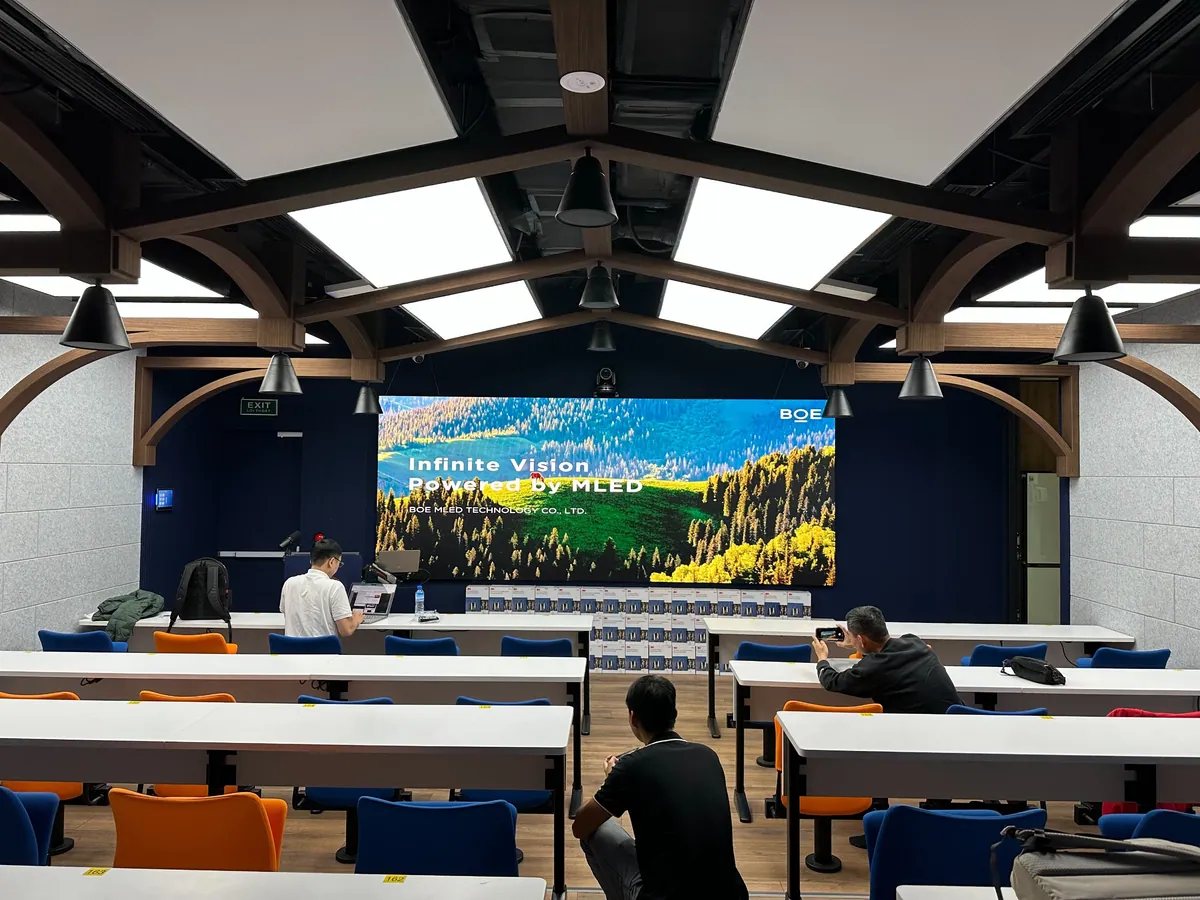
It's important not to use a fixed W/m² value for all displays. Indoor fine-pitch displays used in meeting rooms, studios, or control centers typically operate at moderate brightness, consuming less power than outdoor displays that must compete with sunlight. Even within the same display, content with a lot of white backgrounds and bright images will consume more power than content with dark backgrounds, as LEDs consume power based on illuminated pixels, unlike a backlight that is uniformly on.

What is the Difference Between Average Power Consumption and Peak Power Consumption?
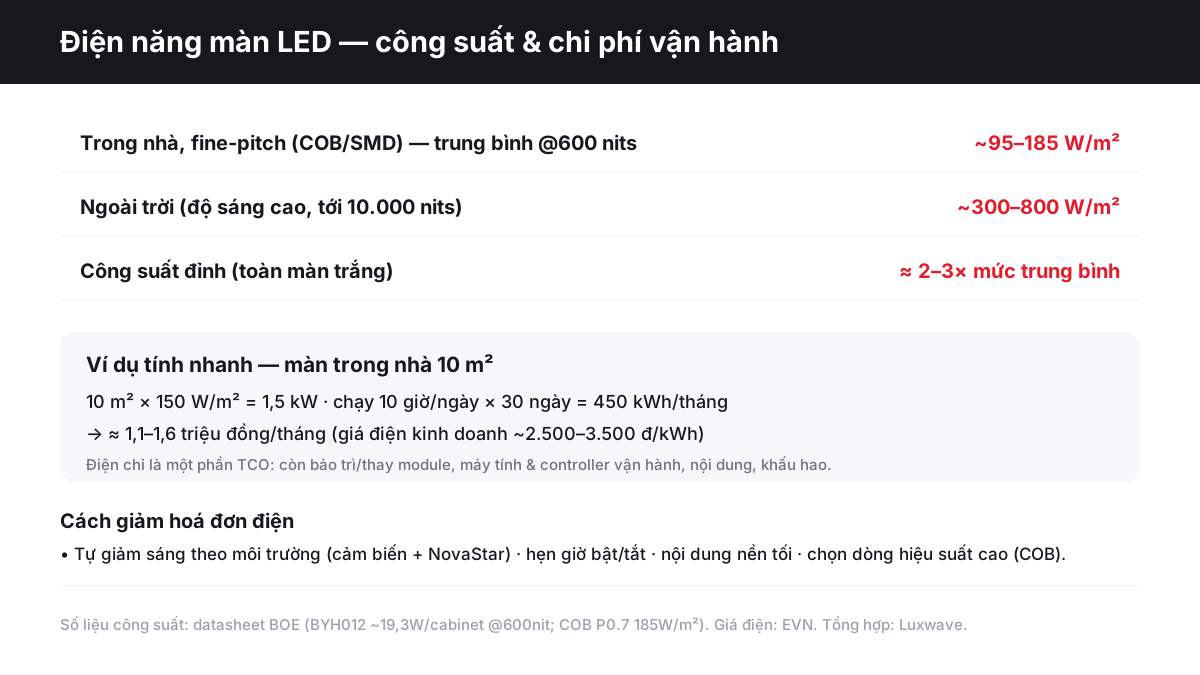
Average power consumption is the reasonable figure for calculating electricity costs because it reflects how the display operates most of the time: videos, slides, dashboards, or advertisements with alternating bright and dark areas. Peak power consumption occurs when the entire screen displays white or experiences extremely high load, typically around 2–3 times the average. These two figures are not interchangeable; one serves the operational budget, while the other serves the electrical design.
When selecting power supplies, circuit breakers, power cables, and electrical panels, the technical team must consider the peak power consumption to ensure the system can handle high-load situations. If only the average power consumption is used for electrical design, the display might be stable when showing dark videos but could overload when performing white balance adjustments, module testing, or displaying bright content. Conversely, using peak power consumption to calculate monthly electricity costs would inflate the estimate, as displays rarely operate at full white continuously in real-world scenarios.

How Many W/m² Do Indoor and Outdoor LED Displays Consume?
According to BOE's manufacturer datasheet power information, indoor fine-pitch COB/SMD displays at an average brightness of 600 nits typically range from 95–185 W/m². For example, the BOE BYH012 consumes approximately 19.3 W per cabinet at 600 nits, equating to roughly 95 W/m²; a P0.7 COB configuration might reach 185 W/m² at 600 nits. This range is suitable for meeting rooms, control centers, showrooms, and spaces requiring sharp images at close viewing distances.
For high-brightness outdoor displays, especially configurations reaching up to 10,000 nits, the average power consumption typically ranges from 300–800 W/m². The reason is not simply that outdoor LEDs are less efficient, but rather that the displays must emit significantly more light to overcome ambient glare. The article What LED Display Brightness (Nits) is Sufficient provides a more detailed analysis of why nits vary based on sunlight direction, viewing distance, and ambient brightness.
How to Calculate Electricity Costs for a 10 m² LED Display?
Let's consider a 10 m² indoor LED display with an average power consumption of 150 W/m². The operating load would be approximately 10 m² × 150 W/m² = 1,500 W, or 1.5 kW. If the display operates 10 hours per day for 30 days a month, the monthly energy consumption is 1.5 kW × 10 hours × 30 days = 450 kWh/month. With a reference commercial electricity price from EVN of approximately 2,500–3,500 VND/kWh, the monthly electricity cost would be around 1.1–1.6 million VND.
| Item | Calculation | Result |
|---|---|---|
| Display Area | 10 m² | 10 m² |
| Average Power | 10 m² × 150 W/m² | 1.5 kW |
| Monthly Energy Consumption | 1.5 kW × 10 hours × 30 days | 450 kWh |
| Reference Electricity Cost | 450 kWh × 2,500–3,500 VND | 1.1–1.6 million VND |
The table above shows that the factors most significantly impacting costs are typically the display area, operating hours, and brightness level. A 10 m² display operating only 6 hours/day will have significantly different costs compared to one running 16 hours/day in a commercial lobby. When budgeting, it's advisable to calculate at least two scenarios: normal operation and peak operation. For COB displays like the BOE BYH COB Ultra P0.9, Luxwave can cross-reference datasheet power consumption with the actual usage schedule to provide a more accurate estimate.
Self-Estimation Table for Quick Application. Customers can estimate costs by selecting a W/m² range based on the installation environment, then multiplying by the area and operating schedule. For indoor fine-pitch displays at 600 nits, a range of 95–185 W/m² can be used for preliminary budgeting; for high-brightness outdoor displays, use the 300–800 W/m² range. This is a reference range based on manufacturer datasheet power consumption and does not replace the final electrical design once the model, brightness, size, and control method are finalized.
| Display Type | Reference Average Power Consumption | When to Use for Estimation |
|---|---|---|
| Indoor Fine-Pitch COB/SMD @600 nits | 95–185 W/m² | Meeting rooms, studios, control centers, showrooms |
| High-Brightness Outdoor up to 10,000 nits | 300–800 W/m² | Billboards, building facades, stadiums |
| Full White Peak Power | Approx. 2–3 times the average | Selecting power supplies, wiring, circuit breakers, and electrical panels |
If a specific model is not yet available, use the midpoint of the range for preliminary budget calculations and add a safety margin for brighter scenarios. If the datasheet is available, prioritize the data from that specific model over market averages. The article LED COB Display Prices 2026 is useful when considering electricity costs alongside initial investment costs, as a high-efficiency display might be more expensive upfront but more economical for long-term operation.
What Costs Are Included in LED Display TCO?
TCO, or Total Cost of Ownership, is not just about electricity costs. For commercial LED displays, TCO should include at least five categories: electricity consumption, maintenance or replacement of faulty modules, operating computers and controllers, content creation, and equipment depreciation. Focusing solely on the initial purchase price can lead clients to choose cheaper configurations that are more power-hungry, difficult to maintain, or require more operational effort over the years.
The control system is a significant cost factor as it directly impacts stability and power consumption. Processors like the NovaStar VX1000 are responsible for receiving signals, processing display output, and supporting operational configurations. When integrated with scheduling, brightness presets, and remote management, the system reduces the need for on-site personnel. The article Remote LED Display Management via Cloud delves deeper into this operational cost aspect.
How to Save Energy Without Making the LED Display Dim?
The most effective way to save energy is by adjusting brightness according to the environment, not by forcing the display to always run at a low level. With light sensors and Novastar control systems, the display can be brighter in well-lit environments and automatically dim when it's dark or room lights are reduced. Viewers still see the content clearly, while the system avoids consuming excess power during unnecessary hours. This is the key difference between operational optimization and manual, one-time brightness reduction.
The remaining three solution categories involve scheduling, content design, and technology selection. Scheduled on/off times ensure the display is not running outside of actual usage hours. Dark background content saves power compared to white backgrounds because LED pixels consume more power only when emitting bright light. High-efficiency series like COB are also a worthwhile consideration for spaces with long daily operating hours, especially when fine image quality, close viewing distances, and stable lifecycle costs are required.
When Should Luxwave Be Contacted for Configuration and Power Supply Calculations?
Luxwave should be consulted for configuration as soon as the project has an estimated size, installation location, and a relatively clear operating schedule. At this stage, the technical team can separate decisions into two layers: the display layer, including pitch, brightness, and COB/SMD technology; and the electrical layer, including average power consumption, peak power consumption, power supplies, wiring, circuit breakers, and electrical panels. As a premium LED display brand under Ho Gia JSC, Luxwave distributes BOE, NovaStar, and Muxwave officially in Vietnam, enabling us to cross-reference datasheets with actual deployment conditions.
For indoor projects like meeting rooms, the priority is usually on image fineness, adequate brightness, and stable operation over many hours. For outdoor displays or stadiums, the focus shifts to high brightness, environmental-adaptive control, and a wider electrical design margin. With the same budget, a correctly configured system will better balance purchase price, electricity costs, maintenance, and lifespan compared to a configuration optimized for only one specification in the catalog.
Conclusion: What to Remember When Estimating LED Display TCO?
Estimating LED display power consumption and TCO is straightforward if each figure's purpose is correctly understood. Average power consumption is used to calculate kWh and monthly electricity costs; peak power consumption is used for designing power supplies, wiring, and circuit breakers; TCO provides a view of the entire lifecycle cost rather than just the purchase price. With the display area, operating schedule, and installation environment known, Luxwave can help select a configuration with adequate brightness, electrical safety, and optimized operational costs.
- Calculate Electricity Costs: Area × Average Datasheet Power × Operating Hours × Days × Reference EVN Electricity Price.
- Electrical Design: Use peak power consumption, approximately 2–3 times the average, to select power supplies, wiring, circuit breakers, and electrical panels.
- Reduce TCO: Utilize light sensors, timers, dark background content, Novastar systems, and high-efficiency LED series like BOE COB.
Pitfalls
Common mistakes
- Using peak power consumption to calculate monthly electricity costs — the estimate is inflated because the display rarely operates at full white continuously
- Using average power consumption to select power supplies, wiring, and circuit breakers — the system may overload with bright content or during white balance calibration
- Ignoring operating schedules and actual brightness levels — a 10 m² display running 6 hours/day differs significantly from one running 16 hours/day
- Focusing only on electricity costs while neglecting maintenance, control computers, content, and depreciation — the lifecycle TCO is incomplete due to missing cost components
FAQ
Frequently asked questions
Are LED displays power-hungry?
LED displays consume power based on their area, brightness, and displayed content. Indoor fine-pitch displays typically consume around 95–185 W/m² at an average of 600 nits according to manufacturer datasheets, while high-brightness outdoor displays consume about 300–800 W/m². With a reasonable operating schedule and automatic brightness adjustment, electricity costs are often more predictable than many assume.
Should average or peak power consumption be used for cost calculations?
Monthly electricity costs should be calculated using average power consumption, as displays do not continuously show full white. Peak power consumption, typically 2–3 times the average, is used for designing power supplies, circuit breakers, and wiring. Separating these two figures ensures operational estimates are not inflated while maintaining electrical safety.
How much does a 10 m² indoor LED display cost per month in electricity?
For example, a 10 m² indoor display using 150 W/m² would consume approximately 1.5 kW. If operated for 10 hours daily for 30 days, the energy consumption is 450 kWh/month. With a reference commercial electricity price from EVN of approximately 2,500–3,500 VND/kWh, the monthly electricity cost would be around 1.1–1.6 million VND.
Why does dark background content help save power on LED displays?
LED displays emit light on a per-pixel basis, so dark areas or black backgrounds consume less power than bright white areas. A playlist with many white backgrounds, bright charts, or high-luminance videos will increase the average power consumption. Designing content with dark backgrounds and good contrast helps reduce power consumption while maintaining readability.
What costs are included in LED display TCO besides electricity?
LED display TCO includes electricity costs, maintenance and replacement of faulty modules, operating computers, control systems, content creation costs, and equipment depreciation. For commercial projects, these costs should be calculated monthly or annually to provide investors with the total lifecycle cost, not just the initial purchase price.
Can LED display brightness be automatically reduced?
Yes. The control system can integrate with light sensors to reduce brightness based on ambient light conditions, which is particularly useful for outdoor displays and lobbies where lighting changes throughout the day. Control solutions like NovaStar allow for configuring schedules, brightness levels, and operating scenarios to reduce power consumption, minimize glare, and ensure a stable viewing experience.
References
- 1.ManufacturerBOE US — manufacturer information and MLED product data
- 2.ResearchEVN — reference electricity tariff
- 3.ManufacturerNovaStar — control system manufacturer