

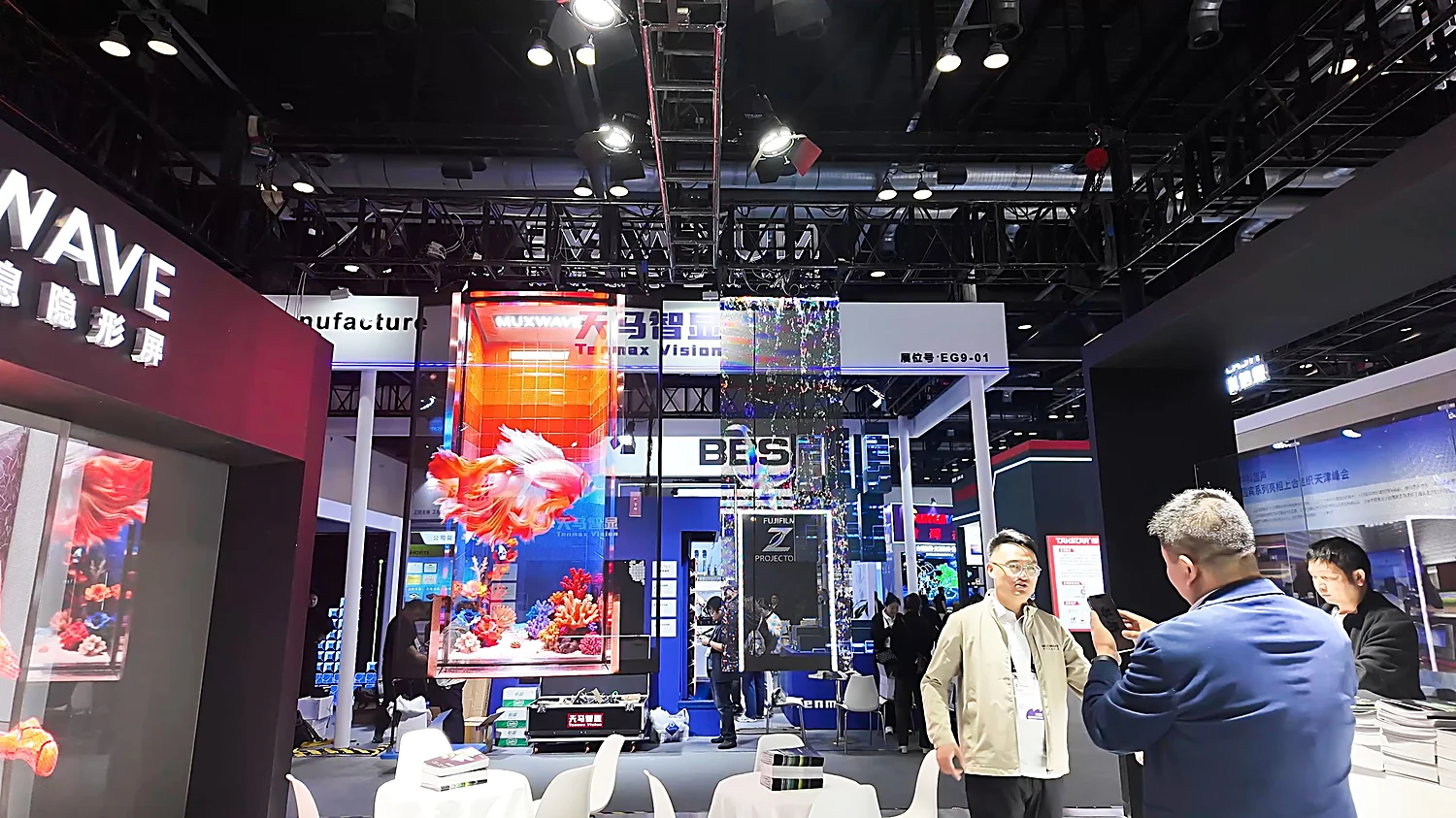
InfoComm 2026 demonstrates that transparent LED displays are no longer just concept videos. For Muxwave, a brand specializing in transparent LED since 2012, 2026 marks a series of deliberate showcases: appearing at InfoComm China in Beijing from April 15-17, 2026, and then bringing the M6 Pro and holographic transparent displays to InfoComm USA in Las Vegas from June 17-19, 2026. For the Vietnamese market, the key takeaway is not about the 'most novel display,' but which technologies can be integrated into showrooms, retail spaces, hotel lobbies, and glass facades within the next 12-24 months.
This article synthesizes data from Muxwave, the official Muxwave website, and InfoComm/AVIXA, viewed from the perspective of a Vietnamese distributor. Luxwave is the authorized Muxwave distributor in Vietnam. Therefore, the focus is not on amplifying exhibition hype, but on accurate interpretation: which models are demos, which have commercial profiles, and what questions Vietnamese projects need to ask before budgeting for transparent displays.
!Muxwave booth at InfoComm 2026 with holographic transparent LED displays
What did Muxwave bring to InfoComm 2026?
Muxwave is bringing holographic transparent LED displays to two key InfoComm events in 2026: InfoComm China at the China National Convention Center, Beijing, from April 15-17, 2026; and InfoComm USA at the Las Vegas Convention Center, from June 17-19, 2026. According to Muxwave, the focus in Las Vegas will be live demonstrations of the M6 series, including the Muxwave M6-Pro, along with new transparent products at their booth.
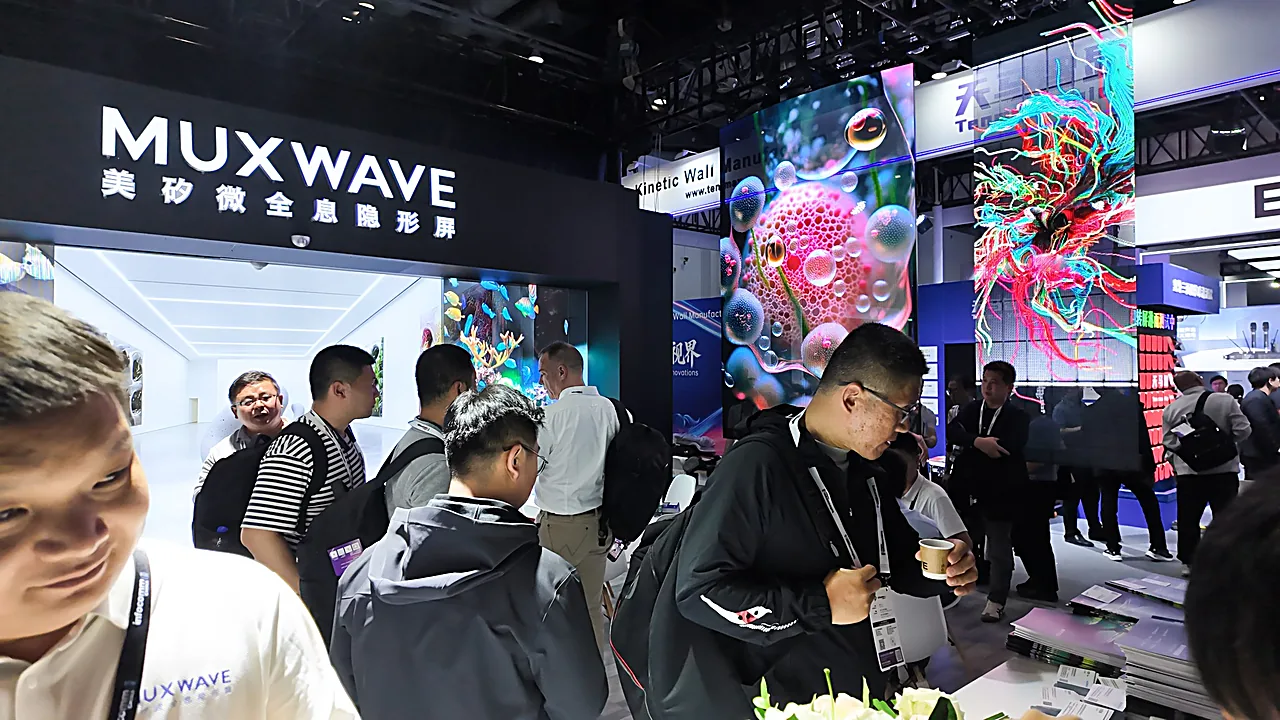
A notable aspect is Muxwave's approach to product storytelling through practical experience rather than solely relying on spec sheets. Visitors will see holographic images that appear to float on a transparent background, while still perceiving the space behind. This demonstration style suits AV professionals, retail designers, brand activation specialists, and system integrators, who inquire not only about brightness but also about how the display impacts the spatial experience.
InfoComm 2026 in Las Vegas features over 750 exhibitors, including more than 130 Chinese companies. A broader analysis of the landscape was covered in the article InfoComm 2026: the Chinese supply chain is increasingly dominant, from chips and packaging to modules and complete displays. In this context, Muxwave has chosen a clear position: not to claim expertise in all types of LED displays, but to emphasize its specialized capabilities in transparent and holographic LED.
!Muxwave transparent LED display tower showcasing holographic content at InfoComm Las Vegas

Why is the M6-Pro more noteworthy than a typical demo display?
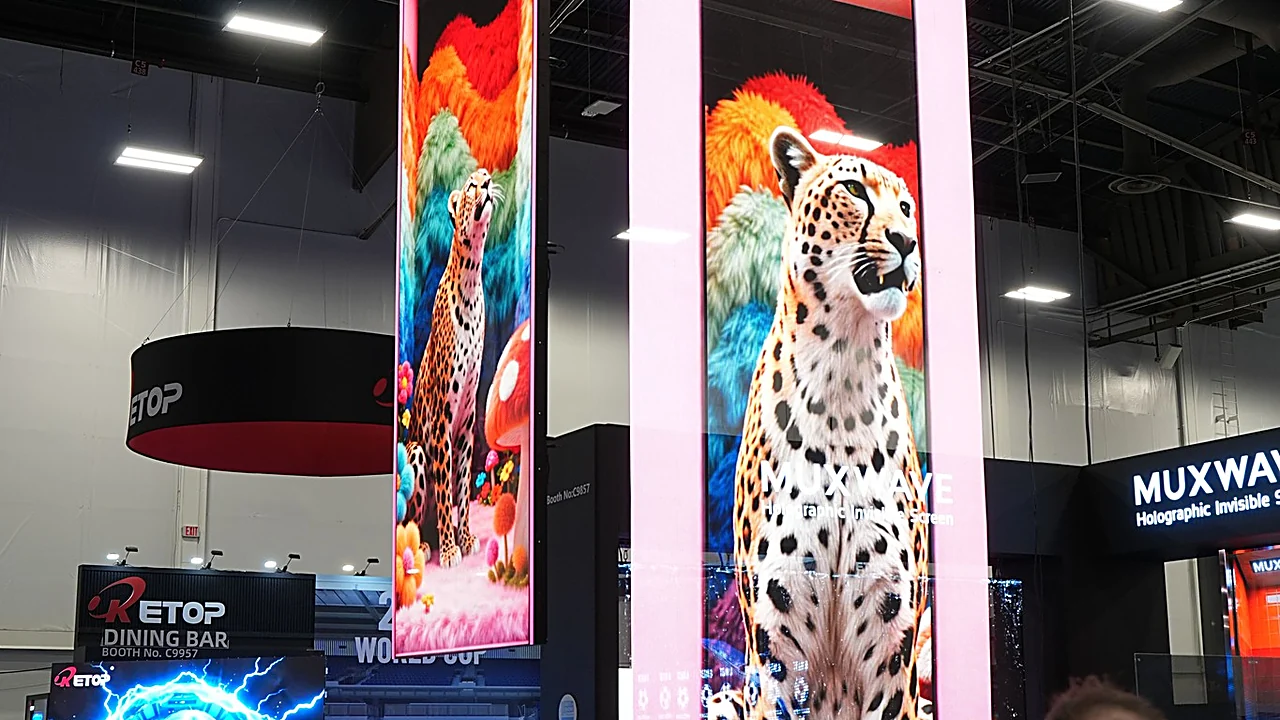
The M6-Pro is noteworthy because it addresses three challenging requirements for transparent displays within a single product direction: high transparency, sufficient brightness for commercial spaces, and long modules for large surfaces. According to Muxwave, this flagship transparent series offers up to 90% transparency, approximately 3,500 nits brightness, and module lengths of 4.22m or 6.75m. These figures should be understood as manufacturer specifications for the product line, not guarantees that every project will achieve the same visual effect.
For standard LED displays, buyers typically start with pixel pitch, brightness, and refresh rate. For transparent displays, the initial questions must differ: how much visibility through the glass is needed, what is the viewing distance, is the background bright or dark, and does the content involve small text or primarily brand effects? Up to 90% transparency is advantageous when maintaining an open feel through the glass, but it does not automatically make all content easily readable.
The M6-Pro is therefore more suitable for facades, large exhibition booths, and events requiring visual impact on extended surfaces. In Vietnam, potential applications for consideration include automotive showrooms, luxury retail stores, product exhibition areas, brand activation stages, and glass facades requiring dynamic communication layers. For smaller glass panes or spaces requiring direct application on thin glass, the Muxwave M Series may be a comparable option.

How does holographic on a transparent background differ from regular LED advertising?
Holographic in the Muxwave context should be understood as a rendering technique that creates a 3D-like floating effect on a transparent background, not a true three-dimensional object suspended in air. When content features clear bright areas, a sufficiently dark background, and custom-designed motion, the image can appear to hover in front of or behind the glass. According to Muxwave, this is one of the display highlights at InfoComm 2026 for their transparent screen range.
The difference from standard advertising LED displays lies in the role of the background space. Standard LED displays obscure the background to create an independent luminous surface; transparent displays allow images to integrate with actual products, interior design, lighting, and customer flow. Thus, a car showroom might use animated graphics on the glass to accentuate the car's lines inside, while a fashion store could run campaign motion graphics while maintaining visibility into the displayed merchandise.
The trade-offs are also clear. Transparent displays are unsuitable if the goal is to show small text, detailed price lists, or dashboards requiring close reading. Holographic content needs to be custom-produced, with minimal extraneous detail, good contrast, and appropriate dark areas for the floating effect. The article What is Muxwave delves deeper into the principles of see-through viewing; while the article Transparent LED Screens explains the technological foundation compared to standard LED displays.
With transparent LED displays, a beautiful demo is just the starting point; accurate budgeting begins with real glass, real lighting, real viewing distances, and real content.
When will this technology arrive in Vietnam and for which projects?
For technologies showcased at InfoComm, the cycle to reach Vietnam typically ranges from 12-24 months, depending on how commercialized the model is, whether an official distribution channel exists, and the availability of spare parts. This is a cautious approach compared to assuming every display at an exhibition is immediately available for order. For Muxwave, Luxwave will need to confirm configurations, lead times, and warranty policies before including demo models in project quotes.
The most suitable applications in Vietnam are spaces with glass surfaces requiring brand effects, including retail, exhibition showrooms, building facades, and hospitality venues. Muxwave transparent displays offer an advantage when clients want glass facades to remain visually open while displaying dynamic content to attract passersby. This differs from LED displays for meeting rooms or standard outdoor advertising screens.
In car showrooms, holographic effects can highlight new car launches, product lines, or seasonal campaigns. In luxury stores, transparent displays add dynamism to the facade without completely obscuring merchandise. In hotel lobbies, they can create visual focal points while preserving architectural openness. For glass facades, a thorough survey of the structure, sun exposure, maintenance access, and lighting regulations is necessary before finalizing the area.
!Full view of the Muxwave booth with multiple transparent displays and visitors
What should Vietnamese investors ask before purchasing?
Before purchasing Muxwave transparent displays, investors should ask suppliers technical and commercial questions. Technical inquiries should cover actual transparency, perceived brightness at the installation site, pixel pitch, viewing distance, installation method (adhesive or suspended), cabling, maintenance accessibility, and content requirements. Commercial questions should include product status, lead time, spare parts, warranty policy, and local support responsibility.
Do not just ask 'what percentage is this display transparent.' Transparency is important, but it must be considered alongside brightness, resolution, and the background. A sun-facing glass surface, a brightly lit showroom, or a store with a very bright background can diminish the holographic effect if the content is not properly designed. Conversely, a space with depth, controlled background lighting, and minimalist content can create a high-end feel without covering the entire facade.
For demo models at exhibitions, questions about commercial availability are crucial. InfoComm 2026 is where brands showcase capabilities and product direction, but project quotes require more specific information: which version is orderable, which module sizes are suitable, delivery timelines, accompanying control systems, and local warranty service. This is why Luxwave maintains a neutral stance: the technology is worth considering, but investment should only proceed when project details are sufficiently clear.
Conclusion: What does Muxwave at InfoComm 2026 say to the Vietnamese market?
Muxwave's presence at InfoComm 2026 indicates that transparent LED displays are evolving from niche novelties to viable solutions for retail, showrooms, lobbies, and glass facades. The company's participation in both Beijing and Las Vegas events this year signals a clear strategy: to present transparent/holographic LED technology to an international audience, especially at InfoComm USA, which convenes the professional AV ecosystem at the Las Vegas Convention Center from June 17-19, 2026.
For Vietnam, the lesson is not to rush into buying the latest technology, but to prepare for accurate assessment. If a project requires maintaining visibility through glass while creating a dynamic communication layer, Muxwave M6-Pro, Muxwave M Series, or Muxwave S Series are worth investigating. If a project requires displaying small text, data, or close-up content, standard LED displays might still be more appropriate. The article Transparent LED Displays & Concepts at InfoComm 2026 provides a good foundation for broader comparisons.
As an authorized distributor, Luxwave interprets InfoComm as a signal of supply and technology, not a sales push. Investors should request demos with realistic content, survey the glass and lighting conditions before finalizing configurations, and verify lead times, warranties, and spare parts. This approach ensures budgets are allocated effectively to create value: see-through effects that genuinely enhance the appeal of retail spaces, exhibition areas, or glass facades.
Pitfalls
Common mistakes
- Viewing holographic effects at a booth as the default display quality for all glass surfaces, when background lighting and actual content significantly influence performance.
- Selecting the highest transparency without verifying perceived brightness, pixel pitch, and content readability at actual customer viewing distances.
- Failing to determine the installation method from the outset: adhesive mounting, suspension, or facade integration will dictate cabling, maintenance, and costs differently.
- Assuming demo models at InfoComm are immediately available in Vietnam, instead of inquiring about commercial status, lead times, and official warranty policies.
FAQ
Frequently asked questions
What did Muxwave showcase at InfoComm 2026?
Muxwave presented its holographic transparent LED display range at InfoComm 2026 in both Beijing and Las Vegas. In Las Vegas, the company featured live demos of the M6 series, including the M6-Pro, alongside new transparent products at their booth. The highlight was images with a floating effect on a see-through background, suitable for retail and showroom environments.
When is InfoComm 2026 in Las Vegas taking place?
InfoComm 2026 in the USA will be held from June 17-19, 2026, at the Las Vegas Convention Center, not Orlando. The event will host over 750 exhibitors and is a major gathering for the professional AV industry. For LED displays, it's a venue where many brands demonstrate technology to integrators, rental companies, retailers, and corporate clients.
What are the notable specifications of Muxwave's M6-Pro?
According to Muxwave's published information, the M6-Pro is a flagship transparent series featuring up to 90% transparency, approximately 3,500 nits brightness, and module lengths of 4.22m or 6.75m. These specifications indicate the product's focus on facades, large events, and spaces requiring see-through visibility, differentiating it from standard LED displays.
What applications in Vietnam are suitable for holographic transparent displays?
Ideal applications include automotive showrooms, luxury retail stores, hotel lobbies, exhibition booths, and glass facades where visual effects offer clear brand value. Holographic transparent displays should not be considered primary screens for small text or data dashboards, as transparency inherently involves a trade-off with pixel density and sharpness.
What is Luxwave's role with Muxwave in Vietnam?
Luxwave is the authorized Muxwave distributor in Vietnam, providing consultation based on official models, practical applications, and local warranty capabilities. For new product lines introduced at exhibitions, Luxwave verifies commercial status, lead times, order configurations, and spare parts before including them in official customer quotations.
What should be asked of a supplier when purchasing Muxwave transparent displays?
Investors should inquire about actual transparency, perceived brightness, pixel pitch, installation methods, cabling solutions, maintenance accessibility, and the commercial status of the proposed model. If the model is from an exhibition demo, confirm lead times, ordering conditions, and warranty policies, rather than relying solely on booth demonstrations.
References
- 1.NewsMuxwave (Official Facebook) — InfoComm 2026 demos
- 2.ManufacturerMuxwave M6-Pro — ISLE 2026 review
- 3.ManufacturerMuxwave — Official Website
- 4.NewsInfoComm (AVIXA) — Official Website