

What are Innovative COB LED Displays and Why is BOE Pursuing This Direction?
Innovative COB LED displays are a category of solutions that utilize COB/flip-chip technology but are not limited to flat surfaces. Within the BOE MLED portfolio, this approach manifests in P1.25 curved forms, the 162-inch GPR 3D display, bar displays, and P0.6 double-sided posters. The common thread is their reliance on COB's inherent advantages: enhanced chip protection, a more seamless surface, and suitability for environments with significant close-range visual interaction.
!BOE bar display for lobbies and bars
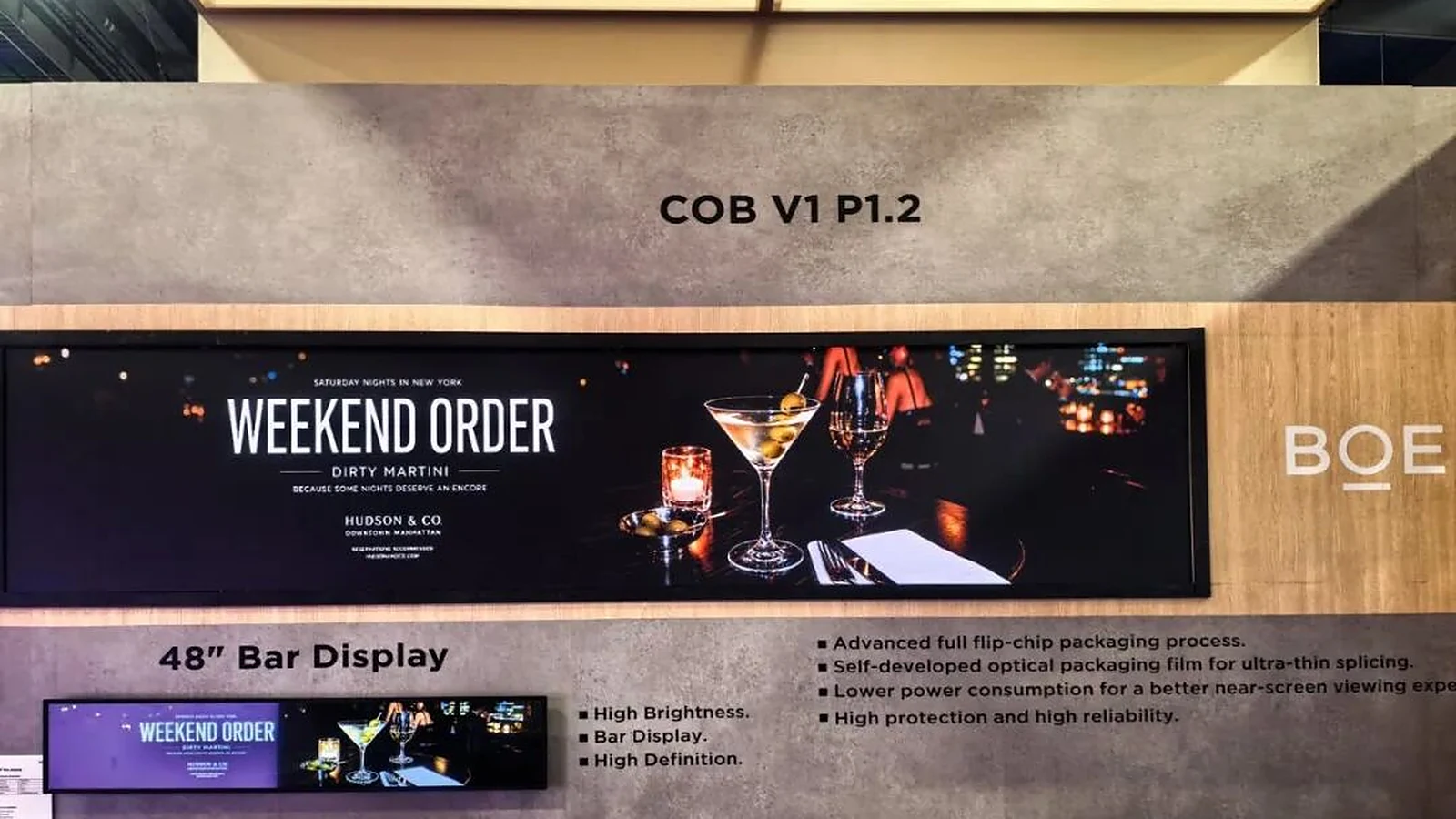
Notably, BOE presents COB not just as a packaging technology, but as a platform for product creation. For developers, this signifies a crucial shift: instead of prioritizing "how bright is this display?", the starting point should be "what problem does the space need to solve?". An empty corner, a round column, a two-way aisle, or a long bar counter each demands a different display shape.
For a conceptual foundation, the article What is a COB LED Display explains why COB differs from SMD in its packaging and surface protection. For BOE's innovative display series, the distinction lies in the subsequent step: using that COB foundation to tackle complex geometries, rather than merely assembling cabinets into a large flat surface. This is also why panel, structure, content, and operation must be evaluated concurrently.
How Does the P1.25 Curved COB Display Break the "COB is Only for Flat" Limitation?
BOE's P1.25 COB Flexible Curved display is described with an ultra-thin PCB and a minimum bending radius of 600mm. This data is significant as it directly addresses a common concern: can COB, with its protective surface coating, only be used for flat displays? With its flexible curved structure, BOE demonstrates that COB can be integrated into corners, round columns, and architectural designs requiring soft curves.
!BOE COB surface as a base for curved and 3D forms
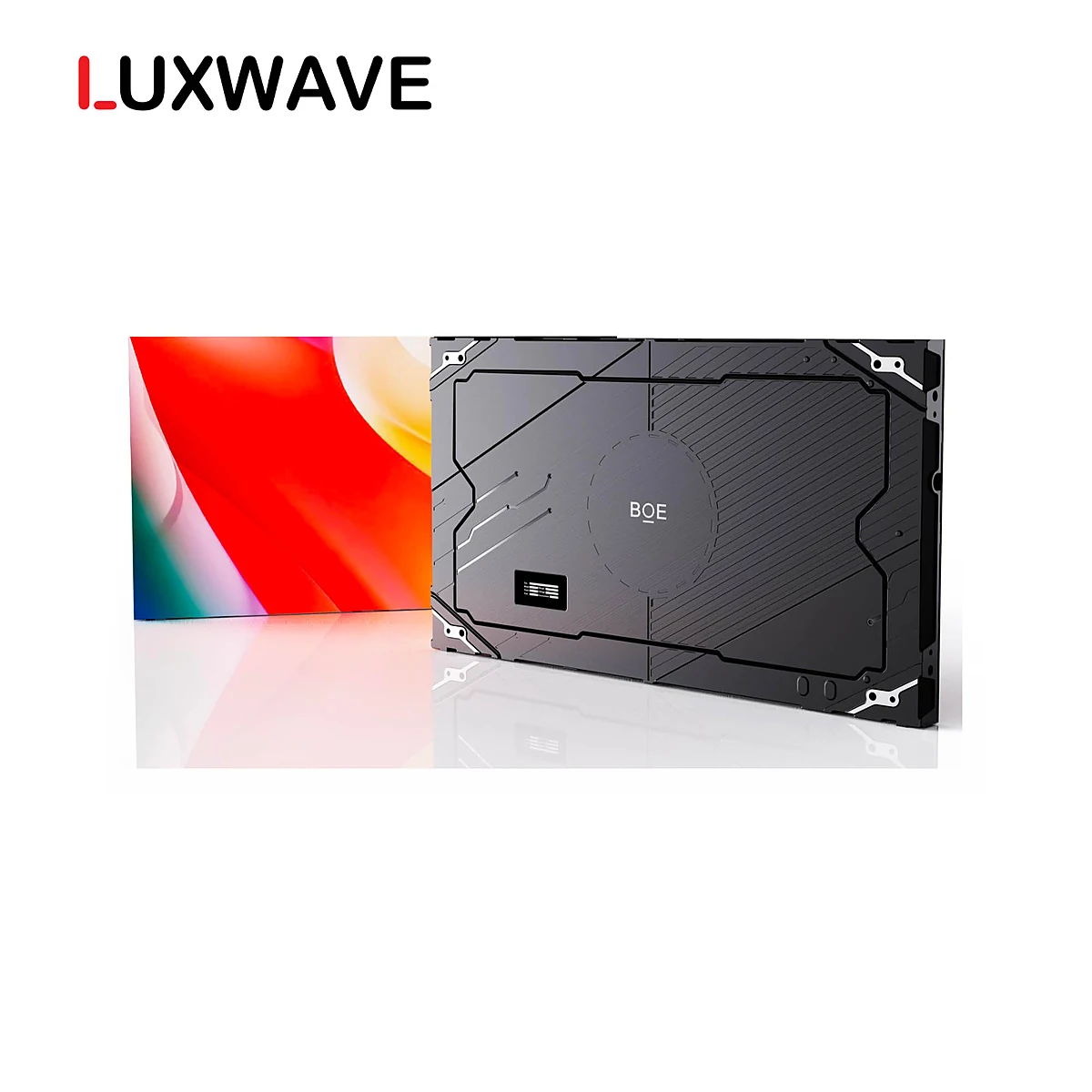
For curved displays, the challenge extends beyond simply bending the modules. The image must be calibrated to the curvature to maintain visual consistency, especially as viewers move along the surface or observe from various angles. BOE's brief mentions curvature correction for image uniformity, a detail that must be included in technical specifications: a beautiful curved display relies not only on mechanics but also on appropriate mapping and calibration.
The most intuitive applications include hotel lobbies, shopping malls, showrooms, galleries, or brand spaces with round columns. In these settings, flat displays often leave gaps or dead zones, whereas curved displays can transform architectural surfaces into focal points. However, curved displays should not be chosen solely for their novelty. A survey of the actual radius, primary viewing lines, viewer paths, and the content to be displayed is essential.

What Problem Does BOE's 162-inch GPR 3D Address?
BOE's P1.25 COB GPR 3D 162-inch display is introduced as the company's first 3D direct-view MLED display, featuring one-touch 2D/3D conversion, central crosstalk below 1%, and viewing angles exceeding 170° horizontally and vertically. These specifications indicate a product designed not merely for displaying 3D content on a flat screen, but as a direct-view display engineered for immersive depth experiences in commercial, medical, educational, and entertainment spaces.
!BOE COB modules are flexible for various display shapes
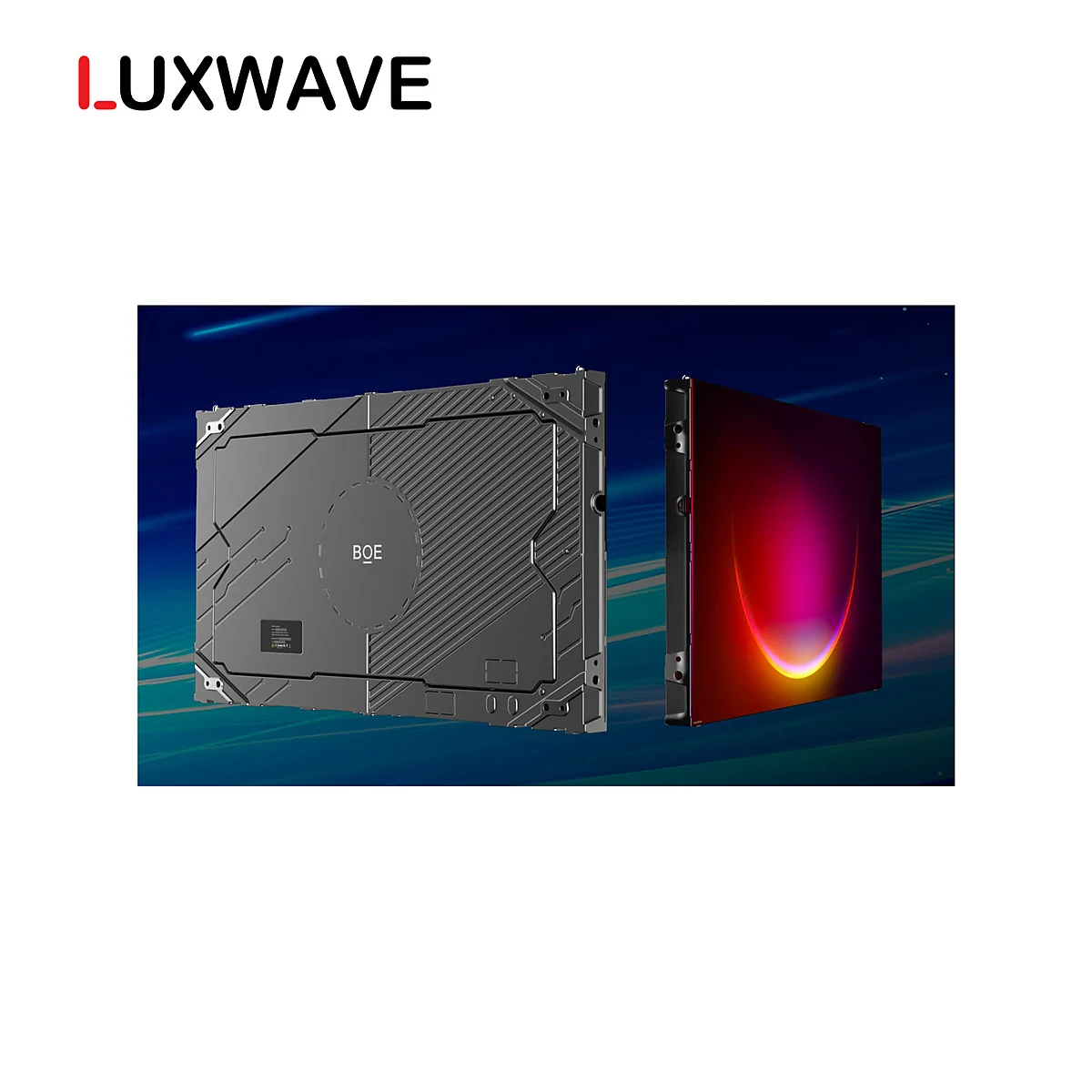
In commercial displays, 3D enhances the perceived depth of products, models, or technical objects compared to 2D video. In medical and educational imagery, depth can aid in explaining complex structures, provided the content is created with the objective in mind. For entertainment, the appeal lies in the one-touch 2D/3D conversion capability, preventing the space from being locked into a single content format.
It's important to distinguish GPR 3D from glasses-free 3D LED displays or outdoor 3D setups using architectural perspective. The brief notes that some content may not require 3D glasses, but this doesn't imply that all content or all viewing positions will yield the same experience. For actual projects, it's advisable to request a demo using content similar to the intended application, testing viewing angles, long-term viewing comfort, and the 2D/3D conversion process.

When Should You Use a COB Bar Display Instead of a 16:9 Display?
Bar displays, or stretched displays, are suitable when a space has a very wide aspect ratio but limited height. BOE COB V1, for example, offers a 48-inch bar display format targeted at bar counters, supermarket shelves, and lobbies. The brief highlights its full flip-chip structure, proprietary optical film, low power consumption, and high durability. These features indicate a product designed for frequently used, close-proximity locations requiring a robust surface.
While 16:9 displays are ideal for standard video playback, they don't always integrate seamlessly with architecture. A long bar counter, a retail shelf strip, or a reception desk edge often requires horizontal content: logos, short menus, promotional information, area status updates, or rhythmic visuals. Forcing 16:9 video into an ultra-wide format can lead to content cropping, small text, or wasted space.
Therefore, when selecting a bar display, the correct question isn't "Can it replace a TV?", but rather "Is the content designed for an ultra-wide aspect ratio?". BOE's bar display models are well-suited for commercial applications where viewers are in motion, receive quick information, and don't stand for extended reading. If a project requires a primary screen for meetings, operations, or dense data presentation, consider flat panel displays like the BOE BYH012 COB P1.25 or more appropriate video wall configurations.
What Spaces Are Suitable for the P0.6 Double-Sided Poster?
BOE's P0.6 double-sided MPD addresses a very specific need: displaying content from two directions within a single device suspended in space. The brief mentions the product's full-coverage packaging, enhancing resistance to impact, moisture, and oxidation; a brightness of up to 1000 nits; and a contrast ratio of 10,000:1. These specifications are ideal for digital posters placed in lobbies, showrooms, shopping malls, or corridors with two-way foot traffic.
Unlike wall-mounted flat displays, double-sided posters eliminate wasted rear space. When suspended centrally, they can serve viewers approaching from both directions, such as at mall entrances, check-in areas, event foyers, or exhibition corridors. However, this also complicates deployment: the unit must be neatly powered, securely mounted, not obstruct pathways, and have a maintenance plan that minimizes operational disruption.
Regarding content, double-sided posters should utilize concise messages, clear imagery, and appropriate transition durations. If each side serves a different viewing direction, the content playback schedule can also differ based on viewer behavior. This is where coordination between spatial designers, LED technicians, and content operators is crucial. For brand projects, further information on manufacturer capabilities can be found at BOE MLED to review product specifications and technological positioning.
What Criteria Should Guide the Selection of Special COB Displays?
Special COB displays should be chosen when the form factor genuinely adds value to the experience or resolves architectural constraints. If the need is to wrap around a column, the P1.25 COB Flexible Curved is relevant. If depth presentation is required in an exhibition area, the 162-inch GPR 3D is worth considering. For narrow and long spaces, a bar display is more suitable than a 16:9 screen. If viewers approach from two directions, the P0.6 double-sided poster can better utilize a mid-space suspension point.
A practical evaluation method involves four key questions. First, does the display's shape solve a problem that a flat display handles poorly? Second, is the content produced for the correct aspect ratio, surface, and viewing angle? Third, can the signal processing, calibration, and maintenance systems keep pace with the unique shape? Fourth, is the operational lifecycle compatible with the real environment, including potential impacts, humidity, foot traffic, and operating hours.
At the system level, special COB displays still require an image processor, signal mapping, and a technical team proficient in fine-pitch LED. Luxwave typically recommends reviewing the overview article BOE BYH Ultra - The Latest High-End COB LED Display to understand the high-end COB platform, and also consulting How to Choose LED Pixel Pitch 2026 before finalizing size and viewing distance. Innovative shapes are sustainable only when built upon sound engineering design, not merely as a visual effect for the opening day.
For spaces like event stages or command centers, selection criteria differ. Stages prioritize visual impact, transitions, and lighting integration. Command centers prioritize data readability, image uniformity, long operating hours, and predictable maintenance. Therefore, even within the COB/flip-chip category, each BOE form factor should be shortlisted based on its specific use context, rather than being considered direct alternatives to each other.
Pitfalls
Common mistakes
- Choosing a curved display solely for visual effect without verifying the bending radius, frame structure, and whether content is adapted for the curved surface.
- Confusing direct-view 3D displays with all types of glasses-free 3D LED displays; clarity is needed on content conditions, viewing angles, and display objectives.
- Using bar displays in locations requiring detailed reading of small text from afar, when the ultra-wide aspect ratio is better suited for short, motion-based content and brand recognition.
- Suspending double-sided posters in a space without considering foot traffic, viewing directions, power supply, maintenance, and mechanical safety.
FAQ
Frequently asked questions
How do innovative COB LED displays differ from standard flat COB displays?
Flat COB displays focus on smoothness, surface durability, and seamless integration on a plane. BOE's innovative forms extend the COB/flip-chip platform to curved, 3D, bar, or double-sided surfaces. Therefore, the challenge involves not just pixel pitch but also geometry, viewing angles, and content.
Where is BOE's P1.25 curved COB display suitable?
The P1.25 COB Flexible Curved is ideal for corners, round columns, commercial lobbies, or exhibition spaces requiring a display that conforms to architectural curves. The minimum 600mm bending radius overcomes flat-panel limitations, but requires frame design, signal routing, and content tailored to the actual curvature.
Is the 162-inch GPR 3D a glasses-free 3D display?
According to BOE's brief, the 162-inch GPR 3D is BOE's first direct-view 3D MLED display, featuring one-touch 2D/3D conversion, with some content viewable without 3D glasses. However, the perceived effect depends on the content, viewer position, and intended use.
What kind of content is best suited for COB bar-shaped LED displays?
Bar displays or stretched displays are ideal for short content, brand recognition, motion graphics, signage, menus, or horizontal visuals at bar counters, supermarket shelves, and lobbies. The ultra-wide aspect ratio is not optimal for text-heavy presentations, requiring custom layout design instead of simply adapting 16:9 video.
How does a P0.6 double-sided LED poster differ from a standard suspended LED display?
The P0.6 double-sided MPD is designed for dual-directional viewing, suitable for suspension in spaces like digital posters. Its full-coverage packaging enhances resistance to impact, moisture, and oxidation. During deployment, careful consideration of viewer paths, mounting safety, and maintenance access is essential.
Should I choose a special COB LED display over a flat panel?
Choose one when the special form factor genuinely solves a problem: wrapping columns, handling corners, suspending in traffic flow, or creating a 3D exhibition experience. If the space only needs clear content delivery on a large flat surface, a standard flat COB display might still be the more appropriate solution.
References
- 1.ManufacturerBOE MLED COB & COG at InfoComm 2025
- 2.ManufacturerGenuine BOE MLED
- 3.ManufacturerBOE Technology Group
- 4.ManufacturerGenuine PixelHue
- 5.NewsPixelHue Facebook
- 6.StandardPixelHue Master Academy Curriculum
- 7.ResearchCreative LED Applications Compilation