

Why is Brightness the Biggest Deciding Factor Between Indoor and Outdoor?
Brightness (measured in nits) is the primary differentiator that drives all other differences between indoor and outdoor LED displays. Indoor screens only need 800–1,500 nits to be clearly visible in rooms with ambient ceiling lighting (300–500 lux). Outdoor screens, however, must achieve 5,000–10,000 nits to compete with Vietnam's intense sunlight, which can peak at 10,000–15,000 lux midday. Because they require 5–10 times higher brightness, outdoor LED chips consume more power, generate more heat, and consequently necessitate a larger, heavier cabinet structure.
It's crucial to distinguish between the "peak brightness" stated on datasheets and the actual operating brightness. Datasheets typically report the maximum value a chip can achieve under short-term testing conditions, while actual operation is limited to 60–70% of the peak to protect chip longevity. An outdoor display with a 10,000 nits peak rating will operate at approximately 6,000–7,000 nits in reality, still 5–7 times brighter than indoor screens. You can view Luxwave's LED project portfolio to visualize actual brightness levels in various environments.
!Bright outdoor LED billboard in the rain, IP65 waterproof
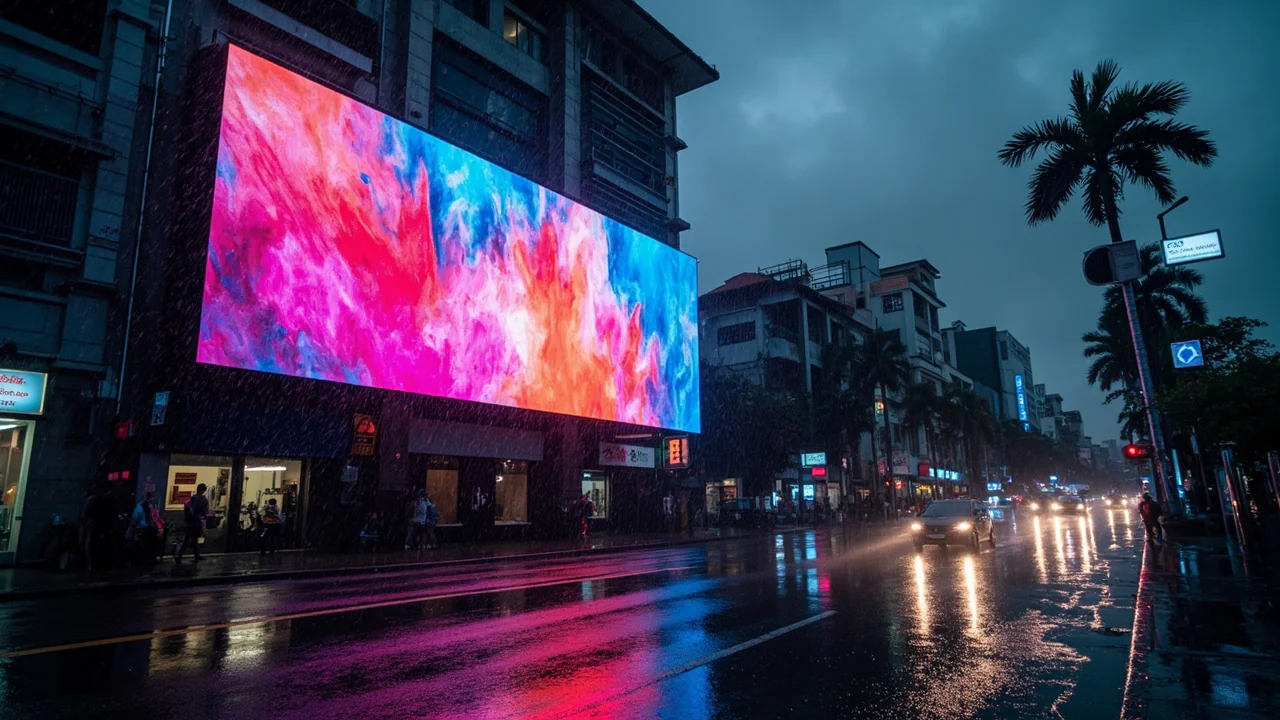
How Do Peak Brightness and Operating Brightness Differ?
When operating outdoors, an auto-brightness sensor will automatically reduce brightness in the evening to 30–40% of the daytime output. This not only saves 30–40% on electricity but also extends chip lifespan. For the same outdoor model, the absence of such a sensor leads to significantly higher electricity and maintenance costs over 5 years. For indoor screens, this feature is rarely needed due to stable ambient lighting conditions.

What's the Difference Between True IP65 and "Paper" IP65 for Outdoor Screens?
The IP (Ingress Protection) standard, according to IEC 60529, is defined by two digits: the first indicates dust protection (scale 0–6), and the second indicates water protection (scale 0–9). True outdoor LED displays must achieve IP65 on the front and IP54 on the rear. The issue is that many products only advertise front testing, while the rear, where power ports, fans, and cables are located, may only have IP43–54 protection. When rain hits the rear of the cabinet, it can corrode resistors and capacitors within 3–6 months, leading to widespread cabinet failure.
To verify the true IP rating, request the official manufacturer's datasheet, not just a marketing brochure. A proper datasheet should clearly state "IP65 (front) / IP54 (rear)" or equivalent, ideally accompanied by an independent test certificate from an organization like TUV or SGS. Products that vaguely state "IP65" without specifying front or rear are a clear red flag. Refer to our Q2/2026 Price List to compare costs across different IP rating levels.
How to Check the IP Rating of an Outdoor Screen Before Purchase
A practical tip from Luxwave's technicians is to examine the rubber gaskets around the cabinet edges and the rear power ports. True outdoor cabinets feature seamless, sealed gaskets and IP67-rated waterproof connectors, not exposed outlets. If a supplier is unwilling to show the rear of the cabinet or avoids questions about rear IP protection, it's a sign the product does not meet genuine outdoor standards for tropical climates.

Which Pixel Pitch and Refresh Rate Should Be Chosen Based on Viewing Distance?
Pixel pitch and refresh rate should be selected based on the actual viewing distance, not solely on whether the environment is indoor or outdoor. A quick rule of thumb used by technicians is: minimum viewing distance (meters) ≈ pixel pitch (mm) x 3. For meeting rooms where viewers are 2–5 meters away, a small pitch like P1.5–P2.5 is required. For outdoor billboards viewed from 10–30 meters, P6–P10 is appropriate; choosing a smaller pitch would be unnecessarily expensive as the difference is imperceptible at that distance.
Regarding refresh rate, indoor meeting rooms and studios require 3,840–7,680Hz to prevent flicker when recorded by cameras. Outdoor screens typically only need 1,920Hz, which is sufficient for passersby. This is because typical smartphone cameras record at 60fps, and a 1,920Hz refresh rate is 32 times higher, eliminating visible flicker. Only consider upgrading to 3,840Hz for outdoor screens if the content will be filmed by drones or DSLR cameras at concerts or outdoor events. For detailed selection criteria, see our article on Choosing Pixel Pitch for LED Meeting Room Screens and the BOE BYH-COB P0.9 series for close viewing applications.
!Rear of an outdoor LED cabinet with waterproof rubber gasket and moisture-proof power connector
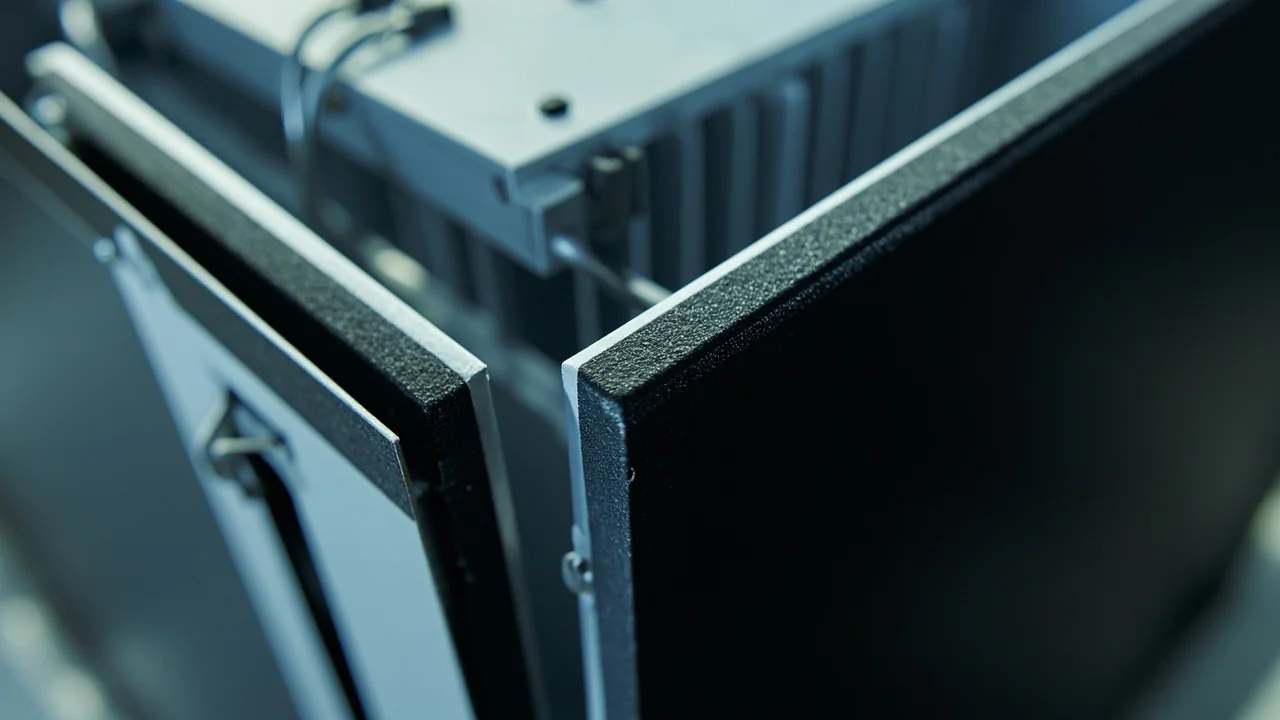
Which Type is Suitable for Indoor Showrooms and Exhibitions?
Indoor showrooms and exhibitions often have visitors viewing from very close distances, under 3 meters. Therefore, small pixel pitches and high refresh rates are necessary for clear images captured by visitor cameras. The SMD P1.86 series, such as the BOE BSL P19, offers a good balance between sharpness and cost, while the COB P0.9 is designed for high-end VIP areas. This is a typical indoor environment where 800–1,200 nits brightness is more than adequate, eliminating the need for outdoor power specifications.
Why Are Temperature and Heat Dissipation Critical Tests in Vietnam's Climate?
Operating temperature is one of the most underestimated factors, yet it significantly determines the lifespan of displays in tropical climates. Vietnam's outdoor temperatures can peak at 40°C in summer in Ho Chi Minh City and Hanoi, and surfaces near asphalt roads can reach up to 60°C. Outdoor LEDs must operate stably within the -30°C to +60°C range as specified by BOE and NovaStar. In contrast, indoor LEDs are designed for -10°C to +45°C. Installing them outdoors during the Vietnamese summer will trigger thermal protection and cause automatic shutdowns every 2–3 hours of operation.
The more severe consequence is that prolonged operation beyond the designed temperature threshold accelerates chip degradation by 3–5 times compared to normal operation. After 6–12 months, indoor screens installed in the wrong environment will experience color degradation, brightness inconsistencies between modules, and eventual cabinet failure. This is also why outdoor cabinets require steel frames and larger heat sinks, making them 3–4 times heavier than indoor ones. An indoor cabinet weighs only 6–9kg, while an outdoor unit can weigh 24–32kg, necessitating structural considerations for wind load according to TCVN 2737-1995.
When Is a Structural Engineer Required for Load Calculations?
For all outdoor projects exceeding 10m², the mounting structure must be specifically calculated by a structural engineer, considering cabinet weight, wind load, and installation location. Building facades require calculations for wind load and waterproofing of the structural components, while independent pole-mounted billboards need concrete foundations and a minimum wind load rating of 12. Generic metal frames are insufficient for safely mounting 24–32kg cabinets at height, especially in typhoon-prone areas. Contact Luxwave's technical team for a structural survey before receiving a quote.
Should Indoor LEDs Be Used Outdoors to Save Costs?
Absolutely not, even though some low-cost dealers may advise that "indoor LEDs can be used outdoors with a canopy" to reduce prices by up to 40%. This is seriously misleading advice with costly consequences. The 1,500 nits brightness of indoor screens is insufficient for daytime visibility under sunlight, leading to customer complaints within the first week. Rain penetrating the canopy will still corrode cabinets, which only achieve IP31, within 6 months, and peak summer temperatures will repeatedly trigger thermal shutdowns.
Most importantly, the manufacturer's warranty will be voided due to incorrect installation environment, a policy clearly stated by both BOE and NovaStar in their terms and conditions. The actual lifespan of indoor screens installed outdoors is reduced to 12–18 months instead of 8–10 years if the correct outdoor models were chosen. Consequently, the initial "40% savings" turn into a significant loss when the entire screen needs replacement after just over a year. The correct approach is to determine the actual environment from the outset: whether there will be direct sunlight, rain exposure, and peak summer temperatures, and then select the appropriate indoor or outdoor model—there is no viable "hybrid" option. Subsequently, verify the IP rating on the official datasheet, budget for the mounting structure, and for outdoor installations, prioritize brands with typhoon resistance certifications. For specific configuration advice, please contact Luxwave's technical team for a transparent site survey and itemized quotation.
| Criterion | LED Indoor | LED Outdoor |
|---|---|---|
| Peak Brightness | 800-1,500 nits | 5,000-10,000 nits |
| Front IP Rating | IP21-IP31 | IP65 |
| Rear IP Rating | — | IP54 (rain splash resistant) |
| Refresh Rate | 3,840-7,680 Hz | 1,920 Hz (common) |
| Cabinet Thickness | 80-100mm | 130-180mm |
| Weight/Cabinet | 6-9 kg | 24-32 kg |
| Operating Temperature | -10°C to +45°C | -30°C to +60°C |
| Auto-Brightness Sensor | Not required | Yes (30-40% power saving) |
| Equivalent P5 Investment Cost | Lower (rare P5 indoor) | Higher due to IP, power, die-cast housing |
Pitfalls
Common mistakes
- Thinking water resistance is the only difference — 4 other factors (brightness, refresh rate, thickness, temperature) are critical, affecting cost and lifespan.
- Trusting "IP65" specs without checking the rear — many products claim front IP65 but have IP43 rear; rain ingress will cause failure within 3–6 months.
- Using indoor LEDs outdoors to save 40% cost — consequence: failure in 6–12 months due to temperature and humidity, warranty denial for incorrect environment.
- Underestimating outdoor mounting structure loads — outdoor cabinets are 3–4 times heavier than indoor ones, requiring reinforced metal frames and wind load calculations.
- Installing outdoor screens without auto-brightness sensors — operating at 100% max brightness continuously wastes power and reduces chip lifespan by 40–50% over 5 years.
FAQ
Frequently asked questions
Can indoor LEDs be used outdoors?
Not recommended. Indoor LEDs with 800–1,500 nits brightness cannot compete with Vietnam's harsh sun (peak 10,000–15,000 lux). IP21–31 standards only offer light dust protection, not rain resistance. Outdoor installation will result in washed-out images during the day and module failure within 6–12 months due to moisture. Manufacturer warranties are voided for incorrect environmental use, a policy applied by both BOE and NovaStar.
Can outdoor LEDs be installed indoors?
Yes, but it's overkill and unnecessarily expensive. Outdoor LEDs with 5,000+ nits brightness will be excessively bright and cause glare in rooms with standard ceiling panel lighting. Their thicker (130–180mm) and heavier cabinets are difficult to mount on meeting room ceilings. The cost is 30–50% higher than indoor screens with the same pitch. They should only be used for specific needs like garages, covered terraces, or transitional indoor-outdoor spaces.
What does IP65 mean and is it sufficient for Vietnam's outdoors?
IP65 means complete dust protection (digit 6) and protection against water jets from any direction (digit 5) according to the IEC 60529 standard. This is generally sufficient for normal Vietnamese rain. However, many products only have IP65 on the front, with IP43–54 on the rear, which can fail if rain splashes in. The correct outdoor standard requires IP65 front and IP54 rear. Always check the official datasheet before purchasing; do not rely on generic marketing specifications.
What refresh rate is needed for outdoor displays?
1,920Hz is the standard for common outdoor use, sufficient for viewing by passersby. If the content will be captured by cameras, such as at outdoor concerts or drone shoots, 3,840Hz is needed to avoid flicker. Modern smartphone cameras recording at 60fps may show flicker even at 1,920Hz, so upgrading to 3,840Hz is advisable if the content will be shared on social media. Smaller outdoor pitches like P3–P4 are often paired with higher refresh rates.
Is an auto-brightness sensor necessary for outdoor displays?
Highly necessary. The sensor detects ambient light and automatically reduces brightness by 60–70% in the evening. This saves 30–40% on power and extends LED chip lifespan, as continuous operation at 100% brightness reduces lifespan by 40–50% over 5 years. Outdoor screens without this sensor operate sub-optimally, wasting electricity and causing rapid chip degradation. Tier-1 OEMs like BOE and NovaStar include sensors with their controllers.
How much heavier are outdoor cabinets compared to indoor ones?
Outdoor cabinets are 3–4 times heavier than indoor cabinets of the same size due to steel frames, heat sinks, and waterproofing layers. An indoor cabinet weighs only 6–9kg, while an outdoor unit can weigh 24–32kg. Therefore, outdoor mounting structures must be specifically calculated for wind load by a structural engineer according to TCVN 2737-1995, and generic metal frames are not sufficient. For large outdoor projects, this is a critical cost and safety consideration that cannot be overlooked.
References