

Why are RGB Displays Heating Up Before the 2026 World Cup?
The 2026 World Cup is the first to be co-hosted by three nations: the USA, Canada, and Mexico. The scale is also expanding to 48 teams, with 104 matches over 39 days, meaning a concentrated period of top-tier football content spread over more than a month. For display manufacturers, this is a natural proving ground for high-end TVs: wide green pitches, colorful team jerseys, extremely bright stadium lights, fast motion, and viewers wanting to feel like they are at the stadium.
!High-end RGB display showing a 2026 World Cup football match with vibrant colors
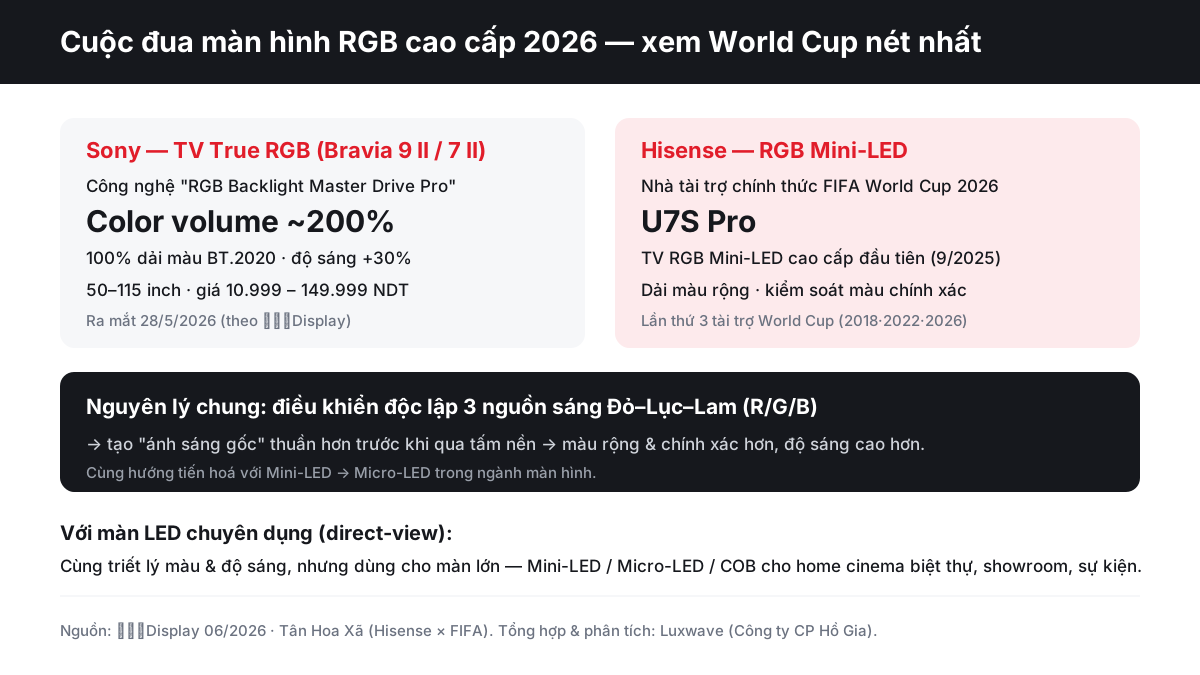
What's notable in 2026 isn't just bigger TVs, but how manufacturers are returning to address the fundamental aspect of image: light. Sony is opting for the True RGB approach with its Bravia 9 II and Bravia 7 II lines, launching on May 28, 2026, using RGB Backlight Master Drive Pro technology. Hisense is following the RGB Mini-LED path, tying this narrative to its role as the official FIFA World Cup 2026 sponsor for the third time after 2018 and 2022.
For Vietnamese consumers, this news shouldn't be seen as just a TV race. It indicates that the high-end display industry is collectively moving towards two familiar goals for professional LED displays: wider color gamut and higher brightness. If the need is just for a living room TV, the RGB consumer lines are one direction. But if the goal is a large-format football display for a villa, home theater, showroom, or premium lounge, the answer often lies in direct-view LED COB/Mini-LED rather than large-inch TVs.
What are RGB Backlight, True RGB, and RGB Mini-LED?
RGB backlight is a lighting architecture that uses three separate red, green, and blue light sources instead of a white or blue backlight followed by a color conversion layer. When the three primary colors are independently controlled, the display can mix colors more purely from the source, reduce filter loss, and expand color volume. This is why terms like True RGB, RGB Mini-LED, or RGB Backlight all revolve around the same philosophy: controlling color from the light source.
Mini-LED has typically significantly improved contrast over traditional LCDs thanks to more, smaller dimming zones. QLED is often mentioned for its quantum dot layer that expands color. However, both these popular approaches still rely heavily on a backlight system that doesn't fully separate the three RGB sources independently. RGB Mini-LED goes deeper: individual red, green, and blue light clusters are coordinated to create colors and brightness closer to the intended image, especially in HDR scenes with very bright areas.
Sony calls the technology in its new Bravias RGB Backlight Master Drive Pro. According to 行家说Display, the Bravia 9 II and Bravia 7 II use independent control of Red/Green/Blue light sources, aiming for purer colors and higher brightness. The Bravia 9 II achieves a color volume of about 200%, and the Bravia 7 II about 150%, described as the highest in Sony's consumer TV history. For TVs, this is an upgrade at the backlight level; for professional LED displays, it recalls a well-known principle: good color starts with a good light source.

What are Sony and Hisense Betting on for the Football Season?
Sony is launching the Bravia 9 II and Bravia 7 II in China on May 28, 2026, just in time for the 2026 World Cup. The Bravia 9 II is the most heavily promoted model: new LED controller, RGB Triluminos Max, Luminance Booster Pro, "miraculous black screen Pro" anti-glare, about 30% increased brightness, and covering about 90% of the BT.2020 color gamut. Sizes range from 65 to 115 inches, positioned in the premium TV segment, with the 115-inch model being the most expensive flagship in the line.
Sony's message is clear: premium TVs in 2026 will compete not just on resolution or screen size, but on their ability to maintain color accuracy at high brightness levels. For football, this is a tougher challenge than movies in a dark room. A daytime match features a green pitch, white jerseys, LED boards around the stadium, and strong sunlight or floodlights; if the screen increases brightness but loses color saturation, the image will appear washed out. RGB backlight aims to avoid this by maintaining vibrant colors even when pushing nits.
Hisense is taking a broader approach: linking RGB Mini-LED with the FIFA World Cup 2026. According to Xinhua/news.cn, Hisense is the official sponsor of the FIFA World Cup 2026 for the third time after 2018 and 2022. The U7S Pro model was introduced in late September 2025 as the company's first premium RGB Mini-LED TV. This technology emphasizes high color gamut, precise color control, and low blue light for eye protection; FIFA calls it a "major leap in the football viewing experience."
Why is RGB Different from Previous Large TV Races?
For years, the premium TV market has typically focused on three narratives: 4K/8K, number of dimming zones, and larger screen sizes. While these factors remain important, they don't fully answer the perceptual question: why do two screens with the same 4K resolution, same size, and same HDR content look different? RGB shifts the competition to the foundation of the experience: the light spectrum, color purity, and how the screen maintains color as brightness increases.
With typical QLED or Mini-LED, manufacturers can achieve very high brightness, but the color creation process still depends on passing through conversion layers and color filters. As brightness increases, controlling saturation, white balance, and highlight detail becomes more difficult. RGB backlight separates the red, green, and blue sources, giving the system more control. This isn't a magic bullet that replaces all image processing, but it provides a better foundation for HDR.
This point directly relates to the challenges that professional LED displays have long pursued: HDR on fine pitch LED displays requires not just brightness, but controlled brightness, maintained detail, and colors that aren't harsh. Similarly, Mini-LED vs. Micro-LED differ not just in chip size, but in how they emit light, are packaged, controlled, and applied in practice. RGB in TVs is a branch of the same pursuit of light quality.
!Close-up of a fine pitch COB LED display for large-format home theaters and cinemas
What Can Professional LED Displays Learn from the RGB TV Race?
The key takeaway is that RGB TVs and professional LED displays are not the same products, but they share the same philosophy: wide color and high brightness must be accompanied by good control capabilities. Consumer TVs are still limited by screen size, panel production lines, living room design, and retail ecosystems. Direct-view LED is different: displays are assembled from modules, measured by area, with pixel pitch chosen based on viewing distance, and use specialized processors for calibration in each space.
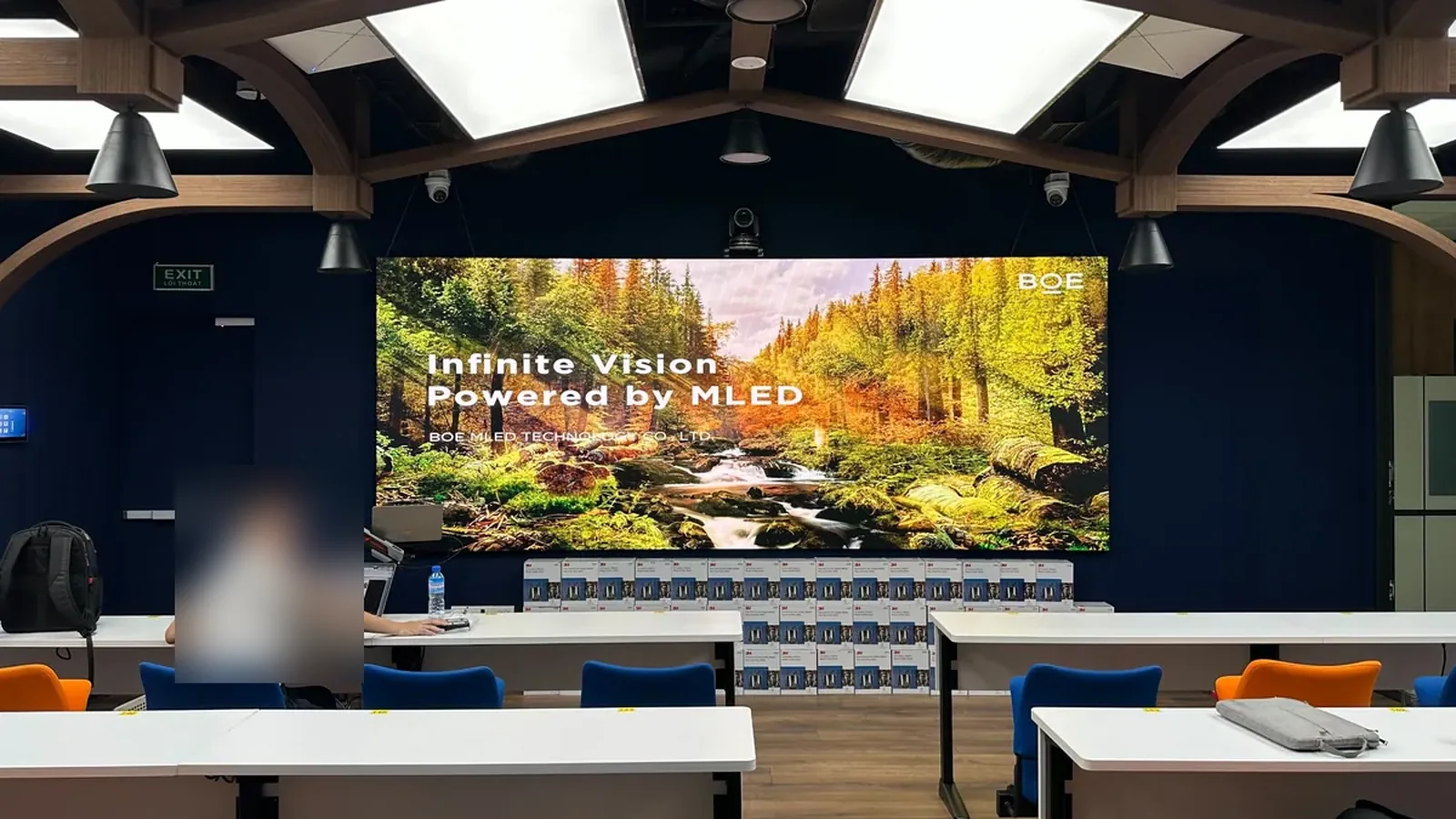
For large screens, the solution isn't to push TVs to 115 inches at all costs, but to use direct-view LED such as Mini-LED, Micro-LED, or COB. COB is particularly suitable for premium spaces due to its sealed packaging surface, smooth appearance at close distances, reduced risk of pixel damage, and seamless feel when creating screens from 120 inches, 150 inches, up to several hundred inches. This is why projects for luxury villa home cinemas or private theaters are increasingly moving beyond the traditional wall-mounted TV mindset.
Luxwave does not sell Sony or Hisense consumer TVs. Luxwave is a premium LED display brand under Ho Gia JSC, an authorized distributor for BOE, NovaStar, and Muxwave in Vietnam. Luxwave's focus is on large-format LED displays: BOE COB fine pitch for theaters, showrooms, meeting rooms, and experience zones; NovaStar for signal processing, color calibration, mapping, and stable operation. A relevant example for high-end football viewing needs is the BOE BYH COB Ultra P0.9, a small pitch series for smooth images at close distances.
What Should Vietnamese Consumers Choose for Premium Football Viewing?
If the requirement is a standard living room, close viewing distance, and a ready-made product, a high-end RGB TV is a reasonable choice if the budget allows. The Sony Bravia 9 II, with its 115-inch version, shows how far consumer TVs are advancing. However, 115 inches is still 115 inches: in a villa with a large viewing room, a premium lounge, or a crowded venue, this size might not be enough to create a stadium-like feel.
For large-format football displays, it's best to start with three practical questions. What is the closest viewing distance for the audience? Is the space bright like a living room, a dark theater, or a brightly lit venue? Will the content be solely football, or also movies, presentations, events, or livestreams? Based on this, you can choose the pixel pitch, brightness, and control system. The article High-end Interior Villa LED Displays analyzes how to select a display based on living space, not just catalog specifications.
For villas, home theaters, and showrooms, direct-view LED COB or fine pitch Mini-LED are worth considering. Displays can be designed to the correct aspect ratio and wall size, without being limited by a few fixed inch sizes. When a brand experience space is needed, Exhibition Showrooms also benefit from LED displays, as they can show football content, product launches, video presentations, event backdrops, or interactive content. For outdoor or semi-outdoor solutions for venues, series like the BOE BYB Plus P4.4 follow a different logic of brightness and durability.
The practical conclusion: RGB TVs are a very noteworthy technological signal, but the "ultimate" display isn't always the most expensive TV. For those wanting to watch the 2026 World Cup on a large format in their villa, private theater, or venue, direct-view LED COB/Mini-LED allows for an experience tailored to the room, audience size, and budget. The Sony-Hisense race therefore doesn't overshadow professional LED displays; it confirms that the market is adopting wide color, high brightness, and precise control as the new standard for premium displays.
What Mistakes Should Be Avoided When Buying a Display Before the 2026 World Cup?
The first mistake is lumping all LED-related products into one category. RGB Mini-LED TV, Mini-LED TV, QLED TV, and direct-view LED displays are architecturally different. TVs are still consumer panels with backlights or separate display layers; direct-view LED is a surface that emits light directly from LED modules. When aiming for a large screen for multiple viewers, this difference dictates installation, maintenance, signal processing, and total cost.
The second mistake is judging solely by the vibrancy in a showroom. A display with overly saturated colors might be impressive for a few minutes, but watching multiple football matches continuously requires natural colors, stable motion, comfortable brightness, and HDR processing without losing detail. This is where the role of the processor, color calibration, and environment-specific configuration becomes crucial. For professional LED displays, a NovaStar control system and proper calibration process can make a bigger difference than a single advertised specification.
The final mistake is buying based on the event date rather than the product lifecycle. The 2026 World Cup lasts only 39 days, but a good large-format LED display will be used for movies, sports, karaoke, family events, conferences, or business for many years to come. Therefore, the configuration should be based on the actual space, usage habits, and maintenance capabilities. Choosing correctly from the start ensures the display is not only vibrant during the football season but also valuable long after the final whistle.
Pitfalls
Common mistakes
- Confusing RGB Mini-LED TV with large-format LED displays — TVs are still consumer products measured by inch size, while direct-view LED is designed by area, viewing distance, and control system
- Focusing only on color volume while ignoring brightness, anti-glare, and HDR processing — football requires wide colors but also needs to maintain detail in stadium highlights
- Purchasing a screen that is too small for a large living room, villa, or viewing venue — a 100-inch TV might still lack a stadium feel if the viewing distance is far
- Choosing a large-format LED display without considering pixel pitch based on viewing distance — excessively large pitch results in pixelation, while excessively small pitch increases cost without significant visual benefit
FAQ
Frequently asked questions
How does RGB Mini-LED differ from regular Mini-LED?
Regular Mini-LED uses a white or blue backlight that passes through a color conversion layer and filters. RGB Mini-LED uses independent red, green, and blue light sources that are controlled separately, allowing for purer colors, a wider color gamut, and higher brightness. This is a difference in backlight architecture, not just an increase in dimming zones.
Is Sony True RGB a direct-view LED display?
No. Sony True RGB in the Bravia 9 II and Bravia 7 II is still a consumer TV that uses an RGB backlight behind the display panel. Direct-view LED is a display where each LED pixel emits light directly on the surface, typically used for large theaters, showrooms, stages, or luxury home cinemas when sizes exceed standard TVs.
Why is the 2026 World Cup driving the RGB display race?
The 2026 World Cup features 48 teams and 104 matches over 39 days across the USA, Canada, and Mexico, leading to a surge in demand for high-quality football viewing. Football is content that is sensitive to the colors of the pitch, jerseys, stadium lights, and fast motion. RGB technology allows TV manufacturers to tell a clear story: wider colors, higher brightness, and more vibrant visuals.
For large-format football viewing in Vietnam, should one choose an RGB TV or a COB LED display?
If you have a smaller living room and need a ready-made product, a high-end RGB TV is a reasonable choice if the budget permits. For villas, home theaters, lounges, showrooms, or venues requiring screens around 120 inches or larger, direct-view LED COB/Mini-LED offers more flexibility as it scales with the area and is optimized for viewing distance.
Does Luxwave sell Sony Bravia or Hisense TVs?
No. Luxwave is a premium LED display brand under Ho Gia JSC, focusing on large-format LED displays and specialized ecosystems like BOE, NovaStar, and Muxwave. The article uses Sony and Hisense as indicators of industry technology trends, while Luxwave's recommended solutions are direct-view LEDs for projects.
What specifications should be considered for large-format LED displays for football viewing?
Three key specifications are pixel pitch based on viewing distance, brightness/HDR according to the environment, and the control system for signal processing. Dark rooms might prioritize small pitch, contrast, and anti-reflection; brightly lit venues or showrooms require higher nits. Processors like NovaStar help with color balance, frame synchronization, and stable operation.
References
- 1.News行家说Display — Sony launches Bravia True RGB
- 2.NewsXinhua — Hisense and FIFA World Cup 2026
- 3.ManufacturerSony China — Bravia TV
- 4.ManufacturerHisense Global — TV & Display