

Why is PixelHue Certification a Significant Indicator?
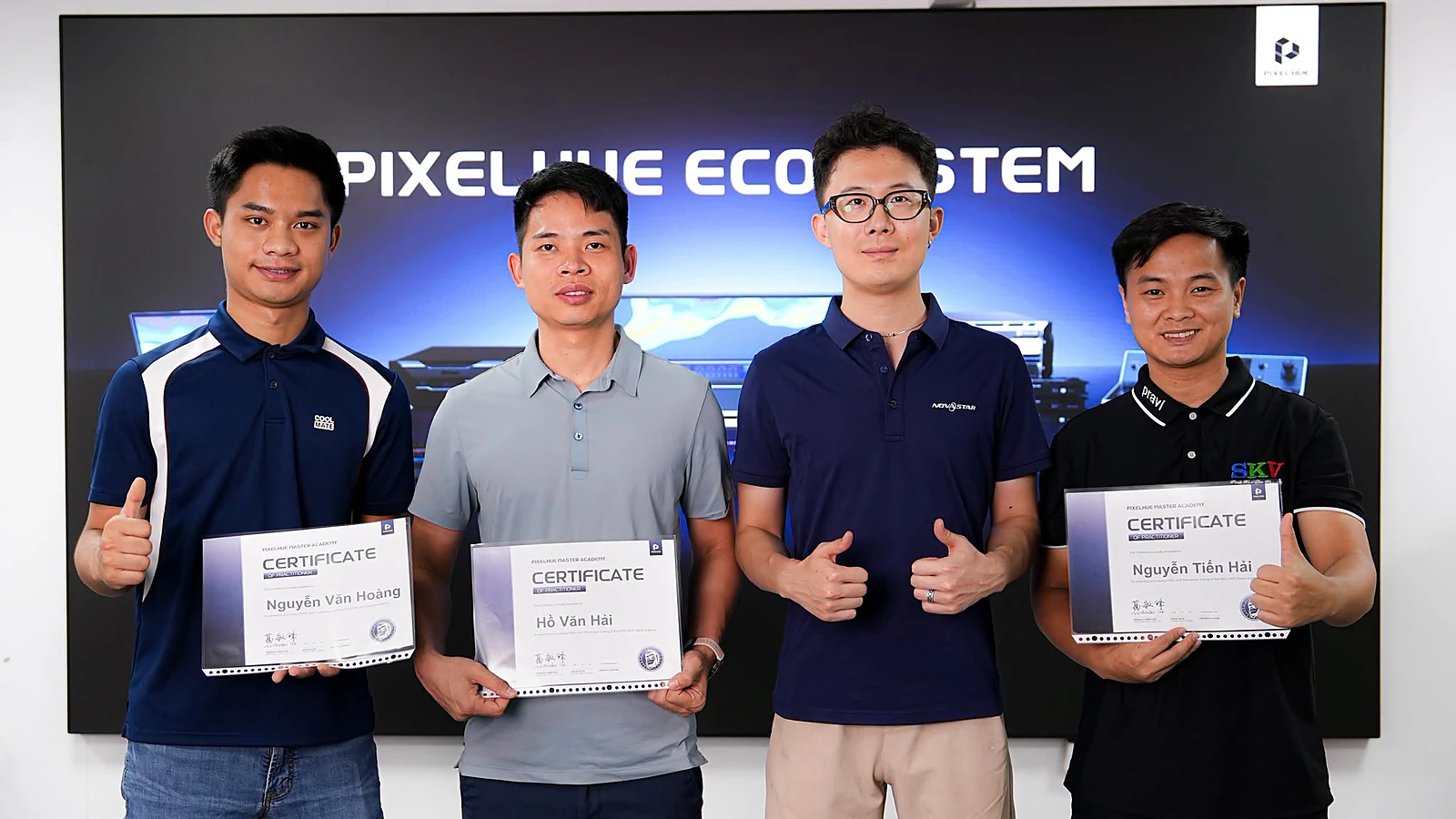
Three Luxwave engineers—Nguyễn Tiến Hải, Nguyễn Văn Hoàng, and Hồ Văn Hải—have successfully completed PixelHue's technical training program and earned their certification. For a company specializing in professional video system deployment, this is more than just internal personnel news; it's a direct indicator of capability for clients operating expensive equipment in live environments, where source switching errors, incorrect presets, or signal loss can jeopardize an entire production.
!Three Luxwave engineers receive PixelHue Master Academy (PMA) certification
PixelHue is a brand of video processing equipment designed for complex scenarios involving multiple sources, layers, large LED screens, and live switching. LED systems for broadcast, high-end auditoriums, touring stages, or LED studios often need to integrate numerous computers, cameras, media servers, and backup sources simultaneously. Therefore, technical proficiency lies in the ability to design signal flow diagrams, verify preview/program feeds, save presets, manage EDID, organize backups, and troubleshoot issues swiftly.
Having three certified engineers reinforces Luxwave's role as an authorized PixelHue dealer in Vietnam. Clients can engage with a team that understands the products from configuration consultation through to on-site operation, rather than just receiving spec sheets or price quotes. For projects demanding high stability, this difference becomes most apparent during setup, rehearsal, and last-minute adjustments before going live.
Who Are the Certified Engineers?
This certification round recognizes three engineers from Luxwave's technical team and its sister brand SKV, both part of the SKV/Hồ Gia ecosystem: Nguyễn Tiến Hải, Nguyễn Văn Hoàng, and Hồ Văn Hải. All three have achieved PixelHue Master Academy (PMA) certification—PixelHue's official training and technical certification program. PMA is structured into four progressive levels: Entry (basic), Practitioner (hands-on, focusing on P and Q series), Advance, and Specialist. Each level includes product curriculum and theoretical exams. This standardized training ensures consistent operational knowledge for real-world project deployment.
!Technician operating a PixelHue console before a large event audience
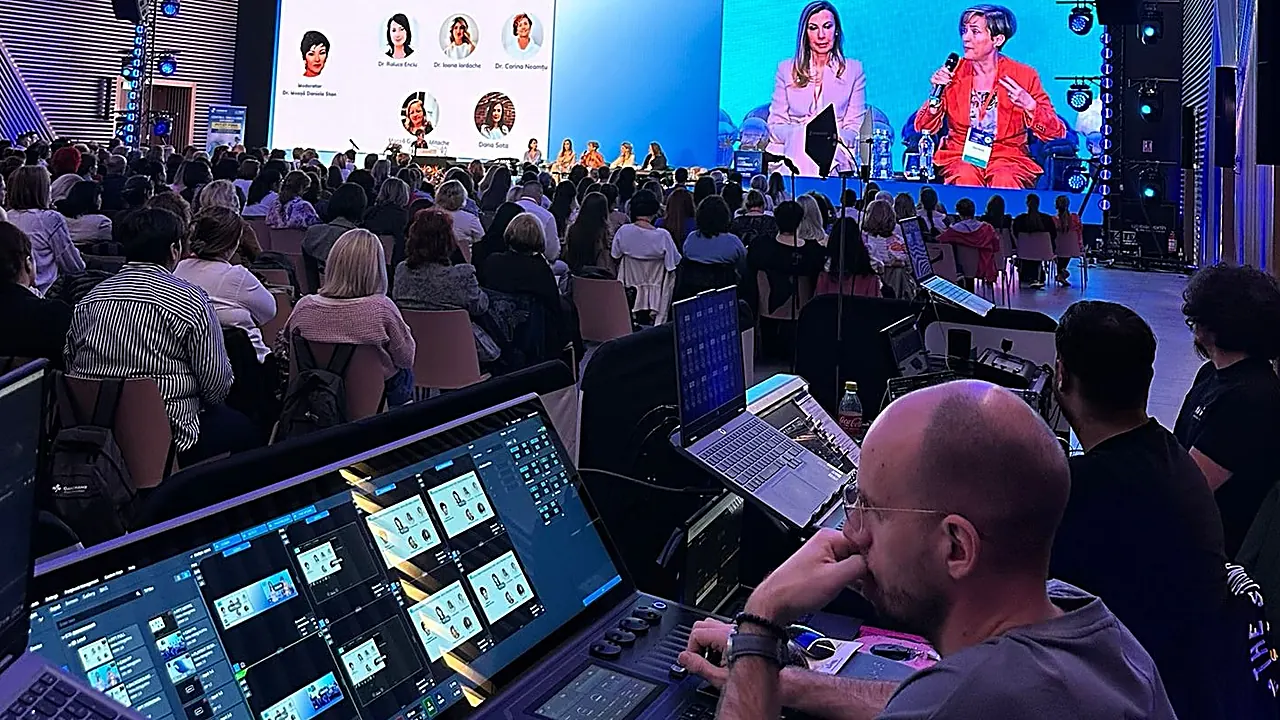
In project execution, the video engineer acts as the crucial link between content producers, directors of photography, LED technicians, audio-visual teams, camera crews, and the client. They must understand the video processor's capabilities and interpret the operational script: when to switch sources, which layers are primary, which source is backup, and which areas are displayed on the program output. The manufacturer's certification thus standardizes knowledge for more consistent technical team performance.
This also serves to bolster Luxwave's E-E-A-T (Experience, Expertise, Authoritativeness, Trustworthiness) in a practical sense: expertise demonstrated through human capability, not just a product catalog. When clients research What is PixelHue and how do LED video processors work, the next questions are typically about who will consult, configure, test, and support on-site. This announcement addresses that need.

What Are the Benefits for Clients from a Manufacturer-Certified Team?
For clients in broadcast, touring events, LED studios, or high-end auditoriums, the video processor is often a critical component of the entire operational chain. A powerful configuration used incorrectly can still pose risks: unsynchronized inputs, unverified presets, incorrect layer masking, preview mismatches with the program output, or lack of backup solutions for primary source failures. A PixelHue-certified team helps mitigate these risks from the design phase through to program execution.
!PixelHue processors and control consoles in a equipment staging area
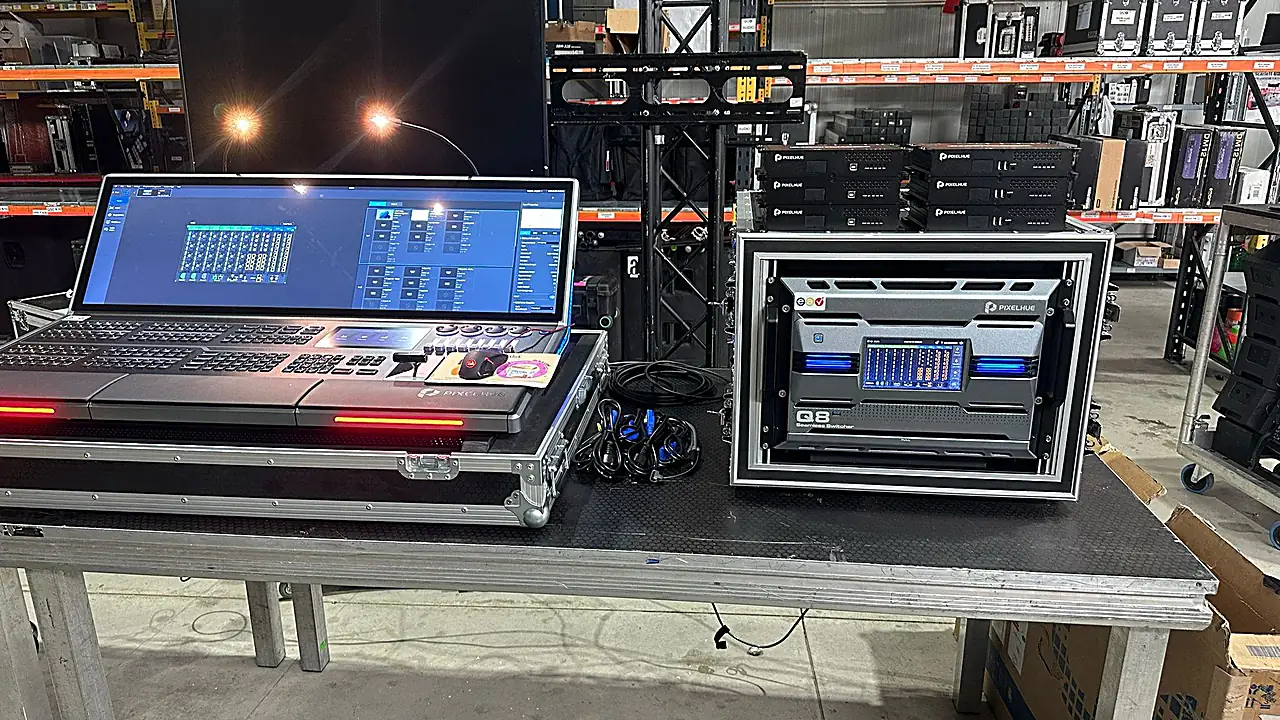
The primary benefit is accurate configuration consultation. A small stage may not require an oversized processing system, whereas a main screen for a festival, LED studio, or multi-camera event demands careful consideration of inputs, outputs, layers, canvases, signal formats, and backups. A technically proficient team will inquire about source types, content control, preset requirements, and the need for seamless transitions.
The second benefit is on-site operation. During live events, the minutes before showtime often involve the most changes: a speaker swaps laptops, the content team sends new files, cameras need reframing, or the director requests a layout adjustment. When the technical team thoroughly understands the PixelHue workflow, these changes can be managed using presets, preview/program feeds, and verification processes before going live.
The third benefit is post-handover support. For auditoriums, control centers, or studios, clients need a team that can provide operational guidance, configuration checks, usage scenario updates, and context-aware troubleshooting. Technical certification does not replace system acceptance testing but ensures equipment is configured and handed over with a clearer workflow.

What Are the Notable PixelHue Product Lines?
Luxwave's PixelHue portfolio focuses on professional video processing systems for large LED screens, live events, broadcast, studios, and high-end conferences. Key product lines include the P10, P20, P80, Q8, and F4. A common characteristic of these products is their focus on multi-source, multi-layer processing, FPGA platforms, 4:4:4 10-bit image quality, and seamless integration of switchers, splicers, preview/program outputs, and live operational workflows.
The P series offers accessibility for various live projects. The PixelHue P10 is a 4K switcher/splicer supporting 4:4:4 10-bit for systems requiring source switching, signal aggregation, and moderate-scale layout management. The PixelHue P20 doubles the P10's capacity, targeting larger events. The PixelHue P80 is a 4K presentation switcher for studios and conferences needing extensive source management and clear transition control.
At a higher tier, the PixelHue Q8 is the flagship, functioning as a 32x4K layer switcher or a 64x4K layer splicer, designed for systems demanding significant processing power and complex layouts. Meanwhile, the F4 is a modular mainframe for production studios and festivals, suitable for configurations requiring expansion via cards, source counts, or specific technical requirements.
Clients can view an overview of the brand on the PixelHue on Luxwave page. Crucially, device selection should not be based solely on model names. Correct configuration depends on the number of sources, resolution of each source, LED canvas, concurrent layers, transition types, backup strategies, and the skill level of the on-site operator.
How Do Switchers and Splicers Differ in Large LED Setups?
In professional LED screen projects, the terms 'switcher' and 'splicer' often appear together but should not be confused. A switcher is a device or function used to transition between multiple live sources, typically associated with preview/program outputs, presets, cuts, fades, or other directorial actions. A splicer is a function for tiling, dividing, and distributing signals across a large LED screen or multiple display areas, especially when the canvas exceeds standard resolutions.
For conferences with multiple laptops, speaker cameras, and video playback, a switcher enables the technical team to decide which source appears on program and which is being prepared on preview. The goal is to avoid black screens, visible test actions, or interruptions when switching presenters. Thus, live workflows clearly separate the preview feed for technicians and the program feed for the audience.
A splicer addresses a different challenge: large LED screens may not adhere to a 16:9 aspect ratio, could be ultra-wide backdrops, curved displays, multiple connected screens, or canvases divided into various zones. In such cases, the input signal needs to be tiled, cropped, scaled, and distributed to the correct areas. An effective splicer ensures the LED screen displays the correct pixel map, layout, and without distortion.
Many PixelHue products integrate both functionalities to support a complete workflow. The FPGA platform, 4:4:4 10-bit processing, and multi-source/multi-layer capabilities make these devices suitable for scenarios requiring both live switching and signal tiling for large LED screens. When Luxwave's technical team is PixelHue certified, correctly distinguishing between switchers and splicers becomes a foundational aspect of configuration consultation.
Which Projects Will Luxwave Apply This Expertise To?
Luxwave's PixelHue expertise is targeted towards projects requiring stable video, multiple sources, and clear operational workflows. The first group includes broadcast and content production, where signals from cameras, media servers, graphics, switchers, and LED screens must harmonize. The second group encompasses large-scale events, tours, festivals, and conferences, where the technical team needs presets, preview/program feeds, and backup solutions to manage changes during live operation.
The third group includes LED studios and premium projection spaces. In these environments, LED screens are not merely backdrops but integral parts of the image production process. The processing configuration must consider resolution, layers, color depth, canvas aspect ratio, latency, and how content sources are integrated into the system.
As an authorized PixelHue dealer in Vietnam, Luxwave can combine the provision of genuine equipment with configuration consultation and on-site operational support. This is ideal for clients seeking a partner responsible for both pre- and post-delivery phases: site surveys, model recommendations, signal flow diagrams, preset verification, basic operational training, and live run support.
A key takeaway from this announcement is Luxwave's focus on long-term capability rather than short-term sales messaging. The emphasis is on team expertise: engineers who have completed manufacturer training, earned technical certification, and can apply that knowledge to specific projects. For clients considering PixelHue, this provides a solid basis for in-depth discussions on configuration, workflow, source redundancy, and on-site support.
In conclusion, the achievement of PixelHue technical certification by Nguyễn Tiến Hải, Nguyễn Văn Hoàng, and Hồ Văn Hải represents a significant enhancement of Luxwave and SKV's capabilities within the SKV/Hồ Gia ecosystem. For clients, the value lies in working with an authorized PixelHue dealer in Vietnam whose technical team possesses deep product knowledge, understands live workflows, and can provide end-to-end support from configuration consultation to on-site assistance.
Pitfalls
Common mistakes
- Misinterpreting technical certification as project acceptance; certification standardizes operational knowledge but does not replace site surveys and acceptance testing for individual LED systems.
- Selecting PixelHue models based solely on name or 'flagship' status, overlooking crucial factors like source count, LED canvas, concurrent layers, and practical backup strategies.
- Confusing switchers with splicers; switchers handle live multi-source transitions, while splicers tile signals onto large, multi-zone LED screens—many projects require both.
- Neglecting live operational workflows (presets, preview/program, source backup); even high-end equipment carries risks if the operator lacks workflow proficiency.
FAQ
Frequently asked questions
Which three Luxwave engineers received PixelHue technical certification?
The three recognized engineers are Nguyễn Tiến Hải, Nguyễn Văn Hoàng, and Hồ Văn Hải. All have achieved PixelHue Master Academy (PMA) certification, PixelHue's official technical training program comprising four levels: Entry, Practitioner, Advance, and Specialist. This announcement focuses on team capabilities, not specific model numbers or scores.
What does PixelHue certification mean for clients?
Certification indicates that the technical team has undergone manufacturer-led training on relevant products and workflows. For clients, this translates to accurate configuration advice, controlled equipment operation, preset preparation, preview/program verification, and source backup management. This is particularly crucial for live events, broadcast, and LED studios.
Is Luxwave an authorized PixelHue dealer in Vietnam?
Yes. Luxwave is an authorized PixelHue dealer in Vietnam, providing genuine PixelHue equipment and technical support to domestic clients. This role ensures clients work with a single point of contact offering a product catalog, configuration consultation, and a technical team trained within the PixelHue ecosystem.
What needs does the PixelHue P series address?
The P series, including P10, P20, and P80, is designed for 4K switcher/splicer and presentation switcher applications. The P10 is suitable for 4K systems requiring 4:4:4 10-bit, the P20 offers double the P10's capacity for larger events, and the P80 is ideal for studios and conferences needing robust source switching, layout control, and presentation management.
How does the Q8 differ from other PixelHue models?
The Q8 is the flagship model, distinguished by its capability as a 32x4K layer switcher or a 64x4K layer splicer. This device is suited for large-scale systems, multi-zone displays, numerous 4K sources, or complex production workflows. When considering the Q8, clients should conduct a thorough survey of source requirements, LED canvas, concurrent layers, and operational scenarios.
What kind of projects is the F4 suitable for?
The F4 is a modular mainframe designed for production studios and festivals, ideal for projects requiring expandable configurations, numerous sources, or I/O requirements that vary per program. Selection of the F4 should be based on the actual signal flow diagram, the number of cards needed, the role of each source, and the on-site operational plan.
References