
Trên trang
- What's the Difference Between P0.9 and P1.25?
- How Does Viewing Distance Determine Pitch?
- When is P0.9 Worth Every Penny?
- When is P1.25 the Smart Balance Point?
- Hidden Costs of Going Smaller Pitch: More Than Just Panel Price
- Quick Decision Chart by Scenario
- Conclusion: Measure Distance First, Choose Pitch Second
In the COB fine-pitch segment, P0.9 and P1.25 are the two most frequently asked-about options — and the price difference between them is substantial enough to make the wrong choice costly. This comparison is based on published manufacturer data and Luxwave's experience installing both pitches in real projects. Luxwave is a brand under Ho Gia Joint Stock Company, an authorized distributor for BOE, NovaStar, and Muxwave.
What's the Difference Between P0.9 and P1.25?
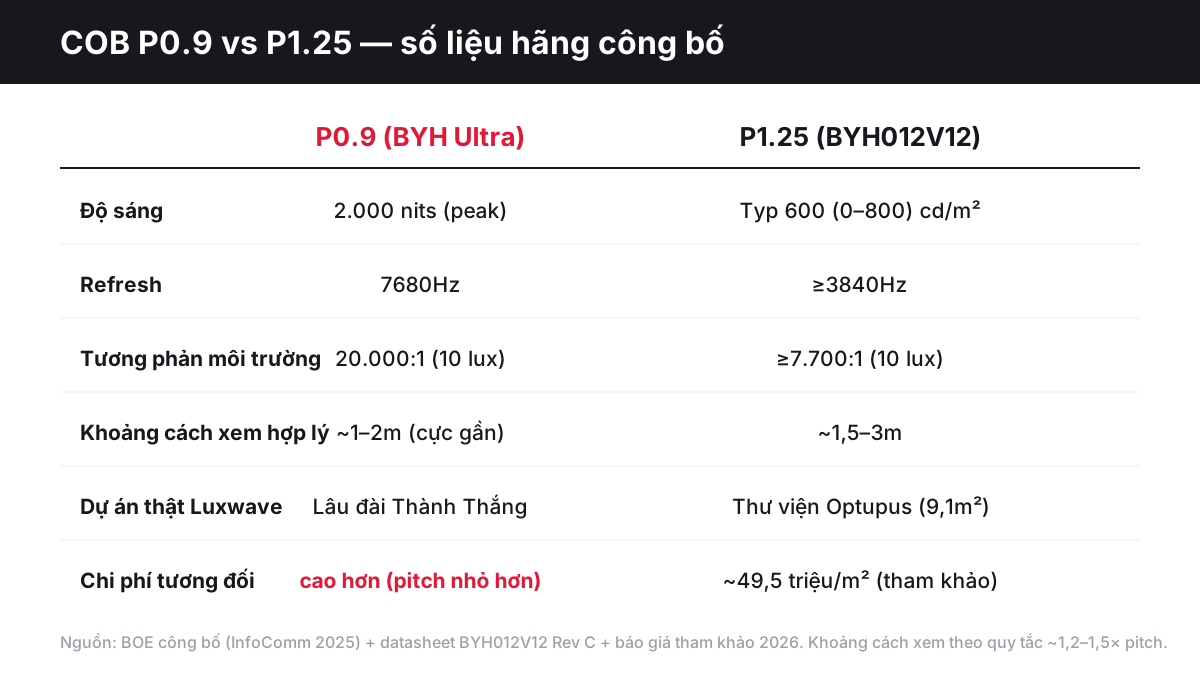
The fundamental difference is pixel density: a 0.9mm pitch packs nearly twice as many chips per unit area as a 1.25mm pitch, proportionally increasing resolution, controller load, and cost. In terms of specifications, BOE's flagship BYH Ultra P0.9 is rated at 2,000 nits peak brightness, a 7680Hz refresh rate, and a 20,000:1 contrast ratio. In contrast, the BYH012 P1.25 datasheet indicates a typical 600 cd/m² (0–800 adjustable) brightness, ≥3840Hz refresh rate, ≥7.700:1 contrast ratio, along with IP65 protection and 2H surface hardness. On paper, P0.9 wins across the board — the real question is whether you will be standing close enough to benefit from that advantage.
It's also crucial to interpret the numbers correctly: the 2,000 nits for P0.9 is a peak level for HDR and bright environments, not the sustained operating brightness. In a light-controlled room, both models operate around a few hundred nits for comfortable viewing. Similarly, the difference between a 7680Hz and 3840Hz refresh rate is only noticeable when professional cameras are filming extremely close-up shots of the screen. For the human eye and standard smartphones, 3840Hz is already beyond the threshold of perception. Understanding this helps avoid paying for specifications you will never utilize.
How Does Viewing Distance Determine Pitch?
A simple industry rule of thumb: the optimal viewing distance (in meters) is approximately 1.2–1.5 times the pitch (in millimeters). Accordingly, P0.9 performs optimally at distances of about 1–2 meters — close enough to discern every detail. P1.25 appears smooth from approximately 1.5–3 meters. Beyond 3 meters, the two screens are virtually indistinguishable to the naked eye, and any extra cost for P0.9 becomes an investment with no visual return. Therefore, the first step is not to open a catalog but to measure: what is the distance from the screen to the closest viewer in your space? The article How to Choose LED Pixel Pitch 2026 provides a comprehensive guide to this rule for all pitch ranges.
When is P0.9 Worth Every Penny?
There are three scenarios where P0.9 is the absolute winner. First, extremely close viewing distances: executive desks placed very near the screen, or visitors standing directly in front of a presentation display — below 2 meters, P1.25 may start to appear pixelated to discerning eyes. Second, specialized monitoring environments like command centers where operators continuously read small data points at short distances. Third, brand representative spaces — where "the best possible screen" is a statement. These are the use cases where Luxwave recommends P0.9 (the BYH009 series) after surveys indicate actual viewing distances are under 2 meters. For the reception hall at Thanh Thang Castle, actual measurements showed that P1.25 met the viewing requirements at an approximate 2-meter distance, making P0.9 unnecessary.
When is P1.25 the Smart Balance Point?
For most business applications — such as meeting rooms, training rooms, and reception areas — the actual viewing distances fall within the 2–5 meter range, precisely where P1.25 delivers a perfectly smooth image. The Optupus International Library project is a prime example: a 9.1m² P1.25 screen serves a training room where attendees sit from the front row, more than 2 meters from the screen. Throughout its operation, there have been no complaints about image sharpness — while the cost savings compared to P0.9 were sufficient to invest in enhanced image processing and better redundancy. According to reference pricing for 2026, COB P1.25 is around 49.5 million VND/m²; detailed pricing structures are available in the article LED COB Screen Price 2026.
Hidden Costs of Going Smaller Pitch: More Than Just Panel Price
Switching from P1.25 to P0.9 doesn't just double the price per square meter. Nearly double the pixels means nearly double the load on the controller. A screen that fits comfortably with a mid-range processing unit might require an upgrade to a higher model, increasing both equipment costs and configuration complexity. The larger data volume also demands a content source with commensurate resolution: displaying 1080p content on a large-format P0.9 density screen is a waste of hardware resources. When creating a budget, request a quote for the entire system for both pitch options — the total cost difference is often greater than the difference in panel price alone.
Quick Decision Chart by Scenario
To summarize for comparison: for viewers closest than 2 meters, content with small text/numbers, or representative spaces → P0.9. For distances of 2 meters or more, standard presentation content, or budget optimization → P1.25. Still undecided in the borderline range of 1.5–2.5 meters? View live demos of both pitches at the actual viewing distance of your space — ten minutes in front of the real screen will provide a more accurate answer than any spec sheet. Luxwave can arrange direct comparison demos as we distribute and have installed both series.
Another variable worth considering in the borderline range is the space's intended lifespan. A room that is a mid-level meeting room today might become a customer demo room with close viewing tomorrow; a lobby that guests currently pass through might later have a reception desk placed directly in front of the screen. If the intended use of the space trends towards bringing viewers closer, choosing P0.9 from the outset is far more economical than replacing the screen mid-way. Conversely, if the space is stable long-term at medium viewing distances, P1.25 is the correct financial decision — the savings can be reinvested into processing, redundancy, and content.
Conclusion: Measure Distance First, Choose Pitch Second
P0.9 and P1.25 are not about "better or worse" but are two tools for two different distances. Luxwave's two real-world projects — Thanh Thang (reception hall, close viewing) and Optupus (training room, medium distance) — both settled on P1.25 after measuring actual viewing distances, indicating that the threshold for upgrading to P0.9 truly lies below 2 meters. Start with a measurement of the viewing distance, calculate the total system cost, and don't hesitate to request a demo at the actual viewing distance — Luxwave's technical team is ready to prepare parallel proposals for both pitches for your direct comparison.
Lưu ý
Sai lầm thường gặp
- Choosing P0.9 for screens viewed from 3m+ — paying for sharpness the eye cannot see
- Choosing P1.25 for positions where guests stand very close, under 1.5m — revealing pixels at close viewing distances
- Forgetting to factor in controller upgrades when pitch decreases (nearly double the number of pixels)
- Comparing prices of two pitches without normalizing to the same system configuration
- Assuming the smallest pitch is always best instead of measuring the actual viewing distance
FAQ
Câu hỏi thường gặp
How much difference is there in actual sharpness between P0.9 and P1.25?
For the same area, a P0.9 screen contains nearly double the pixels of a P1.25, so the difference is clearly visible at distances under 2 meters: smaller text is sharper, and images are smoother. However, at 3 meters, the naked eye can barely distinguish them — at that point, the price difference yields no visual value.
For a 20–30m² meeting room, should I choose P0.9 or P1.25?
Most meeting rooms of this size have viewing distances of 2–4 meters, making P1.25 a reasonable balance between smoothness and budget. P0.9 is only worth considering if executives sit very close to the screen (under 2 meters), the content involves many small numbers or text tables, or the room serves a high-profile brand representation function.
Approximately how much more expensive is P0.9 than P1.25?
A smaller pitch means nearly double the chip density, so the unit price per square meter is significantly higher. For 2026 references, COB P1.25 is around 49.5 million VND/m²; the P0.9 version is higher depending on the configuration. Therefore, request a quote based on specific area and control system rather than estimating based on ratios.
Is P0.9 brighter than P1.25?
According to BOE's specifications, the flagship BYH Ultra P0.9 achieves 2,000 nits peak brightness with a 20,000:1 contrast ratio, while the BYH012 P1.25 operates at a typical 600 cd/m². However, in a light-controlled indoor environment, 600 nits is already more than sufficient — the high brightness of P0.9 is primarily valuable in spaces with abundant natural light or when strong HDR is required.
For the same area, does P0.9 require a more powerful controller?
Yes, and this is a commonly overlooked hidden cost: nearly double the pixels means nearly double the load on the controller. A P1.25 screen that runs fine with a mid-range processor might necessitate upgrading to a higher model when switching to a P0.9 of the same size.
What pitches did Luxwave use in its actual projects and where?
Both projects completed by Luxwave in Q1/2026 selected P1.25 after evaluating actual viewing distances: the Optupus International Library for a training room with viewing distances of 2–5 meters, and Thanh Thang Castle for a reception hall with viewing distances of approximately 2 meters. The seamless COB surface at this pitch met the requirements for both scenarios. P0.9 is reserved for use cases requiring viewing under 2 meters or for continuous reading of small data.
Nguồn tham khảo
- 1.Nhà sản xuấtBOE MLED COB — InfoComm 2025 (BYH Ultra P0.9)
- 2.Nhà sản xuấtBOE BYH012V12 datasheet Rev C 2025-04-09
- 3.Nghiên cứuLED COB P1.25 Screen Price by Size — Luxwave 2026