
On this page
Why is the Pixel Pitch Selection Rule Viewing Distance × 3?
Pixel pitch is the center-to-center distance between adjacent pixels, measured in millimeters — P2.5 means 2.5mm. The smaller the pitch, the denser the pixel count per square meter, resulting in a sharper image viewable from closer distances. But "how close is close enough to remain sharp" doesn't require guesswork: the LED display industry uses a classic formula — minimum viewing distance (meters) ≈ pixel pitch (mm) × 3.
The ×3 multiplier isn't arbitrary. The average human eye can resolve detail at an angle of about 1 arcminute — 1/60th of a degree. When you stand far enough back that two adjacent pixels fall within 1 arcminute, your eyes can no longer distinguish them individually, and the image appears "seamless." Geometrically, this distance corresponds precisely to the pitch (mm) multiplied by 3 to get meters. This is a widely used reference rule among LED display manufacturers when specifying configurations; on the standards side, ANSI/AVIXA V202.01 — Display Image Size for 2D Content addresses the same problem from the display-size and viewing-position angle.
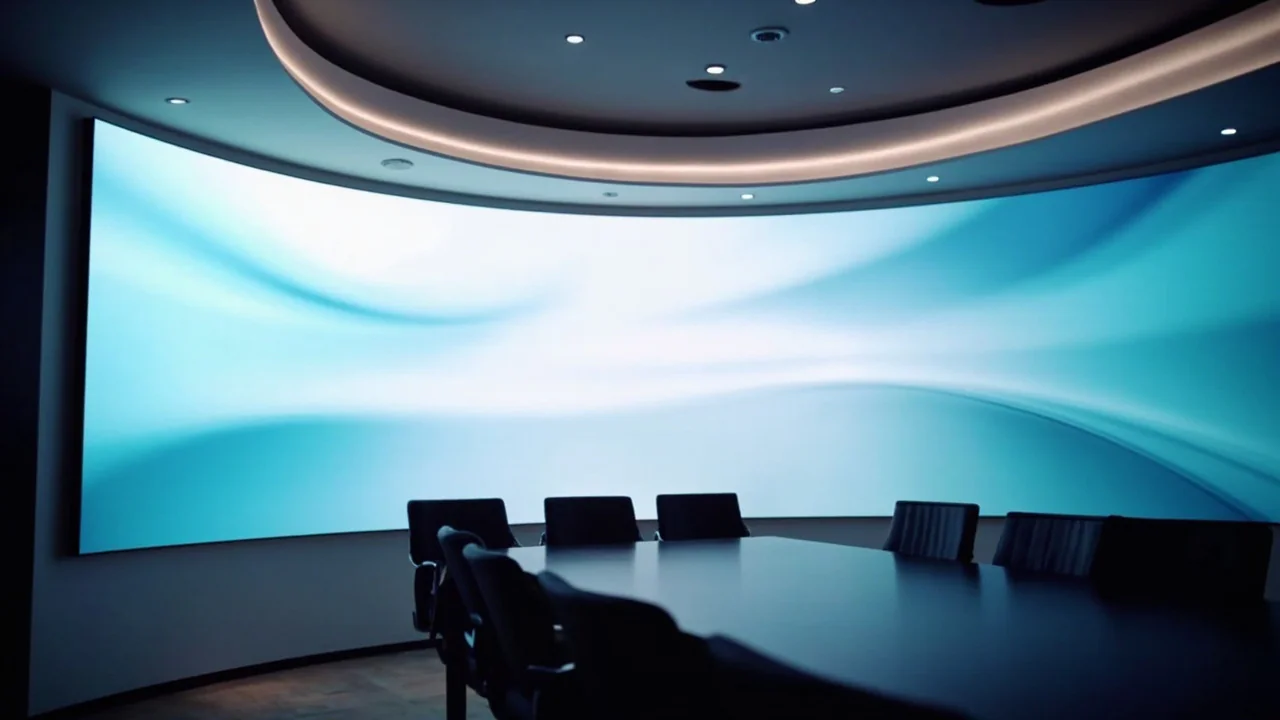
The correct measurement is more important than the formula itself: measure from the screen to the nearest row of seats, not the average distance. A 30m² boardroom with a CEO's seat 2m from the screen requires pitch calculation based on 2m (→ P0.9-P1.5), even if most other seats are 4-5m away. The principle: whoever sits closest will be the first to notice "pixelation" if the pitch is too large.
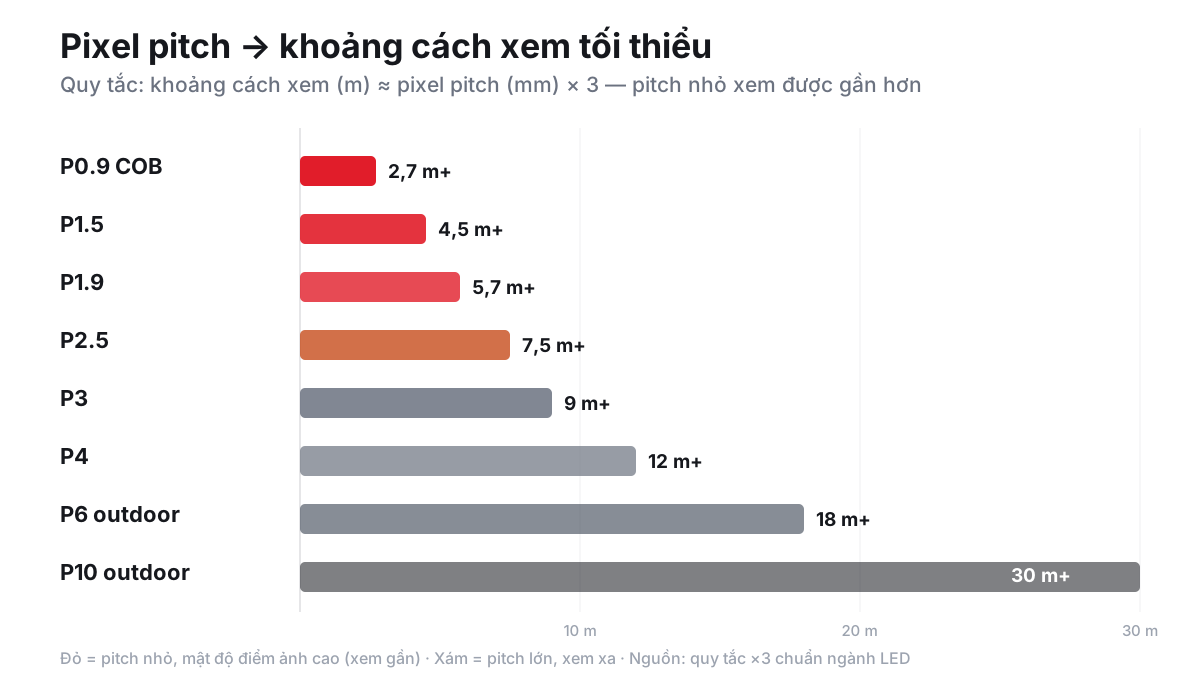
Quick examples: a meeting room with the first row 4.5m away → minimum pitch = 4.5 ÷ 3 = 1.5mm → choose P1.5. An auditorium with the first row 9m away → 9 ÷ 3 = P3. The reverse also holds true: if you have a P2.5 panel, the optimal viewing distance starts from 2.5 × 3 = 7.5m onwards.
A note on technology: the seamless flat surface of COB offers better contrast and viewing angles than SMD at the same pitch, allowing for a "sharper" perception at slightly closer distances — this is why premium boardrooms often favor COB despite its higher cost. Conversely, SMD remains the cost-optimal choice for most meeting rooms and auditoriums. For detailed differences, see COB vs SMD.
What Pixel Pitch Should Be Chosen for Each Space Type?
Five common scenarios in Vietnam, following the rule above plus Luxwave's deployment experience:
Executive Boardroom (10-20 people, 2-3m viewing distance). Recommended: P1.5 SMD or flagship P0.9 COB. Close proximity necessitates a small pitch for sharp text and data slides without pixelation. P2.5 is unsuitable at this distance — pixels are immediately apparent. This segment is willing to pay a premium for COB, as close-up viewing creates a "premium" impression for clients and executives.
Meeting Room (20-40 people, 3-5m viewing distance). P2.5 SMD is the sweet spot and Luxwave's bestseller. P1.9 is only needed for frequent 4K video conferencing (international meetings, Zoom HD). Standard B2B meeting rooms use P2.5 paired with Novastar VC2-VC4 for sufficient enterprise-grade performance.
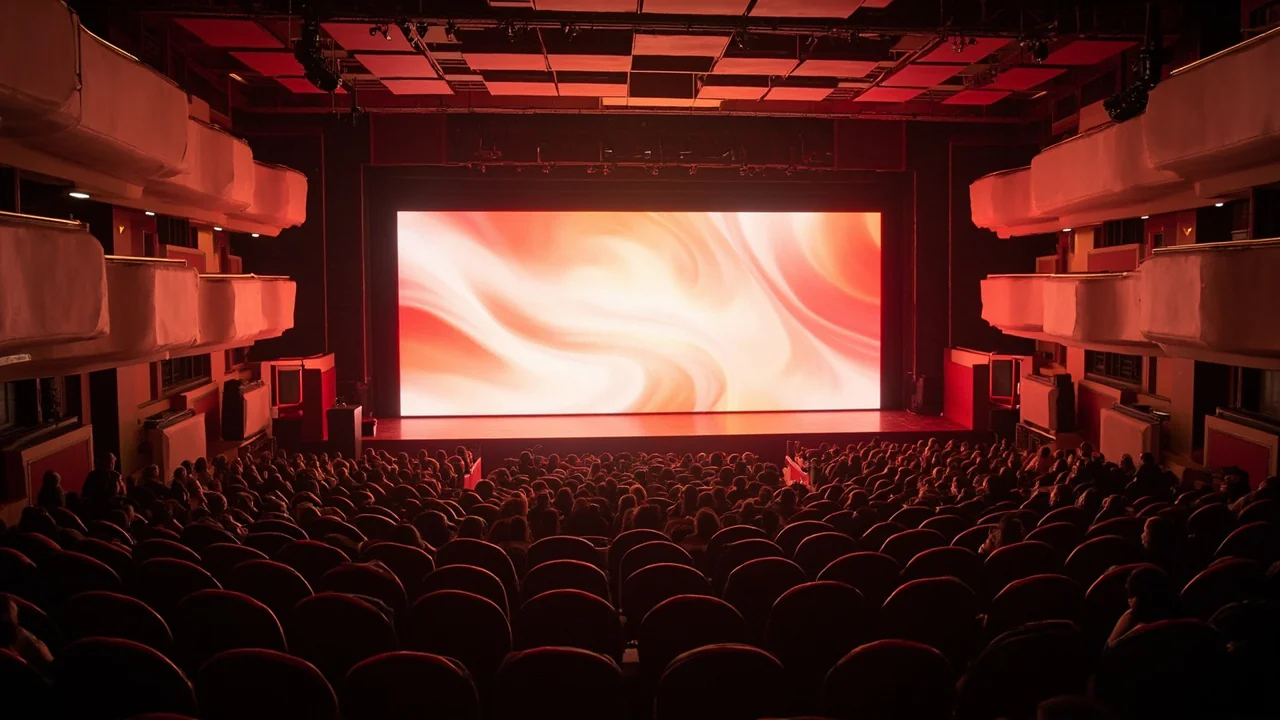
Auditorium (50-200 people, 5-12m viewing distance). P3 indoor is the default. P2.5 is ~25% more expensive, and the difference is imperceptible for back rows at 10m+; P4 is 20% cheaper but pixels are visible from the front rows (5-6m). Refer to /projects/viet-yen-cultural-center-p25 — a 45m² auditorium where Luxwave deployed P2.5 due to client requirements for district-level cultural standards, an example of an "intentional upgrade" discussed later.
Hotel Lobby / High-end Building Lobby. Viewing distance varies (guests pass by → stop to look → approach). Default P2.5-P3 SMD for 30-50m² lobbies; luxury showrooms opt for one tier lower (P1.9-P2.5) as guests approach closely to view products. Details at /solutions/lobby-solutions.
Outdoor Facades and Fascia Signs. P5-P6 for shop facades viewed from ~15-20m (opposite sidewalk, passersby); P8-P10 for highway billboards 30-100m. For outdoor, 5,000-10,000 nits brightness is more critical than pitch to combat Vietnam's harsh sun, coupled with auto-brightness sensors to save 30-40% electricity at night. See /solutions/outdoor-digital-billboards.
When to Choose a Smaller Pitch Than the ×3 Rule?
The ×3 rule applies to the naked eye at a fixed distance. Four situations require dropping the pitch by one tier (equivalent to multiplying by ×2 instead of ×3):
Camera Recording — Broadcast, Livestream, or HD/4K Video Meetings. This is the most critical and often overlooked exception. Camera sensors sample the LED screen's pixel grid; with low refresh rates or a pitch too large relative to the camera's resolution, the recorded image exhibits moiré (wavy patterns) and flicker. HD Zoom meeting rooms should choose P1.9 instead of P2.5, and a minimum refresh rate of 3,840Hz is mandatory. Virtual production studios require P0.9-P1.5 COB with a 7,680Hz refresh rate. If unsure, read more about refresh rates for camera recording.
Showrooms with Close-Up Viewing. Initial viewers stand back but will approach 1-2m to examine product details — choose the pitch based on the closest distance they will approach, not the initial viewing distance.
Virtual Production / XR. LED backdrops for filming are placed a few meters from the camera and must be sharp in every frame — always use small-pitch COB.
Client Demands Flagship Image Quality. Not for technical reasons, but for brand positioning: executive boardrooms, luxury private residences (e.g., Thanh Thang Castle). This is a business decision, not a formula — but it should be clearly identified to avoid mistaking it for a "technical necessity."
Is a Smaller Pitch Always Better?
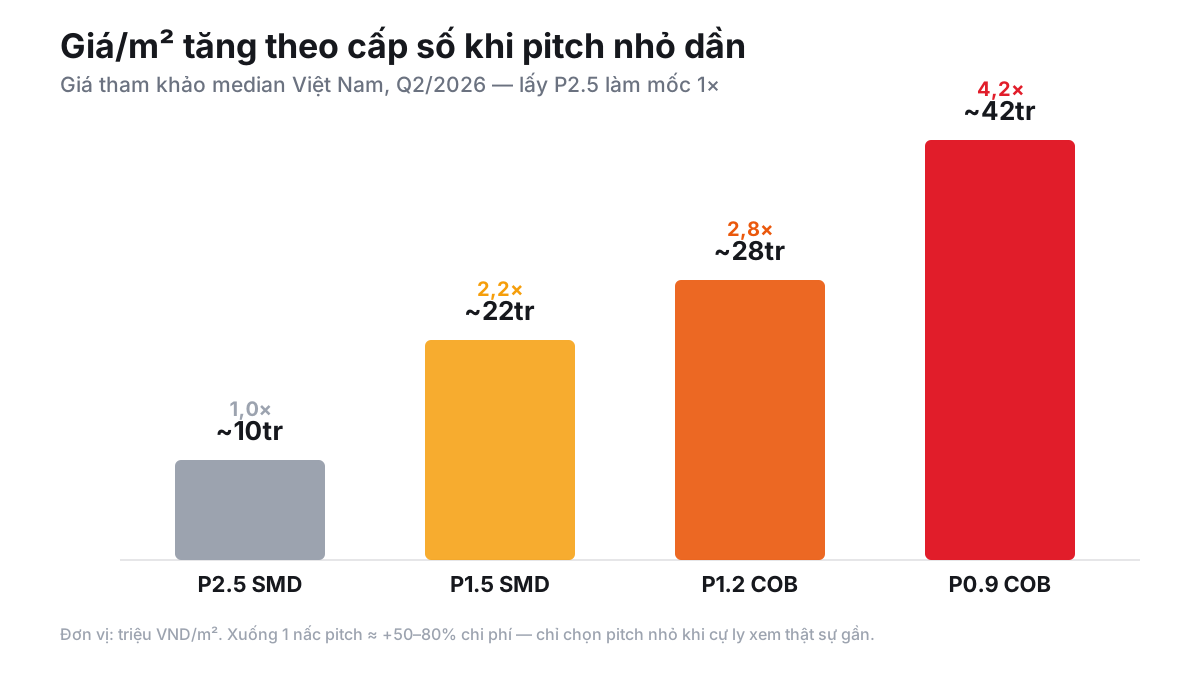
No. This is the most costly mistake when purchasing an LED screen. The investment cost per square meter increases exponentially as pitch decreases, due to the soaring number of LEDs per square meter and the higher cost of COB packaging technology compared to SMD. Using P2.5 as the baseline (1.0×), the relative cost increase between pitch tiers is as follows:
- P2.5: Reference baseline (1.0×)
- P1.5: Approximately 2.2×
- P1.2 COB: Approximately 2.8×
- P0.9 COB: Approximately 4.2×
Specifically: a 30m² meeting room where the back row sits 5m away, but P0.9 is chosen, results in an investment cost about 4 times higher than P2.5 — while people sitting 5m or further away perceive virtually the same sharpness. The absolute difference can be substantial for medium and large areas. Smaller pitches also lead to higher power consumption and heat dissipation. Smart investment means choosing a pitch that is sufficient for the actual viewing distance, then allocating the remaining budget to brightness, image processors, and warranty — factors that impact the experience more than forcing the pitch down a tier that goes unnoticed. For precise figures for your space, contact us for a quote via /quote.
How Do Pixel Pitch and Resolution Differ?
These two concepts are often confused. Pixel pitch is the distance between pixels (mm); resolution is the *total number of pixels* on the screen — dependent on both pitch and screen size. For the same pitch, a larger screen has more pixels; for the same size, a smaller pitch results in higher resolution.
For example, a 3×2m screen: with P2.5, you get approximately 1,200×800 px; dropping to P1.5 at the same size yields ~2,000×1,333 px (close to 2K). This is important because Full HD (1920×1080) content requires sufficient horizontal pixels for sharp 1:1 display. A small screen with a large pitch might not have 1,920 horizontal pixels, causing small text and logos to appear blurry even if the viewing distance meets the "×3 standard."
A practical rule: after determining the pitch based on viewing distance, multiply the screen's horizontal width in meters by (1000 ÷ pitch) to estimate horizontal pixels — e.g., a 4m wide screen with P2.5 → 4 × (1000 ÷ 2.5) = 1,600 px. If you need to display native Full HD, this number should be ≥1,920; if it's insufficient, either increase the screen size, reduce the pitch by one tier, or accept content scaling by the processor (resulting in some loss of sharpness). This is why two rooms with the same viewing distance might require different pitches if screen sizes and content types vary.
Summary: Choose Pixel Pitch in 4 Steps
1. Measure the distance from the screen to the nearest row of seats (do not average). 2. Apply the formula: pitch ≈ distance ÷ 3 to get the minimum pitch. 3. Check the 4 exceptions (camera recording, close-up showroom viewing, virtual production, flagship quality requirement) — if applicable, reduce pitch by one tier. 4. Consider the budget — each smaller pitch tier adds 50-80% cost; justify clearly before deciding.
Still unsure? Contact us for consultation and quotation: provide your room dimensions and viewing distance, and our technical team will recommend a suitable pitch and provide an accurate quote based on the configuration — or see how it applies to a specific meeting room at Choosing Pixel Pitch for LED Meeting Room Screens.
| Pitch | Viewing distance (m) | Primary Use Case | Relative Investment Level |
|---|---|---|---|
| P0.9 COB | 2.7+ | Executive boardroom, VIP lounges, broadcast | Highest (~4.2×) |
| P1.5 SMD | 4.5+ | Boardroom (10-20 people), luxury showrooms | High (~2.2×) |
| P1.9 SMD | 5.7+ | Meeting rooms (20-30 people) | Medium-High (~1.5×) |
| P2.5 SMD | 7.5+ | Meeting rooms (30-50 people), small auditoriums | Reference baseline (1.0×) |
| P3 SMD | 9+ | Auditoriums (50-200 people) | Standard (<1.0×) |
| P4 indoor | 12+ | Auditoriums >200 people | Low |
| P5-P6 outdoor | 15-18+ | Shop facades, fascia signs | Depends on IP rating & brightness |
| P10 outdoor | 30+ | Outdoor DOOH billboards, stadiums | Depends on IP rating & brightness |
Field insight
Evidence from a Luxwave-delivered project
See the full case study at /du-an/vpf-phong-hop-p15.
Pitfalls
Common mistakes
- Applying the ×3 rule to all situations — not accounting for camera recording. Meeting rooms with 4K video conferencing need a pitch one tier smaller (e.g., P1.9 instead of P2.5)
- Choosing a pitch smaller than necessary — a 30m² meeting room with the back row 5m away choosing P0.9 = 50% cost wasted vs P1.5-P2.5 with similar perceived image quality
- Ignoring front-row distance — pitch is calculated based on the closest seating, not the average. A boardroom with the CEO 2m away needs P1.5, not P2.5
- Not considering growing distance — showrooms where customers approach to view product details require a pitch one tier smaller than for fixed viewing distances
FAQ
Frequently asked questions
Is the viewing distance × 3 rule accurate for all situations?
It's a classic rule but has exceptions. Broadcast/virtual production cameras require a pitch one tier smaller (×2 instead of ×3) to avoid moiré patterns. Showrooms where customers approach closely also require a pitch one tier smaller. For fixed distances without camera recording, the ×3 rule is accurate in 95% of cases.
Should a 30m² meeting room choose P1.5 or P2.5?
Depends on front-row distance and camera use. If the front row is 2-3m from the screen and HD/4K video conferencing is used, choose P1.5. If the front row is 3-5m away and no camera recording is involved, P2.5 is sufficiently clear and saves 40% cost. Executive boardrooms often upgrade to P1.5 for a noticeably more professional image at close viewing distances.
For a 100-person auditorium with seating 8-12m away, what pitch should be chosen?
P3 SMD is the sweet spot. A larger pitch (P4) saves 20% cost but pixels will be visible from the front rows (5-6m). A smaller pitch (P2.5) costs 1.5× more and is imperceptible for the back rows. P3 offers the best balance of cost and quality for auditoriums of 50-200 people.
What pitch is needed for outdoor billboards with a viewing distance of 30m+?
P8-P10 outdoor is standard. Highway DOOH billboards at 50-100m can use P12-P16 to save 30% cost. A smaller pitch (P6) costs 40% more, and drivers won't be able to distinguish the difference. Brightness of 5,000-7,500 nits is more critical than pitch for outdoor use — essential to combat Vietnam's harsh sun.
Is the P0.9 COB pitch truly necessary for meeting rooms?
It's only necessary if all three conditions are met: (1) viewing distance ≤2.5m, (2) flagship image quality is required by the client, and (3) the budget is at least 40% higher than for P1.5. A CEO boardroom for 6-10 people at 2m distance is a suitable case for P0.9. A 30-person meeting room typically doesn't need it — P1.5 already provides comparable image quality at normal viewing distances.
When should I upgrade to a pitch one tier smaller than the ×3 rule suggests?
In 4 cases: (1) broadcast/video conference HD cameras; (2) virtual production to avoid moiré; (3) luxury showrooms with customers approaching closely to view details; (4) client demands image quality beyond normal perception. Each smaller pitch tier adds 50-80% cost and requires clear justification before upgrading.
References