

LED displays in airports and stations are more than just large screens. They are 24/7 passenger information systems operating in crowded public spaces, exposed to sunlight through glass ceilings, and must remain stable for years. Therefore, international transport infrastructure tender packages set technical requirements with a specific logic: selecting pixel pitch based on viewing distance, specifying image processors, mandating redundancy, and including safety standards. This article summarizes common criteria, referencing a publicly available document for easier comparison when estimating costs or developing technical requirements for domestic projects.
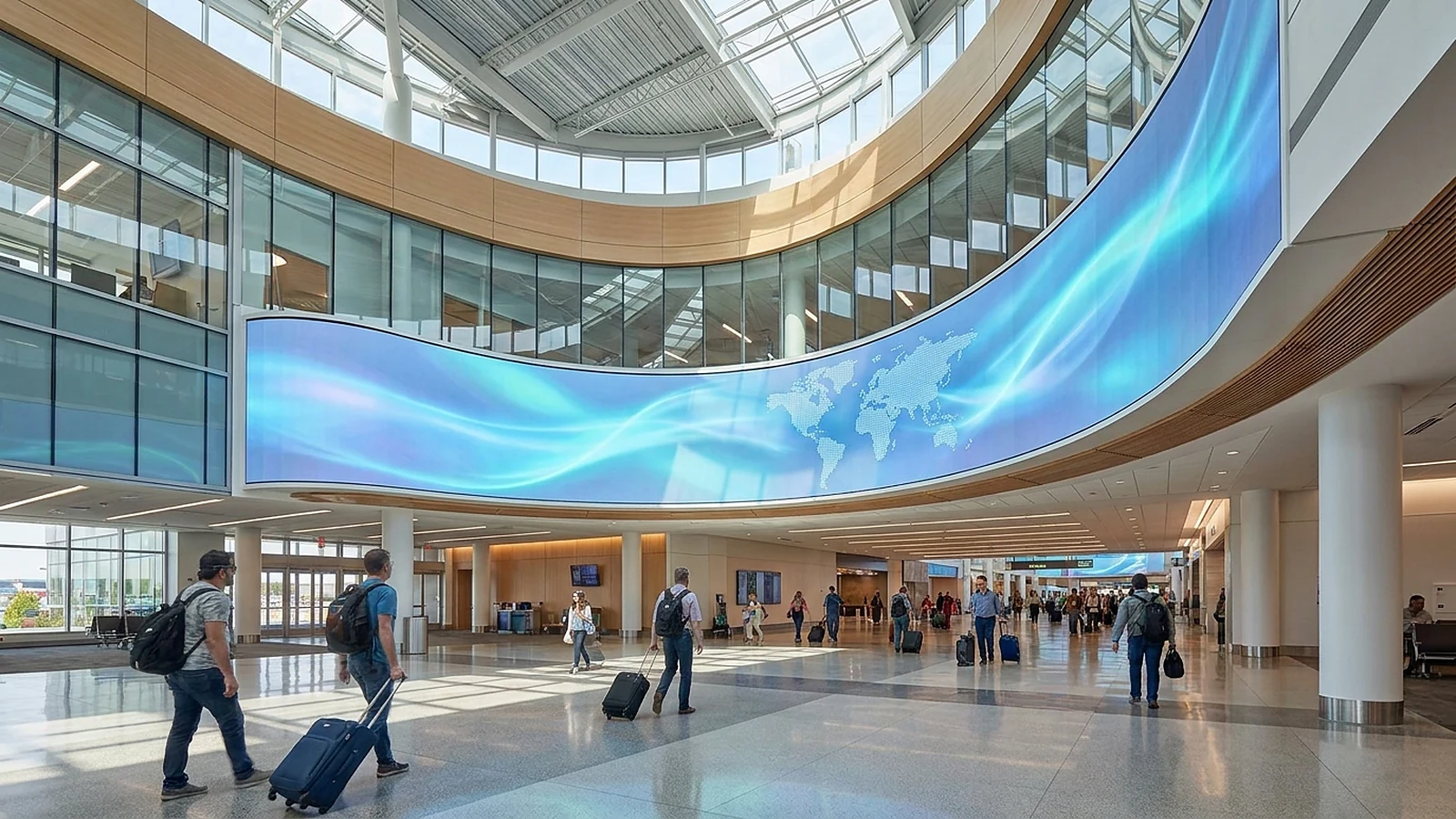
!Airport Lobby LED Display *Large-format LED display in an airport lobby (illustration).*
Why Do Airport and Station LED Displays Need Specific Criteria?
Unlike typical advertising screens, displays in airports and stations are critical infrastructure for information dissemination: showing flight schedules, train times, safety directions, and supporting operational control. The systems run continuously, are located in high-traffic public areas, and are often installed in sunlit lobbies or on curved architectural surfaces. Consequently, technical requirements must cover display quality, stability in case of component failure, fire safety, and long-term operational capability, rather than solely focusing on resolution or size like commercial displays.
What Do Tender Package Pixel Pitch Standards Specify?
Transport infrastructure tenders typically select pixel pitch based on minimum viewing distance, not subjective area assessment. For example, the Houston IAH Airport RFP "Oculus" (H37-OCULED-2023-13, issued 09/12/2022) in §8.6.3.1.2 uses a minimum viewing distance of 15ft (approx. 4.57m) as a benchmark, requiring viewers not to perceive individual pixels on curved screens and specifying pixel pitch to two decimal places. In practice, the displays installed at IAH fall within the P1.4 to P2.0 range. It should be noted that this is an international reference document for developing technical requirements, not a mandatory standard in Vietnam.
What Must Image Processors Meet?
The processor is the control hub for signals to the entire display. The same IAH RFP, §8.6.3.2.5, requires processors to accept a minimum of 4K/UHD @60fps and perform 1:1 pixel mapping, meaning each source pixel corresponds exactly to one pixel on the display to avoid blurry interpolation. §3.1.3 adds 10-bit, 4:2:2 signal support to ensure a wide color gamut and smooth gradients. For curved or multi-panel displays in airports, 1:1 mapping and high input resolution are crucial for sharp content at close viewing distances.

Why Is N+1 Redundancy Mandatory?
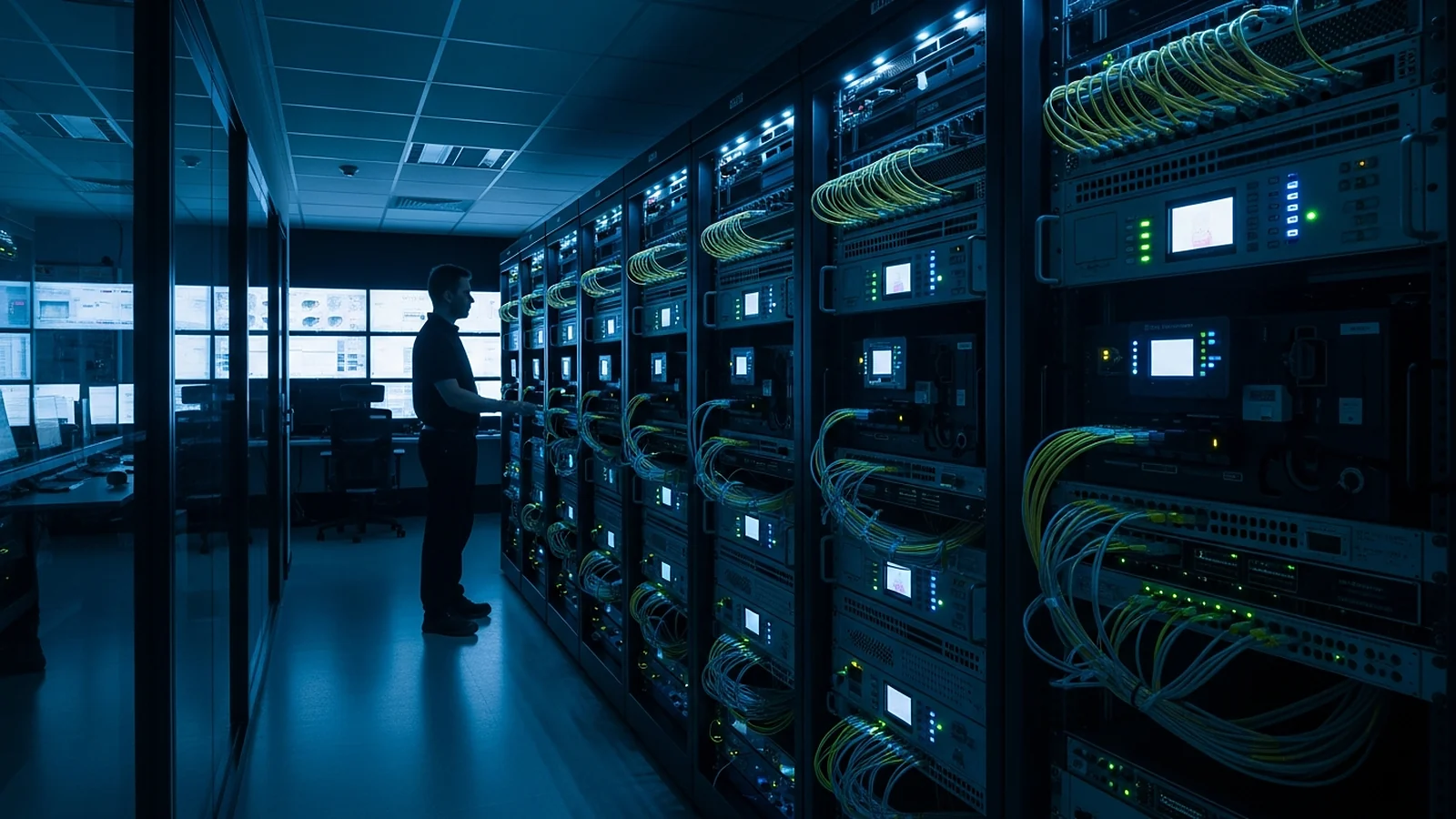
N+1 redundancy means the system has an extra component to ensure continued operation if one component fails. In the IAH RFP, §8.6.3.1.9 requires each LED tile to have redundant data and power paths, while §8.6.3.2.14 mandates processor redundancy. The reason is practical: passenger information displays operate 24/7, and a single point of failure must not interrupt the display of flight or train information. Additionally, §8.6.3.2.6 requires the display to automatically adjust brightness based on ambient light sensors to maintain stable readability day and night.
!Control Room Equipment *Processing and redundancy equipment in a control room (illustration).*
How to Correctly Understand Brightness? This is a point of common misunderstanding. The brightness figure of around 800 nits often mentioned in relation to the IAH project is actually the measurement of the installed display (according to Commercial Integrator), not a clause in the RFP. In other words, the RFP mandates automatic brightness adjustment based on the environment, while the specific nit level is the result of equipment selection for the indoor lobby space. When estimating costs, brightness should be determined based on the actual lighting conditions of the installation site: indoor lobbies require moderate levels, while sunlit glass lobbies need a higher brightness range to combat glare.
How Do Safety Standards for Stations and Metro Differ from Airports?
Railway and metro stations often need to comply with additional specific safety standards. EN 45545-2 specifies fire protection for railway vehicles and environments, EN 50155 applies to electronic equipment used in the railway industry, and ISO 11064-6 covers control rooms. Specifically, ISO 11064-6 states that average brightness should not exceed 500 cd/m² and peak brightness should be below 1500 cd/m² in control rooms to protect the vision of long-shift personnel. Therefore, a metro tender is typically more stringent regarding fire-retardant materials and working conditions compared to airport lobby displays.
What International Projects Can Be Referenced?
Several major global transport infrastructure projects are often cited as references, and it should be clarified that these are not Luxwave projects. LAX Airport's Tom Bradley Terminal uses Daktronics' IEMS system with an area exceeding 1400m². Changi Airport (Singapore) features solutions from LianTronics and Nanolumens. Beijing Daxing Airport uses Unilumin displays covering 542m². Shanghai Metro Line 14's Lujiazui station uses a 112m long LianTronics P2.5 display, and Istanbul Airport has implemented an FIDS system. These examples illustrate the scale and typical deployment methods for airport and station projects.
What Has Luxwave Done in Vietnam?
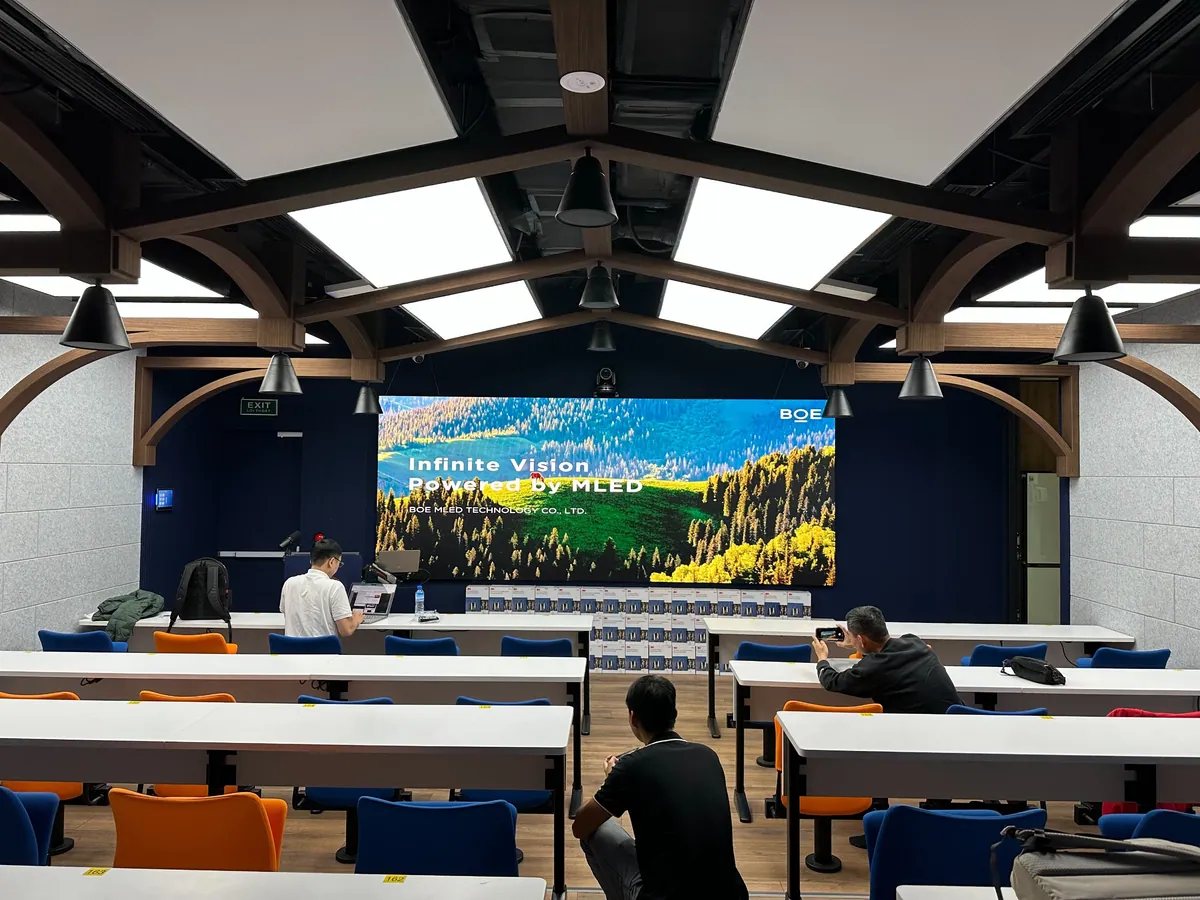
To distinguish from the international projects mentioned above, here is Luxwave's actual capability (a brand of Ho Gia Joint Stock Company). Luxwave has installed approximately 40m² of P1.25 COB displays at Cau Giay People's Committee; COB displays for the Optupus library with a NovaStar VX2000 Pro processor; and COB displays at Thanh Thang Castle. These installations demonstrate Luxwave's capability in fine-pitch indoor COB display construction: seamless surfaces, front maintenance, and stable operation for high-demand spaces like auditoriums, libraries, and headquarters. This forms the foundation for expanding into passenger information displays for stations and waiting areas. Luxwave is currently expanding its capabilities into transport infrastructure and has not yet undertaken airport projects; therefore, the international airport references in this article serve solely to illustrate technical specifications.
!Luxwave COB Project *Photo: Luxwave/Ho Gia project.*
Which Luxwave Products Meet These Criteria?
Luxwave's product catalog includes lines suitable for various public display scenarios. The BOE BYH012 is a P1.25 COB display with over 110% NTSC color gamut, a contrast ratio exceeding 1,000,000:1 in dark conditions, front maintenance, and a typical brightness of 600 nits (peak 800 nits), sufficient for indoor lobbies. The BOE BYH009 Ultra is a P0.9 COB display achieving 1500 to 2000 nits, providing ample brightness for sunlit glass lobbies. For control, NovaStar's H2/H-Series processors feature N+1 architecture and 4K support, aligning with the redundancy and input resolution requirements of transport infrastructure tenders. For higher brightness or smaller pitch for close viewing, the configuration can be upgraded to BYH009 Ultra; for displays viewed from further away with a larger pitch, the required sharpness can still be achieved based on viewing distance while optimizing costs. This approach, based on viewing distance and actual lighting conditions, ensures cost estimates accurately reflect needs rather than opting for over- or under-specified configurations.
What to Consider When Estimating Costs? When developing technical requirements or cost estimates, start by selecting the pixel pitch based on the minimum viewing distance, then determine the brightness according to the actual lighting conditions at the installation site. Next, specify the requirement for a processor supporting at least 4K/UHD @60fps with 1:1 pixel mapping, and N+1 redundancy for both tiles and processors. For stations and metros, add relevant railway safety standards. Finally, clearly distinguish between reference figures (like 800 nits at IAH) and mandatory clauses, so that cost estimates accurately reflect actual needs rather than blindly copying an overseas document.
Pitfalls
Common mistakes
- Confusing the ~800 nit brightness of the installed display at IAH with a mandatory RFP clause; this figure is from the actual system (source: Commercial Integrator), not a technical requirement.
- Treating the Houston IAH "Oculus" RFP as a mandatory standard for Vietnam; it is an international reference for developing technical requirements, not a domestic legal document.
- Omitting N+1 redundancy to reduce costs, leading to the risk of flight or train information display failure when a module malfunctions.
- Selecting pixel pitch based solely on area without considering the minimum viewing distance, resulting in visible pixels on curved screens or wasted budget.
FAQ
Frequently asked questions
Is the IAH "Oculus" RFP a mandatory standard in Vietnam?
No. The Houston IAH Airport RFP (H37-OCULED-2023-13, issued 09/12/2022) is an international reference for how to develop technical requirements. It is not a mandatory standard in Vietnam but is useful for clients to reference when establishing criteria.
What principle should guide pixel pitch selection for airport LED displays?
Minimum viewing distance. For example, §8.6.3.1.2 of the IAH RFP uses a minimum viewing distance of 15ft (approx. 4.57m) and requires that pixels are not visible on curved screens, specifying pitch to two decimal places. The IAH displays were actually installed in the P1.4 to P2.0 range.
What are the image processor requirements for this type of tender?
According to §8.6.3.2.5, processors must accept a minimum of 4K/UHD @60fps with 1:1 pixel mapping; §3.1.3 adds 10-bit, 4:2:2. Additionally, §8.6.3.2.14 requires processor redundancy, and §8.6.3.2.6 mandates automatic brightness adjustment via ambient sensors.
What is N+1 redundancy and why is it mandatory?
N+1 redundancy means having an extra component to ensure the system continues to operate if one component fails. The IAH RFP requires LED tiles to have redundant data and power (§8.6.3.1.9) and redundant processors (§8.6.3.2.14). This ensures uninterrupted operation of passenger information displays 24/7.
What additional safety standards do station and metro LED displays need compared to airport displays?
Stations and metros often need to comply with EN 45545-2 for railway fire protection, EN 50155 for railway electronic equipment, and ISO 11064-6 for control rooms. ISO 11064-6 specifies average brightness not exceeding 500 cd/m² and peak brightness below 1500 cd/m² in control rooms.
Has Luxwave installed airport LED displays in Vietnam?
No. Luxwave (part of Ho Gia Joint Stock Company) has installed several COB displays, including at Cau Giay People's Committee, Optupus Library, and Thanh Thang Castle, and is expanding its capabilities into transport infrastructure. The international airport projects mentioned in this article are references, not Luxwave projects.
References
- 1.ResearchHouston Airport System RFP H37-OCULED-2023-13 (Publicly available PDF)
- 2.ResearchCommercial Integrator — IAH Oculus LED display
- 3.ManufacturerBOE MLED COB Display Solutions
- 4.ManufacturerGenuine NovaStar