
On this page
- Why are luxury villas switching from large TVs to LED screens?
- Fine-pitch COB: the right technology for residences?
- The wall-mounting challenge: front-maintenance changes the game
- Lessons from Thanh Thang Castle: the screen as part of the architecture
- Design & Installation Coordination Checklist for Homeowners
- Conclusion: The space comes first, the equipment second
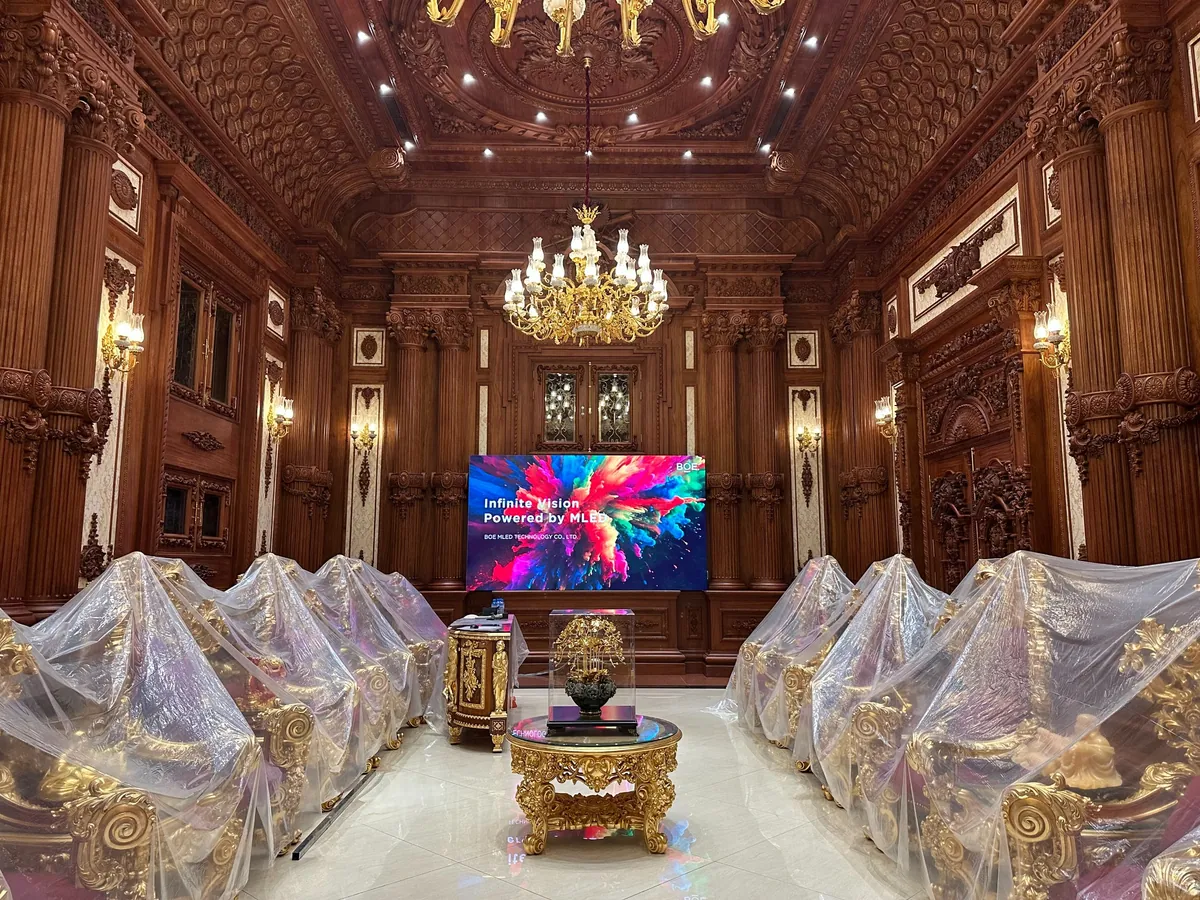
Owners of villas and mansions increasingly desire displays that match their spaces — larger than any TV, seamless like a painting, and integrated into the architecture rather than imposed upon it. This article shares how COB LED screens solve these challenges, drawing from Luxwave's practical installation experience — a brand of Ho Gia JSC, an authorized distributor for BOE, NovaStar, and Muxwave — at the Thanh Thang Castle project.
Why are luxury villas switching from large TVs to LED screens?
Ceiling-mounted TVs come in fixed sizes and always have bezels; meanwhile, living room walls in villas rarely perfectly fit any standard TV size. LED screens are assembled from cabinets, allowing their dimensions to conform to the architecture: matching the wall width and the desired interior design proportions. At 3–5 meter widths, LEDs also surpass TVs in brightness and uniformity — living rooms with many glass windows remain clearly viewable during the day without needing to close the curtains. For dedicated home cinema spaces, home cinema solutions for villas delve deeper into dark room setups; this article focuses on screens within living areas and lobbies.
Fine-pitch COB: the right technology for residences?
Three characteristics of COB precisely meet the needs of high-end homes. First, the monolithic epoxy surface — no visible LED bases, resistant to daily bumps and cleaning. The BYH012 datasheet confirms 2H hardness and IP65 module rating — providing peace of mind in homes with children. Second, pitches as small as P0.9 allow comfortable viewing from under 2 meters on a sofa without pixelation — the BYH Ultra P0.9 standard, as announced by BOE, achieves 2,000 nits peak brightness but can be adjusted down to a comfortable level for living rooms. Third, color depth and contrast: in dark rooms, contrast ratios reach ≥1,000,000:1 on the BYH012 series — night scenes retain full detail, something large-format LCD TVs struggle to achieve.
The wall-mounting challenge: front-maintenance changes the game
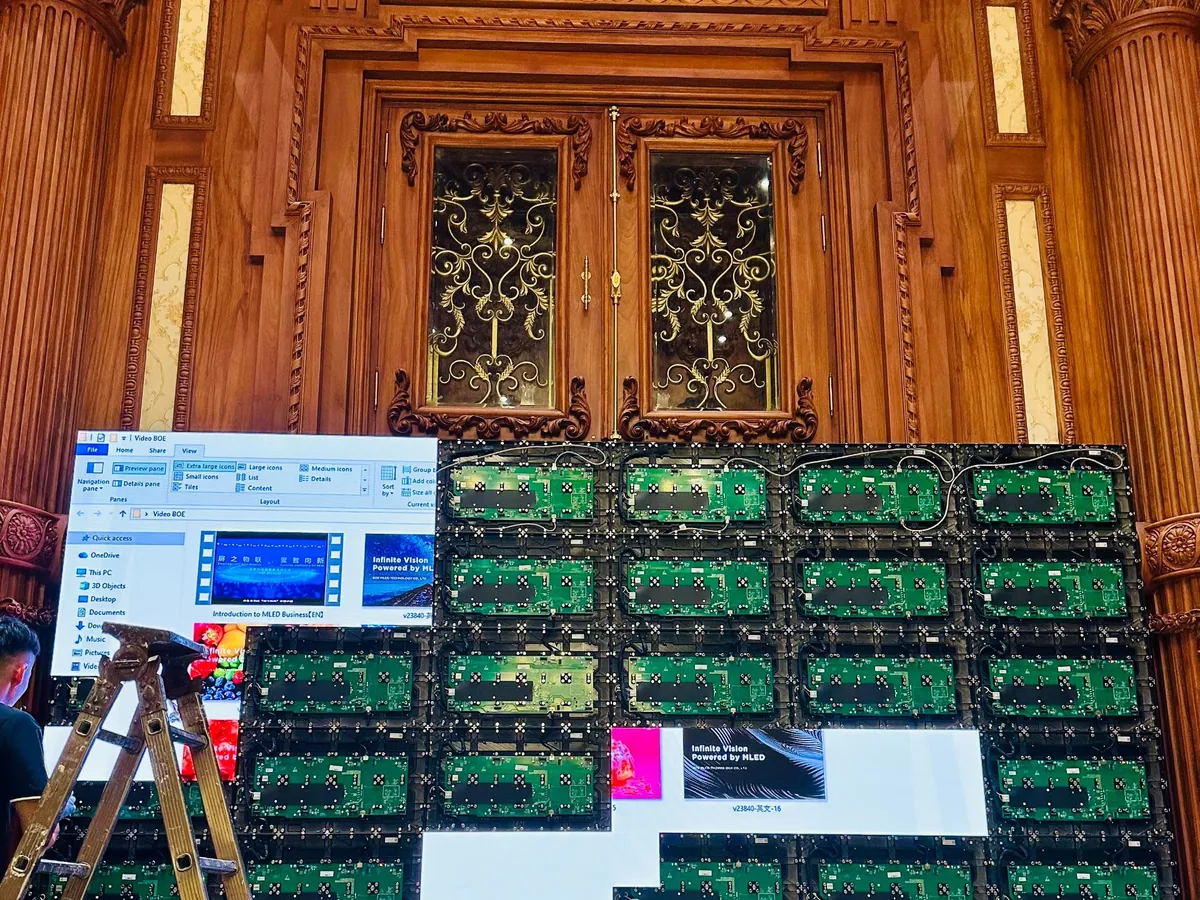
The biggest concern for interior designers hearing "LED screen" is the technical space requirement: traditional screens need rear access for maintenance, implying deep wall recesses or bulky frames that disrupt the facade. COB front-maintenance eliminates this worry: modules are removed and installed from the front using magnetic suction tools, allowing the screen to be mounted flush against wood paneling. All future servicing takes minutes without disturbing the surrounding finishes. The design benefit is significant — a slim overall profile, wood trim fitted precisely to the screen edges, and a truly flat "dynamic painting" integrated into the wall.
Two technical details still require space considerations in the design, even with wall-flush mounting: heat dissipation and power supply location. COB screens generate low heat at typical living room brightness levels, but a completely sealed wooden frame around the screen should still be avoided — a thin ventilation gap hidden within the trim is sufficient. Power supplies and controllers should be planned for a nearby technical compartment (within a decorative cabinet, adjacent partition) rather than behind the screen, ensuring all auxiliary equipment is as easily maintained as the screen itself. These two minor details determine ten years of smooth operation versus costly wood panel removal.
Lessons from Thanh Thang Castle: the screen as part of the architecture
At the Thanh Thang Castle project, the challenge wasn't the equipment but the context: a grand hall with classic carved wood interiors, crystal chandeliers, and every detail meticulously handcrafted — the screen had to fit seamlessly into this setting without clashing. The solution involved three parts: selecting COB P1.25 for close viewing distances; coordinating with the interior design team from the initial drawing phase to integrate the screen into a custom-designed wall niche, with all signal and power cables completely hidden within the wood structure; and calibrating brightness and color temperature to match the space's warm tones. The result: when off, the screen is a silent, dark panel amidst the wood; when on, the entire hall gains a truly dynamic window of content.
A notable detail from the project: the biggest challenge turned out to be color temperature. The Thanh Thang space is rich in warm tones — reddish-brown wood, golden chandeliers — while LED screens typically default to cooler tones. If left unadjusted, the screen would appear jarringly "blue" in the hall. The technical team custom-calibrated the color temperature and brightness curves for each use case: evening banquets, presentation slideshows, relaxing background music — each with its own saved configuration. This level of fine-tuning isn't included in standard equipment pricing but marks the difference between simply "installing a screen" and "completing a space."
The installation process also reflected the specifics of high-end private residences: each module was installed and calibrated on-site while other interior elements remained protected — the behind-the-scenes photos in this article show the actual Luxwave team at work.
Design & Installation Coordination Checklist for Homeowners
Experience distilled into five sequential steps. One: determine the viewing position and closest viewing distance → decide on the pitch (see also P0.9 vs P1.25 comparison). Two: measure the wall area and let the screen conform to the architecture, not existing TV sizes. Three: involve the screen provider during the interior design phase — hidden cabling, wall niches, finishing frames, and ventilation gaps must be incorporated into the wood design drawings. Four: request brightness and scene-based configurations (day/night/movie viewing) upon handover. Five: confirm the front-maintenance procedure and the availability of spare modules. The lobby area of a mansion follows the same principles on a larger scale.
Conclusion: The space comes first, the equipment second
An LED screen for a villa is successful when guests enter the room and see a more beautiful space — not "a big screen." This requires the right technology (fine-pitch COB, front-maintenance, surface durability for family life) and early design coordination. If you are building or renovating your private space and wish to explore options, you can invite the Luxwave technical team to survey the site with your architect during the design phase.
Pitfalls
Common mistakes
- Installing high-brightness advertising screens in living rooms — causes glare and eye strain
- Finalizing interior design before considering the screen — misses opportunities for hidden wiring and custom wall niches
- Choosing a larger pitch to save cost, then experiencing pixelation from a 2m sofa distance
- Forgetting heat dissipation/power supply space when building a sealed wooden frame around the screen
- Using multi-panel TV setups — seams disrupt the space's seamless aesthetic
FAQ
Frequently asked questions
Why not use a 98–110 inch TV for a villa instead of an LED screen?
TVs are limited to a few fixed sizes and always have bezels; LED screens are assembled from cabinets, allowing them to be built to the exact dimensions of the wall — 4 meters, 5 meters, or any architectural proportion. At large sizes, LEDs are also brighter and more uniform, remaining clearly visible during the day in rooms with many windows.
Are LED screens in homes harmful to the eyes when viewed up close?
The issue isn't the technology itself but the configuration: the pitch must be small enough for the viewing distance, and the brightness must be adjustable to a comfortable level for living rooms. The COB P0.9 series provides smooth viewing from approximately 1–2 meters, with brightness adjustable to the environment — unlike advertising screens, which are configured for outdoor glare.
Can classic wood interiors accommodate LED screens?
Yes, and this was precisely the scenario at the Thanh Thang Castle project: a COB P1.25 screen was installed within a carved wood wall panel. The key was early coordination with the interior design team to integrate the screen into a custom-designed niche, hide all wiring completely, and ensure the finishing frame seamlessly matched the wood trim.
How are LED screens in villas maintained, and does it require breaking walls?
No. Modern COB screens feature front maintenance: modules are removed from the front using magnetic suction tools directly through the screen surface. This allows the screen to be mounted flush against the wall, with all future servicing performed from the front in minutes — no demolition, no removal of wood panels, and no need for a rear technical space.
Are LED screens safe in homes with children?
The COB surface is coated with monolithic epoxy, achieving 2H hardness and an IP65 module rating according to the datasheet — making it more resistant to daily bumps and easier to clean than exposed LED base types. However, it's still advisable to place the bottom edge of the screen out of reach of children or use a decorative barrier, as with any large electronic device in the home.
What is the approximate cost of an LED screen for a villa living room?
It depends on the size and pitch. As of 2026, COB P1.25 is approximately 49.5 million VND/m² for the panel itself; P0.9 is higher. A 3x1.7m screen (equivalent to a 130-inch TV) would incur additional costs for image processing and installation finishing — on-site surveys are recommended for a comprehensive quote.
References
- 1.ManufacturerBOE BYH012V12 datasheet Rev C 2025-04-09
- 2.ManufacturerBOE MLED COB — InfoComm 2025
- 3.ResearchThanh Thang Castle Project — Luxwave Installation