

What's the Difference Between LED COB and LCD Video Walls?
Both LED COB and LCD video walls can serve as central displays for control rooms, but they address this need with very different architectures. LCD video walls combine multiple 46- or 55-inch panels to create a large display surface; LED COB assembles cabinets or modules to form a seamless surface. Therefore, the specifications below should be considered references from individual product datasheets, not general commitments for all market products.
!Seamless LED COB display in a control room with maps and monitoring charts
The most significant difference lies in how the human eye perceives the boundaries between display elements. LCD video walls, even with ultra-narrow bezels, still have bezels or seams of approximately 0.44–1.8mm, creating horizontal and vertical lines between panels. LED COB achieves a 0mm display surface in the sense that there are no panel bezels interrupting the image, allowing maps, dashboards, and charts to span the entire screen with continuity. For a foundational understanding of this technology, the article What is an LED COB Display? explains the chip-on-board structure and protective coatings in detail.

Why Do Seams Matter in Control Rooms?
In control rooms, seams are not just an aesthetic issue. Operators often spend hours reading traffic maps, electrical schematics, camera grids, alert charts, and small text. When a road, pipeline, equipment label, or data column is bisected by an LCD bezel, the eye must mentally reconnect the information. This doesn't break the system, but it reduces reading speed in environments requiring rapid response and minimal errors.
!Diagram comparing bezels between LCD video wall and seamless LED COB displays
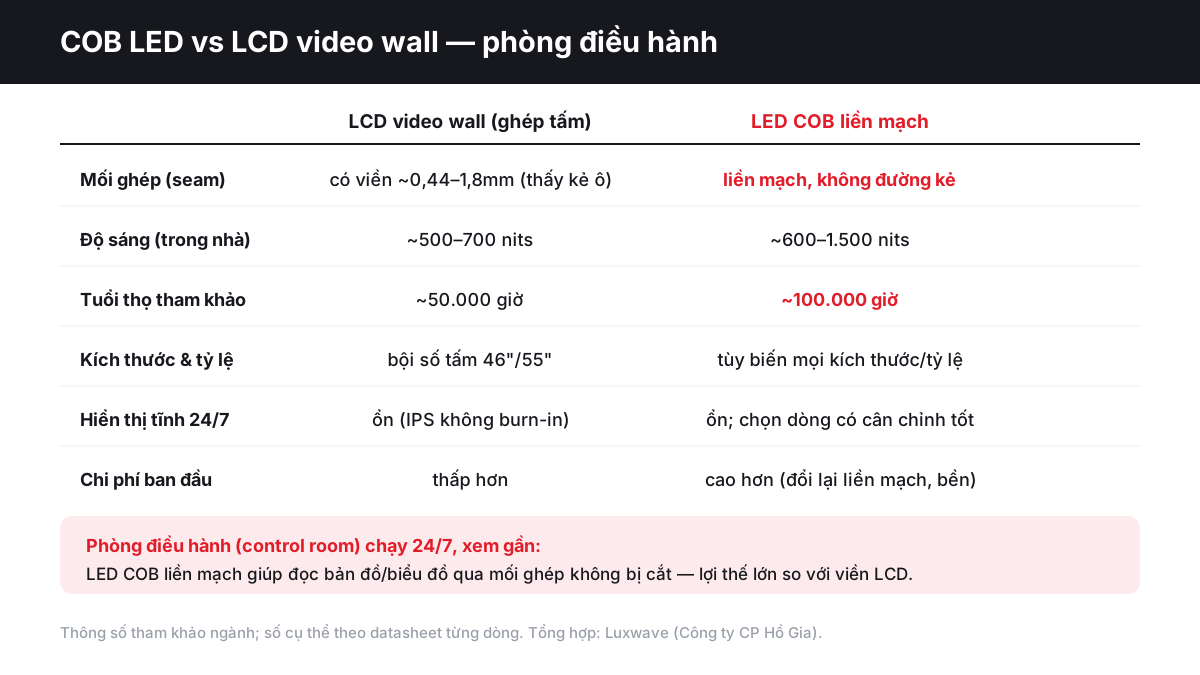
For clearly segmented content, such as each camera feed within its own panel or group of panels, LCD video walls perform adequately. However, in Command Centers and Control Rooms, data is often dynamic and not confined to individual cells: maps zoom, timelines scroll, real-time charts update, and control windows may align with bezel locations. Seamless LED COB offers an advantage because interface designers don't need to work around bezel grids. This is a minor hardware difference but directly impacts the layout of monitoring software.

Quick Spec Comparison: COB LED vs. LCD Video Wall
Looking at individual numbers, both LCD and LED COB have strengths. LCDs typically offer brightness around 500–700 nits, a reference lifespan of about 50,000 hours, and a lower initial purchase cost. LED COBs generally range from 600–1,500 nits, have a reference lifespan of around 100,000 hours, and offer more flexible size customization. These ranges are industry benchmarks for preliminary configuration; actual purchases must always refer to the specific product datasheets from brands like BOE, NovaStar, or related ecosystem devices.
The key point is that control rooms aren't buying a screen for beautiful video playback for a few hours, but a data surface running 24/7. When comparing, consider each specification in context: Is the brightness sufficient for a brightly lit room? Does the size match the map's aspect ratio? Is the lifespan suitable for continuous shifts? And do the seams cut through critical data? For fine-pitch COB series like the BOE BYH COB Ultra P0.9, the main benefit is not just resolution, but the ability to create large, smooth, and seamless displays for close viewing distances.
When is an LCD Video Wall Still a Reasonable Choice?
LCD video walls remain a sensible option when the initial investment budget is the primary constraint and the content is already designed in a grid format. A security room, small camera monitoring station, or local operations center might use multiple 55-inch panels to display camera feeds, with each stream within its own window. When critical maps or charts do not cross panel boundaries, the LCD lines cause significantly less disruption than on a central display showing an overview.
LCDs also have practical advantages: 46- or 55-inch sizes are common, making area estimation straightforward and offering many cost options. IPS LCD panels do not suffer from burn-in in the way users might fear with OLEDs, so displaying static dashboards 24/7 is technically feasible if brightness, thermal management, and maintenance are properly configured. The limitations are that sizes are always dictated by panel multiples, screen aspect ratios are difficult to fully customize, and the larger the system, the more prominent the panel lines become. Therefore, LCDs are best suited when the organization accepts a grid-based layout from the outset.
When is LED COB Worth the Investment?
LED COB is worth investing in when the central display is a primary operational tool, not just a large playback screen. Electrical dispatch, traffic control, security, logistics, manufacturing plants, or data center control rooms often require a continuous display surface for maps, route schematics, KPI dashboards, and real-time alerts. In such contexts, a seamless display prevents data fragmentation and allows for aspect ratio customization to fit walls, control consoles, or software layouts.
The initial cost of LED COB is typically higher than LCD, but in return, it offers a longer reference lifespan, more flexible brightness options, and fewer constraints imposed by 46- or 55-inch panel sizes. For close-viewing rooms, also check pixel pitch, color uniformity, surface flatness, and post-operation recalibration capabilities. The article Is LED COB Durable? delves into durability, surface impact, and maintenance; the article COB vs. GOB vs. SMD helps differentiate COB from other LED structures before finalizing a solution.
How to Choose Based on Control Room Scenario?
The most practical approach is to start with the content and viewing distance, not the catalog. If the display primarily shows segmented camera feeds, has minimal small text, and viewers are seated far away, an LCD video wall can meet requirements effectively at a lower initial cost. If the display shows panoramic maps, real-time data, long charts, or operators are seated close during 24/7 shifts, a seamless LED COB display is generally a stronger option for readability and scalability.
For enterprise-level or critical infrastructure control rooms, it's advisable to create a mockup of the actual content before finalizing the configuration. Place maps, dashboards, alert charts, and SCADA interfaces at approximate scale, then view them from the actual seating positions. If LCD seams cut through critical data areas, it's a sign to prioritize LED COB. If the content naturally divides into segments and doesn't require a continuous canvas, LCD might be the more economical decision. For broadcast or content creation studios, consider applications like Broadcast Studios, where color uniformity and signal processing are also crucial.
What to Check Before Finalizing Configuration?
Before deciding between LED COB or LCD video wall, request specific datasheets and check at least five points: bezels, brightness, reference lifespan, available sizes, and warranty conditions for 24/7 operation. For LED COB, also review pixel pitch, refresh rate, module replacement options, color calibration, and controller. For LCD, check actual bezels, uniformity between panels, thermal management, and alignment capabilities after extended use.
The control system should not be an afterthought. Processors and controllers like the NovaStar MCTRL4K play a vital role in signal synchronization, calibration, and stable operation, especially when the display handles multiple data sources simultaneously. As a premium LED display brand under Ho Gia JSC, the authorized distributor for BOE, NovaStar, and Muxwave in Vietnam, Luxwave typically recommends surveying the actual content, viewing distance, and signal infrastructure before selecting a technology. The neutral conclusion is: LCD wins on initial cost; LED COB wins when seamlessness, customization, and data readability are operational priorities.
| Criteria | LCD Video Wall | LED COB |
|---|---|---|
| Bezels | Bezels ~0.44–1.8mm | Seamless 0mm |
| Brightness | 500–700 nits | 600–1,500 nits |
| Lifespan | ~50,000h | ~100,000h |
| Size/Aspect Ratio | Multiples of 46/55" panels | Customizable |
| Initial Cost | Lower | Higher |
Pitfalls
Common mistakes
- Comparing only initial purchase price while ignoring 24/7 operational costs, reference lifespan, system downtime, and future module or panel replacement needs.
- Using LCD video walls for large maps, power grid schematics, or full-screen dashboards without considering how bezels will cut through text, routes, and charts.
- Choosing LED COB solely for 'seamlessness' without verifying pixel pitch, minimum viewing distance, color calibration capabilities, and controllers for 24/7 content.
- Comparing nits or lifespan specs from general brochures without reading specific product line datasheets and testing content in real-world scenarios before finalizing configuration.
FAQ
Frequently asked questions
Should a control room choose LED COB or an LCD video wall?
If the control room operates 24/7, involves close viewing, and frequently displays full-screen maps or dashboards, LED COB is generally more worth considering due to its lack of bezels between panels. LCD video walls remain suitable when the initial budget is low, content is clearly segmented into distinct zones, and operators do not need to read details across bezel lines.
Do the 0.44–1.8mm bezels on LCDs really make a difference?
Yes, but the impact depends on the content. For segmented camera feeds, LCD bezels are usually acceptable. For GIS maps, route schematics, trend charts, or small text spanning across panel boundaries, the 0.44–1.8mm bezels can cut lines and slow down operator reading in situations requiring rapid response.
Does LED COB suffer from burn-in when displaying 24/7 dashboards?
LED COB differs from IPS LCD in its image retention mechanism, but static 24/7 content still requires proper configuration: brightness calibration, color balance, content refresh scheduling, and selecting a model with good uniformity. IPS LCDs typically don't 'burn-in' in the OLED sense, while good LED COB systems are stable if designed for continuous operation.
What are the advantages of LCD video walls over LED COB?
The biggest advantages of LCD video walls are their lower initial cost and the widespread availability of 46- or 55-inch panels. For smaller monitoring rooms with content segmented by camera or individual windows, LCD remains a sensible option. The trade-offs are fixed sizes based on panel multiples and the presence of lines between screens.
Is the 600–1,500 nits brightness of LED COB necessary indoors?
In control rooms, high brightness isn't for constant maximum output but for adjustment margin in brightly lit rooms, rooms with glass walls, or to highlight urgent data. LCDs around 500–700 nits are often sufficient for stable environments. LED COB at 600–1,500 nits offers more headroom but should still be calibrated to the operator's viewing comfort.
Should existing LCD video walls be entirely replaced with LED COB?
Replacement solely for new technology isn't recommended. If the existing LCD system is still functional, content is not significantly hampered by bezels, and the budget is limited, it can continue to operate. Upgrading to LED COB is more logical when the video wall is aging, requires expanded size, a change in display aspect ratio, or when seamlessness becomes a critical operational requirement.
References
- 1.ManufacturerBOE Display Solutions
- 2.ResearchLCD Video Wall Industry Reference
- 3.ManufacturerNovaStar Video Processing and Control