

When designing facades for showrooms, buildings, or exhibition booths, many clients want to display digital content while preserving natural light and outward visibility through glass. This is where transparent and flexible LED displays shine compared to conventional opaque screens. However, these two categories serve different purposes and have numerous sub-series with unique installation requirements, making incorrect choices prone to installation difficulties or unmet expectations. This article serves as a guide to help you select the right series based on installation method and make appropriate comparisons, rather than delving into technical definitions. In-depth content will be linked in corresponding detailed articles.
!Transparent LED display on glass facade *Illustrative image.*
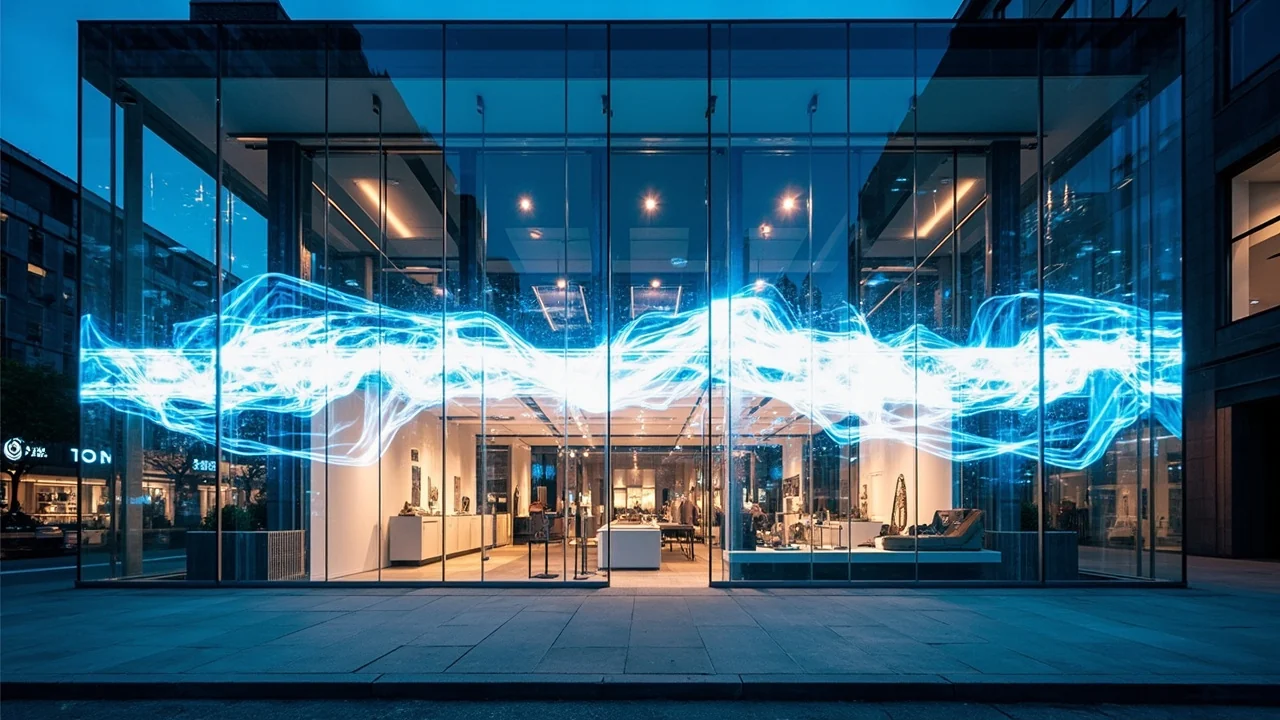
How do Transparent and Flexible LED Displays Differ, and When to Use Them?
These two categories differ in their design objectives. Transparent displays allow viewing through the screen body, making them ideal for adhesion or installation behind glass facades to maintain natural light and outward views. Flexible displays feature bendable modules, used for creating cylindrical shapes, arches, wavy surfaces, or curved structures that flat screens cannot replicate. In short: choose transparent when prioritizing light transmission through glass, and choose flexible when prioritizing shape-forming capabilities. Definitions and operating principles are detailed in the article Transparent LED Displays.
Why Choose a Series Based on Installation Method Before Pixel Pitch?
For facades, the installation and maintenance method often dictates feasibility more than pixel pitch. An indoor glass surface might accommodate thin film adhesion, but a multi-story facade requires rear-access maintenance cabinets or large-format hanging structures. Selecting solely based on pixel pitch and then considering installation can lead to situations where the display looks good on paper but is difficult to install, repair, or integrate with existing structures. Therefore, the logical process is: determine the installation method and environment first, narrow down suitable series, and then select the pixel pitch within that series.

Which Muxwave Series to Choose Based on Installation Method (U, M, A, P, S, F)?
Luxwave is an authorized distributor of the Muxwave series, featuring six distinct lines, each optimized for a specific installation method. The U series is an ultra-thin adhesion film (1.8mm, 2kg), IP20 rated for indoor use, with U3 P3.91 offering approximately 92% transparency and U6 P6.25 around 95%. The M series consists of slightly bendable adhesion modules (M2 P2.5 ~85%, M3 P3.91 ~92%, M6 P6.25 ~95%, up to 5000 nits). The A series is a portable all-in-one unit with a stand (P3.91, ~80% transparency, 5000 nits, iF Design Award 2023 winner). The P series is a plug-and-play poster display, 55–90 inches, with an integrated sending card. The S series comprises glass facade cabinets of approximately 1x1m with rear maintenance access (S10 P10 up to 7000 nits). The F series is for large-format hanging installations up to 5.25x3m, featuring a 7.5mm bezel and 90° or curved splicing capabilities.
!Muxwave transparent display on glass facade *Source: Muxwave — S series glass facade.*
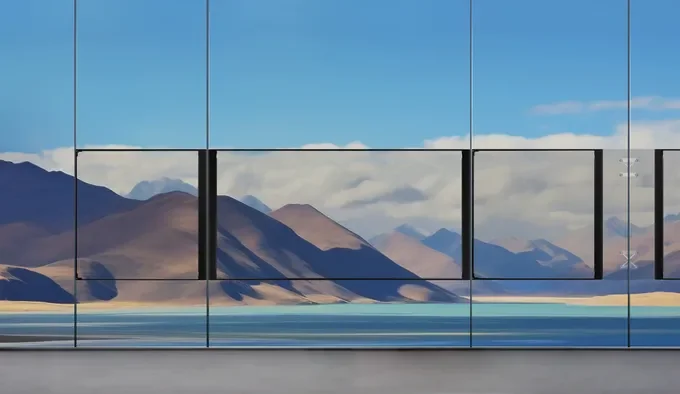
For easier visualization: if you need to adhere a display to an indoor shop window, consider the U or M series; for a portable transparent display for events, the A series is a convenient option, detailed in the article Muxwave A Series All-in-One Transparent LED Display. For rapid deployment without complex power wiring, the P poster series is suitable; for large-scale glass facade cladding with rear maintenance, the S series is ideal; and for very large hanging screens or corner splicing, the F series is the choice. An overview of the entire range and product philosophy is described in the article What is Muxwave Transparent LED Display.
How to Correctly Read and Compare Transparency?
Transparency is the most misleading metric when selecting facade displays. The percentage figure can be compared between brands, but only if they use the same calculation formula. In reality, many brands calculate transparency based on the gaps between LED strips without subtracting the frame, power modules, or accompanying glass panels, resulting in advertised figures higher than the actual perceived transparency. The industry currently lacks a unified calculation standard. Therefore, before making a decision, request suppliers to clearly state their transparency calculation formula and arrange to view a physical sample in an environment with lighting conditions similar to your project. A practical tip when comparing quotes is to ask each supplier to specify whether transparency is measured across the entire panel or only the illuminated gaps, and whether frames, power supplies, or glass layers are excluded. By standardizing the figures to the same calculation method, you can make a fair comparison between series and brands, rather than being swayed by the highest percentage.
What to Consider for Indoor vs. Outdoor Installation Regarding IP Ratings?
The IP (Ingress Protection) rating determines the display's suitability for its installation environment. Muxwave's U series is IP20, designed for indoor use and not resistant to rain or water splashes outdoors. For outdoor facades exposed to weather, a rating of IP65 is required; Luxwave offers such solutions on a project basis. Therefore, the first crucial step is to determine the installation location: indoors behind glass or outdoors in an exposed environment. Clarifying this early helps avoid selecting the wrong series and having to reconfigure the setup later.
Are Mesh or Net Displays an Option for Facades?
Mesh displays are another category of transparent displays, often used for very large facades requiring high ventilation and low weight. Their characteristic open strip structure prioritizes openness and wind resistance over image sharpness. Luxwave currently offers mesh solutions on a project-by-project basis without listed product codes. Therefore, this article only mentions them qualitatively. If your project involves a large-scale outdoor facade where ventilation is a priority, please contact us directly for a tailored configuration consultation rather than comparing standard pixel pitch charts.
What is the BOE BTX-FL Flexible LED Display Suitable For?
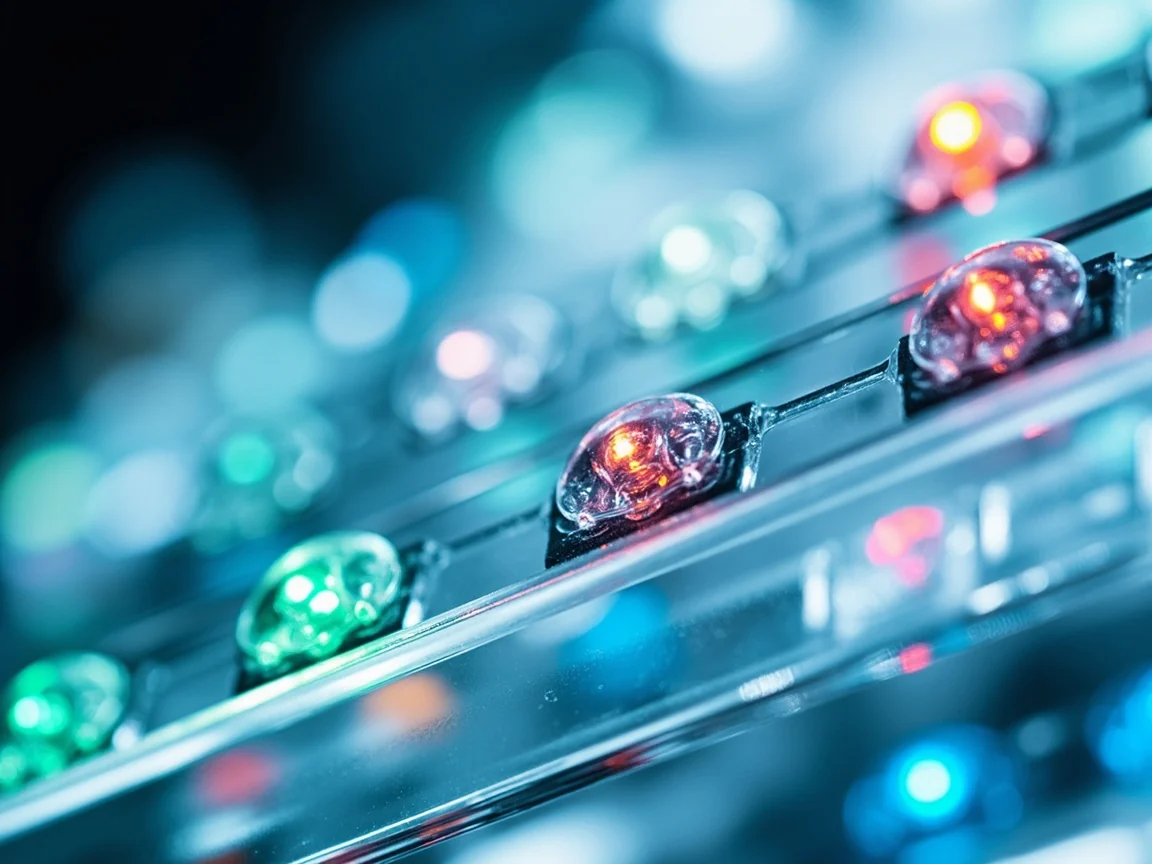
When the requirement is shape creation rather than light transmission, flexible displays are the way to go. The BOE BTX-FL series comprises bendable modules with pixel pitches ranging from P1.25 to P3.076, featuring six models from FL012A to FL030A, utilizing SMD technology. This type is ideal for cylindrical columns, arches, concave surfaces, or wavy structures in lobbies, showrooms, and exhibition spaces. The smaller pixel pitches in the range allow for good detail retention at close viewing distances, while larger pitches are suitable for curved surfaces viewed from afar. If you are interested in volumetric visual effects on curved screens, you can refer to the article Glasses-Free 3D LED Displays.
!Flexible LED module *Illustrative image.*
How to Choose the Right Type for Your Project?
Follow these four sequential questions. First, is the primary objective light transmission and maintaining visibility (choose transparent group) or creating curved shapes (choose flexible group)? Second, where will the display be installed: indoors behind glass (IP20 is sufficient) or outdoors (IP65 required)? Third, what are the installation and maintenance methods: film adhesion, portable all-in-one, plug-and-play poster, rear-access cabinet, or large-format hanging? Fourth, what is the typical viewing distance to determine the pixel pitch within the selected series? Answering these four questions will help you narrow down to one or two specific series.
One final note: if, after consideration, you realize your true priority is a sharp image for close viewing and no transparency is needed, then transparent or flexible displays may not be the optimal choice. In such cases, consider opaque COB technology displays like the BOE BYH012 (P1.25) for high definition at close distances. Identifying the correct usage objective from the outset will ensure accurate budgeting and prevent mid-project configuration changes. Once you have identified a suitable series, you can request a detailed configuration table and pricing options for comparison on an equal technical basis.
Pitfalls
Common mistakes
- Comparing transparency percentages between brands without inquiring about the calculation formula: many calculate based on LED strip gaps, excluding frames, power supplies, or glass, leading to misleading figures.
- Using indoor displays (IP20, e.g., U series) for outdoor facades – an IP65 rated product is required, specified per project.
- Selecting a series based solely on pixel pitch while ignoring installation methods and maintenance procedures, resulting in difficult installation or future repairs.
- Expecting transparent displays to provide sharpness at close viewing distances comparable to opaque displays – for high close-up clarity, consider COB displays like the BOE BYH012 (P1.25).
FAQ
Frequently asked questions
How do transparent and flexible LED displays differ?
Transparent displays allow viewing through the screen body, suitable for adhesion or installation behind glass facades to maintain natural light. Flexible displays have bendable modules for creating cylindrical shapes, concave curves, or wavy structures. The two groups serve different objectives: one prioritizes light transmission, the other shape-forming capability.
Which Muxwave series should I choose for a glass facade?
It depends on the installation method. The U series is an ultra-thin film for direct adhesion to indoor glass (1.8mm, 2kg, IP20). The S series is a cabinet of approximately 1x1m with rear maintenance access for large-scale glass facades. The F series is for large-format hanging installations up to 5.25x3m with 90-degree or curved splicing. Choose based on the installation and maintenance method first, then pixel pitch.
Can transparency be compared between brands?
Yes, but only if using the same calculation method. Many brands calculate transparency based on the gaps between LED strips without subtracting frames, power supplies, or glass panels, so the figures may not reflect actual perception. The industry lacks a unified standard, so it's best to ask for the calculation method and view a physical sample before deciding.
Can transparent displays be used outdoors?
It depends on the IP rating. Muxwave's U series is IP20, designed for indoor use. For outdoor facades exposed to weather, an IP65 rating is required; Luxwave provides these on a project basis. Therefore, it's essential to determine the installation location—indoor behind glass or outdoor in the open—from the start to select the correct protection class.
What is the BOE BTX-FL flexible LED display suitable for?
The BOE BTX-FL series includes bendable modules with pixel pitches from P1.25 to P3.076 (six models FL012A to FL030A), using SMD technology. This type is ideal for curved surfaces, cylindrical columns, arches, or shaped structures that flat screens cannot accommodate. The smaller pixel pitches in the range help maintain detail when viewed up close.
What should I choose if I need high-definition images for close viewing?
Transparent and flexible displays prioritize light transmission or shape-forming capabilities, not maximum sharpness at close viewing distances. If the priority is a sharp image at close range and no transparency is needed, consider opaque COB technology displays like the BOE BYH012 (P1.25). This is a different direction than glass facades, so the intended use must be clearly defined.
References
- 1.ManufacturerGenuine Muxwave
- 2.ManufacturerBOE MLED Display Solutions
- 3.ManufacturerLuxwave Distribution Catalog — Muxwave Series (Verified)